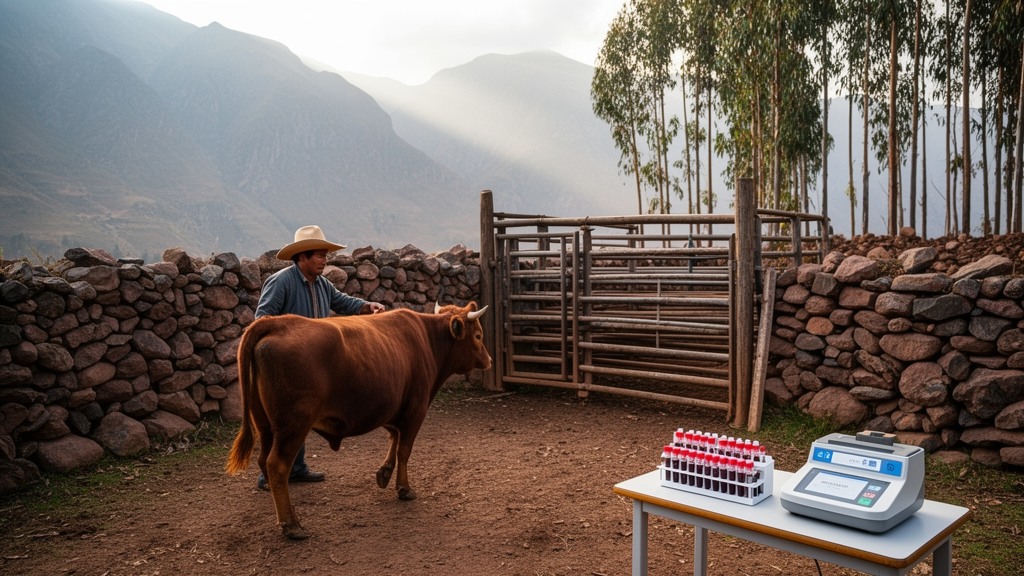
Deep in the Peruvian Andes, where Cunero cattle roam high-altitude pastures with minimal human contact, researchers have captured one of the first physiological snapshots of what happens to these notoriously difficult animals as they arrive at the slaughterhouse. A cross-sectional study of 100 adult Cunero cattle transported from the seven provinces of the Apurímac region to the municipal slaughterhouse in Abancay found a median serum cortisol concentration of 22.00 micrograms per deciliter — a figure that stands in stark contrast to the 4.50 micrograms per deciliter measured in a small reference group of calm, semi-intensively managed Creole × Holstein crossbred cows that were neither transported nor slaughtered. The findings, published in Frontiers in Animal Science, offer a baseline for stress biomarkers in a breed that has been almost entirely absent from the welfare literature.
Cunero cattle, sometimes described as wild Creole cattle, are raised on natural pastures in the highlands of southeastern Peru, interact little with their owners, and are famously hard to handle. That combination of extensive rearing and instinctive behavior makes them an intriguing case for animal welfare science, because the standard stressors of livestock production — capture, loading onto trucks, road transport, unloading, and lairage — may hit such animals differently than breeds accustomed to routine human contact. Stress in cattle is known to be associated with persecution, transport duration, and pre-slaughter conditions, and acute triggers include human handling, mechanical vibrations during transport, and the reorganization of social hierarchies within a group.
The study, conducted between August and September 2024, was led by researchers at the Universidad Nacional Micaela Bastidas de Apurímac together with colleagues in Puno, Cusco, and Spain. The team sampled blood from the coccygeal vein of 50 females and 50 males in the slaughterhouse lairage, between 9:00 a.m. and 11:00 a.m., after transport and unloading but before slaughter. Each animal had been fasted for at least six hours with access to water, in line with Peruvian regulations.
Animals suspected of disease were excluded, and the protocol was approved by the institutional ethics committee at the Universidad Nacional Micaela Bastidas de Apurimac under Peruvian animal protection law. Cortisol, produced by the adrenal cortex in response to pituitary ACTH, is often called the stress hormone because its production rises during acute or severe psychophysical stress, making it a widely used indicator of animal welfare. The researchers quantified it with a competitive ELISA, in which native antigen in the serum competes with an enzyme-antigen conjugate for limited antibody binding sites, so that measured enzyme activity is inversely proportional to cortisol concentration.
Alongside cortisol, they measured five biochemical variables by spectrophotometry — glucose, lactate, urea, creatine kinase, and lactate dehydrogenase — and four hematological parameters: red blood cell count, hematocrit, hemoglobin, and white blood cell count. The choice of biomarkers reflects the physiology of the stress response. Intense activation of the hypothalamic–pituitary–adrenal axis releases epinephrine, cortisol, serotonin, and dopamine, triggering a cascade of biochemical and hematological changes.
Cortisol promotes hepatic glycogenolysis, mobilizing energy reserves, while intense physical activity pushes skeletal muscle into anaerobic glycolysis, raising lactate and inducing fatigue. Creatine kinase leaks into the bloodstream when muscle fibers suffer physical stress, blows, exhaustion, or altered membrane permeability during prolonged capture and truck transport. Acute stress can also raise hematocrit and hemoglobin through splenic contraction and dehydration, while immune activation can elevate white blood cell counts, primarily through neutrophilia.
On the headline biomarker, the results were striking but carefully framed. Cunero cortisol values ranged from 9.5 to 30.0 micrograms per deciliter, with an overall median of 22.00. For comparison, the authors point to published data from Lidia bulls after intense physical exertion during a fight, where cortisol averaged 4.26 micrograms per deciliter, and to Zebu × European cattle in Mexico, where levels ranged from 6.39 to 7.53.
In camels at slaughterhouses, cortisol has been reported at roughly ten times farm levels. The authors stress, however, that their reference group of twenty Creole × Holstein cows differed in genetics, management, nutrition, and behavior, and that the feeding status of those cows at sampling was not recorded — so the comparison is descriptive rather than a demonstration that transport alone caused the elevation. Sex, surprisingly, made no difference to cortisol.
Females showed a median of 21.65 micrograms per deciliter with an interquartile range of 8.50, versus 23.00 with an interquartile range of 10.10 in males — a raw p-value of 0.56, an adjusted p-value of 0.62, and a small rank-biserial effect size of −0.07 with a 95% confidence interval spanning −0.29 to 0.16. The authors had hypothesized that this biomarker would not show sexual dimorphism, noting that temperament, social hierarchy, breed, and previous handling experience may shape the stress response more powerfully than sex. The result aligns with work on pre-slaughter stress in male and female cattle in Algeria, though it contrasts with camel studies reporting higher cortisol in females.
Where sex did matter was in muscle and blood parameters. Male Cunero cattle had significantly higher creatine kinase concentrations, with a median of 278.72 IU/L against 227.64 IU/L in females — a difference that survived the Benjamini-Hochberg correction for multiple testing across ten variables, with a substantial rank-biserial effect size of −0.66. Males also carried higher red blood cell counts (7.57 versus 6.88 × 10¹² per liter), hematocrit (35.44 versus 33.38 percent), hemoglobin (13.85 versus 13.16 g/dL), and white blood cell counts (medians of 5.85 versus 4.69 × 10⁹ per liter), all statistically significant after adjustment.
Glucose, lactate, urea, and lactate dehydrogenase showed no significant sex differences. Crucially, all hematological values fell within established physiological reference intervals for adult cattle, indicating that the sex differences do not reflect clinical compromise. The high-altitude setting adds another layer of interpretation.
Above roughly 3,500 meters, low partial pressure of oxygen stimulates erythropoiesis and hemoglobin synthesis, producing compensatory polycythemia and elevated hematocrit — adaptations that make the hematological profiles of high-Andean livestock differ substantially from sea-level populations and justify breed- and region-specific reference values. The authors propose, as an explicitly untested hypothesis, that the overall hematological elevation in males may reflect an adaptive physiological response, possibly involving splenic contraction releasing stored erythrocytes during exercise and emotional stress. They are careful to note that without baseline measurements or covariates such as age, body condition score, transport duration, and stocking density, the study cannot attribute the observed sex differences to specific pre-slaughter mechanisms.
The limitations are candidly laid out. The study captured animals only once they arrived at the Abancay slaughterhouse, so no within-animal changes could be estimated; confounders were unmeasured; and the reference population is not directly comparable to the Cunero cohort. What the data do establish is an initial baseline for pre-slaughter biomarkers in a breed where none existed.
Future work, they suggest, should include repeated sampling before, during, and after transport, along with additional biomarkers such as ACTH, catecholamines, the neutrophil-to-lymphocyte ratio, non-esterified fatty acids, and capillary cortisol, which has been proposed as a more stable indicator of accumulated chronic stress than serum cortisol. For now, the image that emerges is of a hardy, wild-natured Creole breed whose physiology at the end of the journey tells a story that science is only beginning to read.
Subject of Research: Pre-slaughter stress biomarkers in Cunero cattle in the Peruvian Andes
Article Title: Cortisol measurements, biochemical and hematological parameters as biomarkers of Cunero cattle welfare during pre-slaughter handling in the Apurimac Region of Peru
Article References: Oha-Humpiri, F., Coila, P., Machaca, V., Cardenas, N., Inca, J., Bustinza-Moreno, J., & Pinares, R. (2026). Cortisol measurements, biochemical and hematological parameters as biomarkers of Cunero cattle welfare during pre-slaughter handling in the Apurimac Region of Peru. Frontiers in Animal Science, 7, Article 1955193. https://doi.org/10.3389/fanim.2026.1955193
Image Credits: AI Generated
DOI: 10.3389/fanim.2026.1955193
Keywords: animal welfare, Cunero cattle, cortisol, stress biomarkers, creatine kinase, hematology, pre-slaughter handling, Peru, Andes, livestock transport, Creole cattle, high altitude
News Source: William Thompson. (October 27, 2026). Research report: Cortisol measurements, biochemical and hematological parameters as biomarkers of Cunero cattle welfare during pre-slaughter handling in the Apurimac Region of Peru. Scienmag.