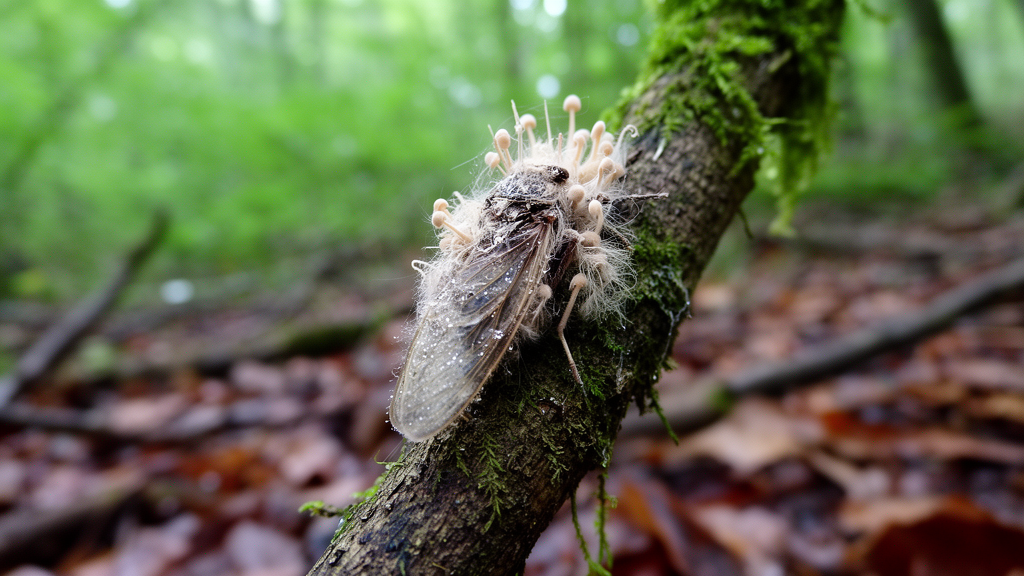
Two entomopathogenic fungi, Zoophthora giardii and Conidiobolus gustafssonii, have been recorded in Switzerland for the first time, bringing the country's known inventory of insect-pathogenic Entomophthoromycota to ninety species. The discovery emerged from infected specimens of two Mediterranean insects that are currently expanding northwards: the southern oak bush-cricket Meconema meridionale and the amber wood cockroach Ectobius vittiventris. Both host insects were found dead and tightly fastened to plant surfaces by fungal rhizoids, a tell-tale sign of entomophthoralean infection, and subsequent microscopic examination revealed fungal structures that matched no previously documented Swiss records.
The Entomophthorales and Neozygitales, the two orders that make up the phylum Entomophthoromycota, are dominated by arthropod-pathogenic species, although saprobiontic members also occur. Because they can decimate insect populations in outbreaks known as epizootics, they are regarded as important natural regulators of arthropod numbers and hold considerable potential for biological pest control. Despite this ecological significance, the group has never been the subject of dedicated large-scale survey work, which is why new national records continue to surface from ordinary field collections.
The Swiss material originated from several localities and collectors. At Bümpliz in the canton of Bern, a strikingly high number of infected bush-crickets turned up in a cemetery, on the underside of leaves of a southern catalpa, Catalpa bignonioides. Further samples came from Muttenz and Duggingen in Basel-Landschaft, where cadavers were found on catalpa and on European beech, Fagus sylvatica, and from Eschenz in Thurgau, where hazel, Corylus avellana, and a Prunus species served as collection substrates.
One bush-cricket was even recovered from the ceiling of a house entrance in Regensdorf in the canton of Zurich. The single infected cockroach was found on ivy, Hedera helix, in the city of Bern. Collections spanned September 2020 through September 2021, with the bulk made in August 2021.
Both host species are Mediterranean in origin but are spreading northwards. Ectobius vittiventris has colonized Germany as far as North Rhine-Westphalia and has been recorded in the Alps up to 1400 metres altitude, while Meconema meridionale has spread across western Europe to the North Sea, apparently avoiding higher elevations. The authors suggest that these expanding populations may be encountering fungal pathogens for the first time in their new ranges, a hypothesis that could explain the unusually severe infections observed in Switzerland.
Laboratory work followed classical mycological protocols. Selected infected bush-crickets and the dead cockroach were placed individually in small Petri dishes with water, and microscope slides suspended above the cadavers collected the primary conidia actively discharged by the fungus. Secondary conidia were picked from the water surface.
Fourteen bush-cricket cadavers and the single cockroach cadaver were then dissected, and the fungal material was mounted in lactophenol-cotton blue or lactophenol-aceto-orcein stains. Measurements were taken only from primary conidia lying with their axis parallel to the slide and with the entire spore outline in focus, with twenty-five structures measured per host individual as a standard series, and multiple series examined to capture variation. The fungus attacking Meconema meridionale proved to be Zoophthora giardii.
The host body was completely filled with hyphal bodies, and compound rhizoids anchored the cadaver firmly to the leaf surface. The conidiophores were branched, and their terminal portions, from which the primary conidia develop, detached before spore formation. The primary conidia were subcylindrical with the widest diameter in the middle, averaging 20.0 to 21.6 micrometres long by 6.8 to 7.2 micrometres wide, with a length-to-diameter ratio of 2.86 to 3.08.
These conidia germinated in two ways: some produced a capillary germ tube ending in a type II secondary conidium, or capilliconidium, while others formed a short thick tube giving rise to a type I secondary conidium resembling the primary spore. The fusiform, slightly bent capilliconidia averaged 20.1 to 20.8 by 5.7 to 6.0 micrometres and developed at the tips of capillary tubes averaging 75.1 to 92.4 micrometres in length. Resting spores were absent.
The identification was confirmed by comparison with the original description of Zoophthora giardii published by Bałazy in 1993, which reported primary conidia of 19.5 to 23.5 by 6 to 7 micrometres and capilliconidia of 21 to 25 by 5.5 to 6.5 micrometres. The minor differences in capilliconidium length between the Swiss material and the original account were judged small enough to be attributable to different preparation and staining methods. Zoophthora giardii was previously known from France, Germany and Poland, where Bałazy considered it rather rare, so its appearance in Switzerland is not unexpected.
What is striking, however, is that in Switzerland the fungus was found at several localities and occasionally reached epizootic levels, a contrast the authors attribute to a difference in host. Bałazy had found the fungus on the oak bush-cricket Meconema thalassinum, whereas the Swiss infections occurred on M. meridionale, a newly documented host. It is possible that this species never encountered the fungus within its original distribution area and is therefore more susceptible to infection.
The cockroach pathogen was identified as Conidiobolus gustafssonii. The diseased Ectobius vittiventris was fixed to an ivy leaf with compound rhizoids, wings slightly opened, and surrounded by a white halo of discharged conidia. Inside the body cavity, the hyphal bodies were irregularly rounded, occasionally composed of two or more rounded elements or short hypha-like structures.
In contrast to Zoophthora, the conidiophores were unbranched, each bearing a single conidium, and the primary conidia were round to slightly pyriform with the spore body merging smoothly into a rounded papilla. Conidia were measured three ways: projected conidia averaged 43.2 by 35.6 micrometres, conidia taken from the leaf 40.6 by 31.5 micrometres, and conidia prepared from host tissue 39.9 by 31.4 micrometres. The projected spores were slightly larger, an artefact of compression between slide and cover glass; the other two preparations contained non-fungal material that prevented compression and thus yielded more accurate values.
The authors therefore consider 40 to 41 by 31.5 micrometres, matching Bałazy's original description of 41 to 47 by 30 to 40 micrometres, as the reliable size for this material. Primary conidia germinated with a single short tube to form a secondary conidium resembling the primary one, though no fully developed secondary conidia were observed, and resting spores were again absent. Bałazy had described the species from Ectobius lapponicus, so E. vittiventris likewise constitutes a new host record.
Voucher material has been deposited at the United Herbaria Zurich under the accession numbers ZT Myc 66704 and 66705 for Zoophthora giardii and ZT Myc 66706 for Conidiobolus gustafssonii. With these additions, the number of entomophthoralean fungi known from Switzerland rises to ninety species, a diversity unmatched by any other country for classified arthropod-pathogenic Entomophthoromycota. Pre-alpine valleys have proven especially rich: more than a third of the species recorded in Switzerland originate from the headwaters of the rivers Murg in Thurgau and Töss in Zurich, where relatively undisturbed riverine forests harbour a rich insect fauna that evidently supports a correspondingly rich fungal fauna.
The authors expect a similar effect in alpine ecosystems, which remain unexplored with respect to insect-pathogenic fungi. They conclude that further species of Entomophthoromycota certainly await discovery, not only in Switzerland but worldwide, since the group has never been systematically studied, even though it plays an important role in regulating arthropod populations and carries substantial potential for pest control. The association of these first records with northward-expanding Mediterranean hosts also hints that range shifts may reshuffle host-pathogen relationships, with newly arrived insects potentially meeting pathogens they have never evolved defences against.
Subject of Research: First Swiss records of the entomopathogenic fungi Zoophthora giardii and Conidiobolus gustafssonii on newly documented insect hosts
Article Title: Zoophthora giardii Bałazy and Conidiobolus gustafssonii Bałazy ( Fungi , Entomophthorales ), two entomopathogens new for Switzerland
Article References: Keller, S. (2022). Zoophthora giardii Bałazy and Conidiobolus gustafssonii Bałazy (Fungi, Entomophthorales), two entomopathogens new for Switzerland. Alpine Entomology, 6, 19-23. https://doi.org/10.3897/alpento.6.83182
Image Credits: AI Generated
Keywords: entomopathogenic fungi, Entomophthorales, Zoophthora giardii, Conidiobolus gustafssonii, Meconema meridionale, Ectobius vittiventris, Switzerland, new host records, insect pathogens, biological pest control, biodiversity, Zoophthora
News Source: Roger Howard. (October 27, 2026). Two Insect-Killing Fungi Recorded in Switzerland for the First Time. Scienmag.