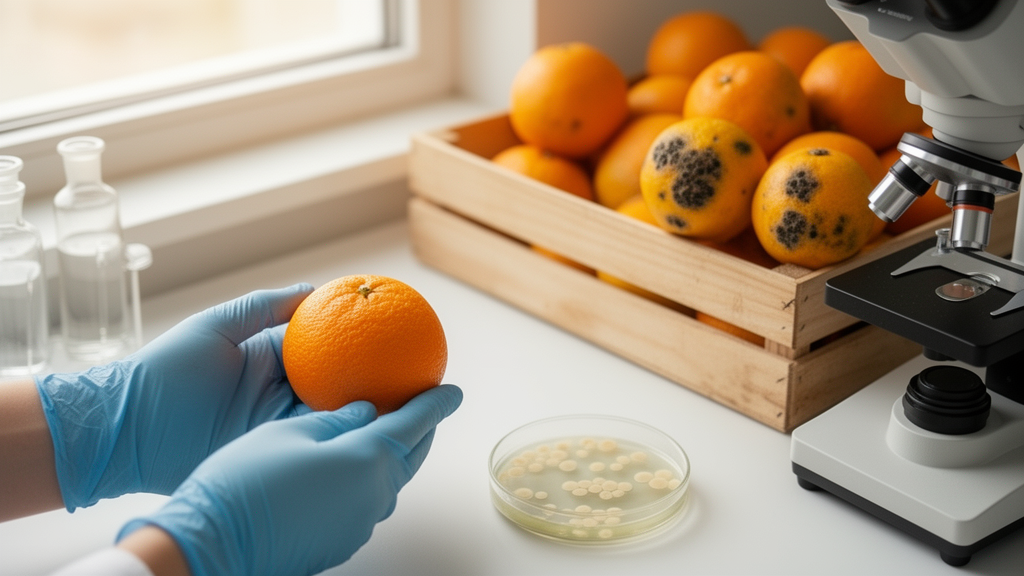
Three soil bacteria isolated from farmland in Guangdong Province, China, have emerged as promising candidates for protecting citrus fruit from a destructive postharvest disease, according to a new study accepted for publication in Frontiers in Microbiology. The strains, recovered from potato and tomato rhizosphere soil, were identified as members of the genus Pseudomonas and were found to combine plant growth-promoting traits with antifungal activity against Geotrichum citri-aurantii, the pathogen responsible for sour rot in citrus. The research team, led by Chunling Wang and Lutian Mao of Huizhou University, designated the three isolates MBJ003, MBJ016 and MB1046.
Identification relied on a combination of morphological characteristics, physicochemical profiles, phylogenetic analysis and whole-genome sequencing. The genomic work revealed that MBJ003 belongs to the species Pseudomonas paraeruginosa, MB1046 is Pseudomonas palmensis, and MBJ016 represents an entirely novel species within the genus Pseudomonas, underscoring how much unexplored bacterial diversity remains in agricultural soils. Whole-genome analysis showed that all three strains carry abundant and diverse secondary metabolite biosynthesis gene clusters, which the researchers report endow the strains with biocontrol potential.
These gene clusters are a key reason the researchers consider the strains to hold biocontrol potential. In addition, strain MB1046 was found to possess 17 components of the type VI secretion system, and the study examined the role of this system in the strain’s antagonism against G. citri-aurantii. Beyond their antifungal behavior, the three strains displayed a suite of beneficial traits in laboratory assays.
Each was able to solubilize phosphate, and each produced siderophores. All three also produced indole-3-acetic acid, a plant hormone. Strain MBJ003 stood out with an additional protease-producing activity. These multiple properties are among the characteristics that make Pseudomonas species widely recognized as promising beneficial microorganisms for agriculture.
Laboratory tests confirmed that all three Pseudomonas strains showed significant antagonistic activity against G. citri-aurantii. The researchers also tested cell-free fermentation supernatants, the liquid growth media left behind after the bacteria were removed, and found that these possessed distinct antifungal potency. This indicates that the inhibitory effect is at least partly mediated by diffusible compounds the bacteria secrete during growth rather than requiring direct contact between the living cells and the fungus.
Strain MBJ003 exhibited the most prominent inhibitory effect among the three in the supernatant assays. The team then conducted in vitro inoculation assays, which showed that the three strains could markedly inhibit postharvest citrus disease caused by G. citri-aurantii. The study also provided insights into the role of the type VI secretion system in strain MB1046’s activity against the pathogen, adding a mechanistic dimension to the work.
By characterizing the genetic basis of both growth promotion and antagonism in the same strains, the researchers aimed to systematically clarify how these beneficial Pseudomonas operate. Beneficial rhizobacteria such as Pseudomonas species are widely recognized for their potential to improve plant growth performance and enhance disease resistance, and the study positions its three isolates as valuable candidate microbial resources for the development of biological agents and the control of crop postharvest diseases. As with any laboratory-stage study, the findings come with important caveats.
The inoculation assays were conducted under controlled in vitro conditions, and the results do not yet demonstrate efficacy in commercial orchards, packinghouses or storage facilities. The final, formatted version of the article is still to be published, and the full experimental details, including the precise inhibition rates and the complete characterization of the type VI secretion system’s function, will be available in the published paper. The authors note that all claims expressed in the article are solely their own and do not necessarily represent those of their affiliated organizations or the publisher.
Nevertheless, the study offers a systematic account of the growth-promoting traits and antifungal mechanisms of three beneficial Pseudomonas strains from a single agricultural region, and it adds to the catalogue of bacterial resources that could be explored for postharvest disease control. Further work will be needed to determine whether the laboratory performance of MBJ003, MBJ016 and MB1046 translates into practical protection of harvested citrus fruit.
Subject of Research: Plant growth-promoting and biocontrol traits of three Pseudomonas strains against the citrus sour rot pathogen Geotrichum citri-aurantii
Article Title: Plant growth-promoting traits and biocontrol mechanism of three Pseudomonas strains against Geotrichum citri-aurantii
Article References: Wang, C., Mao, L., Zhu, B., Liu, X., Xv, X., & Zhuo, J. (2026). Plant growth-promoting traits and biocontrol mechanism of three Pseudomonas strains against Geotrichum citri-aurantii. Frontiers in Microbiology, 17, Article 1970166. https://doi.org/10.3389/fmicb.2026.1970166
Image Credits: AI Generated
DOI: 10.3389/fmicb.2026.1970166
Keywords: Pseudomonas, biocontrol, Geotrichum citri-aurantii, postharvest citrus disease, plant growth-promoting rhizobacteria, siderophores, phosphate solubilization, indole-3-acetic acid, type VI secretion system, whole-genome analysis, secondary metabolites, sour rot
News Source: Juliet Wilcox. (October 27, 2026). Three Pseudomonas Strains Show Promise Against Postharvest Citrus Rot. Scienmag.