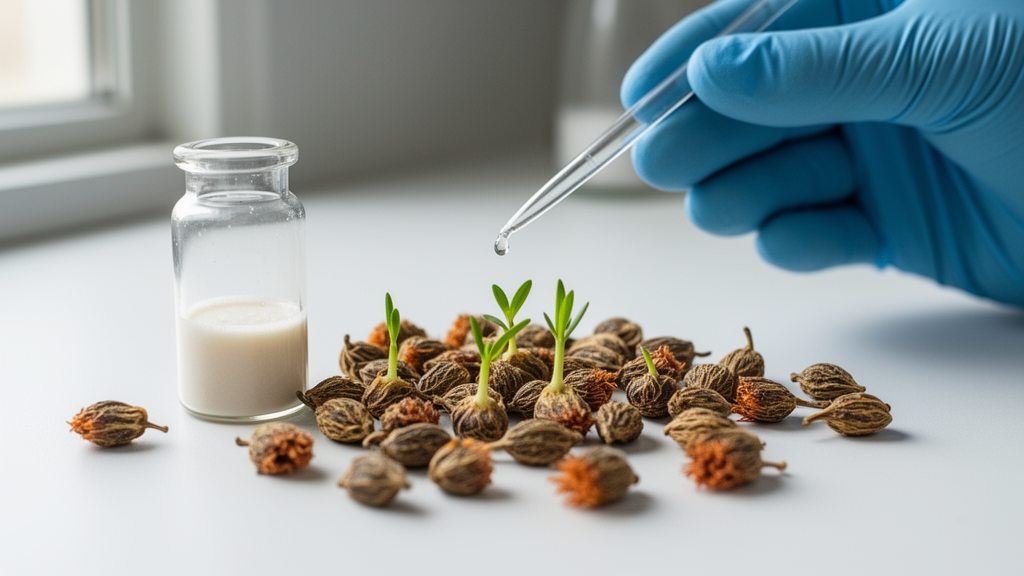
Safflower seeds are prized in traditional Chinese medicine, but their high oil content makes them unusually vulnerable to aging, a process that erodes germination capacity and ultimately threatens both the quality and yield of the crop. A new study published in BMC Plant Biology reports that priming aged safflower seeds with cerium oxide nanoparticles (CeO2NPs) substantially revived their performance, raising germination from 64.5 percent to 87.4 percent while markedly increasing seedling biomass and chlorophyll content. The work combined physiological measurements, lipidomic profiling, transcriptomic analysis and quantitative PCR to trace how the nanoparticles act on aged seeds.
In the treated seeds, CeO2NPs priming reduced ROS accumulation and boosted the activity of antioxidant enzymes, the cellular machinery that neutralizes these harmful molecules. This dual effect, less oxidative damage alongside stronger antioxidant defenses, offers a mechanistic explanation for the improved germination and early seedling growth observed after treatment. The lipidomic results point to a second layer of protection.
Aging compromises seed membranes, and the researchers found that CeO2NPs priming clearly raised the contents of membrane lipids known as DGDG and SQDG. By replenishing these structural lipid components, the nanoparticles appear to facilitate the repair of membrane damage in aged seeds, helping restore the integrity that germination depends on. At the level of gene expression, transcriptomic analysis showed that CeO2NPs significantly upregulated genes related to light-harvesting proteins, the pigment-associated complexes that capture solar energy for photosynthesis.
Quantitative PCR verification then confirmed that genes involved in sugar metabolism, fatty acid metabolism, the antioxidant system and light-harvesting protein synthesis were distinctly upregulated in the treated seeds. Together, these molecular changes align with the observed gains in chlorophyll content and seedling biomass, suggesting that the nanoparticles prime seeds for more effective photosynthetic capacity once germination begins. Taken as a whole, the study concludes that CeO2NPs priming enhances the vigor of aged safflower seeds through two linked routes: promoting photosynthetic capacity and improving antioxidant capacity.
Because safflower is a traditional medicinal material whose seed quality deteriorates readily, the findings identify nanoparticle priming as an innovative technique for improving the physiological performance of stored seeds. The authors note that the mechanisms by which CeO2NPs priming enhances aged seed vigor had previously remained poorly elucidated, and this multi-omics evidence base now connects the treatment to specific lipid, gene-expression and physiological outcomes.
Subject of Research: Cerium oxide nanoparticle priming to improve the vigor of aged safflower seeds
Article Title: Cerium oxide nanoparticles priming enhances aged safflower seed vigor via improved photosynthetic and antioxidant capacity
Article References: Zhong, L., Lv, T., Liu, J., Li, J., Pritchard, H. W., Colville, L., Zhou, T., Ren, C., Pei, J., & Yan, J. (2026). Cerium oxide nanoparticles priming enhances aged safflower seed vigor via improved photosynthetic and antioxidant capacity. BMC Plant Biology. https://doi.org/10.1186/s12870-026-10162-z
Image Credits: AI Generated
DOI: 10.1186/s12870-026-10162-z
Keywords: safflower, seed vigor, cerium oxide nanoparticles, seed priming, seed aging, reactive oxygen species, antioxidant enzymes, lipidomics, membrane lipids, photosynthesis, gene expression, BMC Plant Biology
News Source: Alan Morgan. (October 26, 2026). Cerium oxide nanoparticle priming restores vigor in aged safflower seeds. Scienmag.