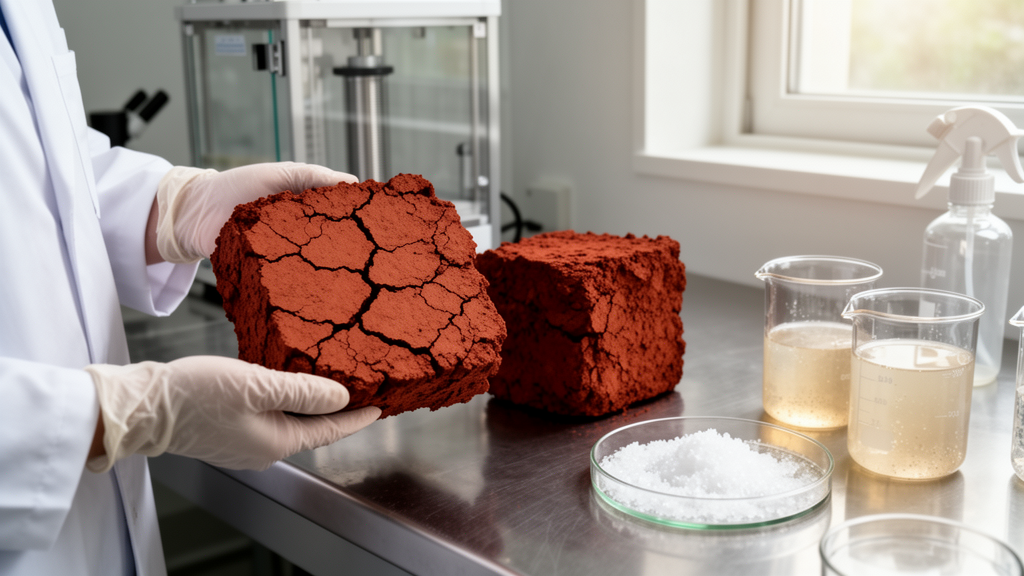
A new laboratory study published in Scientific Reports proposes an eco-friendly answer to this problem using enzyme-induced carbonate precipitation, or EICP, a biomineralization technique in which a plant-derived enzyme catalyzes the formation of calcium carbonate directly inside the soil pore space. The research team, led by Xiaolong Xu and colleagues, set out to quantify how well EICP-treated red clay performs both mechanically and under the harsh alternating wet and dry conditions that typically destroy untreated clay embankments and earthworks. Rather than relying on energy-intensive or cement-based stabilization, the method uses urease extracted from soybeans to hydrolyze urea in a calcium-rich cementation solution, triggering the precipitation of calcium carbonate crystals that bind loose clay particles together.
Before any soil was treated, the researchers optimized the biological reaction itself. They found that soybean urease reached its maximum catalytic activity at a pH of 8.0 and an incubation temperature of 55 degrees Celsius. Through a ratio-optimization campaign, the team identified an optimal formulation of 60 grams per liter of urease combined with a 1.0 mol/L cementation solution.
Under these conditions, the calcium carbonate content produced in the specimens was the highest, and the gain in unconfined compressive strength was the most significant. The mechanical testing program centered on triaxial shear tests, which probe how soil behaves under confining stress. The EICP-treated soil showed a markedly higher compression modulus than untreated material, and its shear failure pattern displayed the typical strain-hardening characteristics of a well-bonded soil, meaning it continued to resist increasing deformation rather than collapsing abruptly.
One of the most striking results concerned cohesion: the effective cohesion of the stabilized soil rose from 18.12 kilopascals in the untreated clay to 43.14 kilopascals after treatment, a more than twofold increase that reflects the new bonds between particles. Durability under environmental cycling was assessed with a series of wetting–drying cycle tests, a standard way to simulate the seasonal soaking and desiccation that field soils endure. After 20 such cycles, the stabilized specimens retained remarkably intact surfaces, with a surface crack ratio of only 5.2 percent.
Total mass loss remained below 5 percent across the cycling program. The authors report that these figures demonstrate excellent volume stability and resistance to collapse, properties that untreated red clay typically lacks under the same conditions. To understand why the treatment works so well, the researchers turned to microscopy and chemical analysis.
Scanning electron microscopy, or SEM, revealed micro- and nanometer-scale calcium carbonate crystals distributed throughout the treated soil, while energy-dispersive X-ray spectroscopy, or EDS, confirmed the chemical identity of the precipitated minerals. Together, the two techniques showed that the biologically induced crystals fill the capillary seepage channels inside the soil, the very pathways through which water normally infiltrates and weakens red clay. The microscopy also showed that the crystals build a strong bonding network between otherwise scattered clay particles.
This dual action, plugging water pathways and cementing grains together, explains the combined improvement in strength, stiffness, and resistance to cyclic wetting and drying. The study is based entirely on detailed indoor laboratory testing, so the reported performance figures apply to the specific soil, formulations, and test protocols used by the authors, and field-scale validation would be a natural next step.
Subject of Research: Stabilization of water-sensitive red clay using enzyme-induced carbonate precipitation
Article Title: Study on the mechanical properties and resistance to wetting–drying cycles of red clay stabilized by enzyme-induced carbonate precipitation (EICP)
Article References: Xu, X., Chen, Z., Wei, J., Chen, C.-T., Wu, S., & Guo, X. (2026). Study on the mechanical properties and resistance to wetting–drying cycles of red clay stabilized by enzyme-induced carbonate precipitation (EICP). Scientific Reports. https://doi.org/10.1038/s41598-026-76942-7
Image Credits: AI Generated
DOI: 10.1038/s41598-026-76942-7
Keywords: red clay, EICP, enzyme-induced carbonate precipitation, soybean urease, calcium carbonate, soil stabilization, triaxial shear test, wetting–drying cycles, unconfined compressive strength, scanning electron microscopy, geotechnical engineering, durability
News Source: Denise Maddox. (October 27, 2026). Enzyme-Induced Carbonate Precipitation Strengthens Red Clay Against Wetting–Drying Damage. Scienmag.