• HOME
  • NEWS
  • EXPLORE
    • CAREER
      • Companies
      • Jobs
    • EVENTS
    • iGEM
      • News
      • Team
    • PHOTOS
    • VIDEO
    • WIKI
  • BLOG
  • COMMUNITY
    • FACEBOOK
    • INSTAGRAM
    • TWITTER
Tuesday, October 27, 2026
BIOENGINEER.ORG
No Result
View All Result
  • Login
  • HOME
  • NEWS
  • EXPLORE
    • CAREER
      • Companies
      • Jobs
        • Lecturer
        • PhD Studentship
        • Postdoc
        • Research Assistant
    • EVENTS
    • iGEM
      • News
      • Team
    • PHOTOS
    • VIDEO
    • WIKI
  • BLOG
  • COMMUNITY
    • FACEBOOK
    • INSTAGRAM
    • TWITTER
No Result
View All Result
Bioengineer.org
No Result
View All Result
Home NEWS Science News Technology

Yellow Maize Cross Shows 15 Percent Heterosis in Pakistani Hybrid Trial

by
October 27, 2026
in Technology
Reading Time: 2 mins read
0
Yellow Maize Cross Shows 15 Percent Heterosis in Pakistani Hybrid Trial

Yellow Maize Cross Shows 15 Percent Heterosis in Pakistani Hybrid Trial

Share on FacebookShare on TwitterShare on LinkedinShare on RedditShare on Telegram

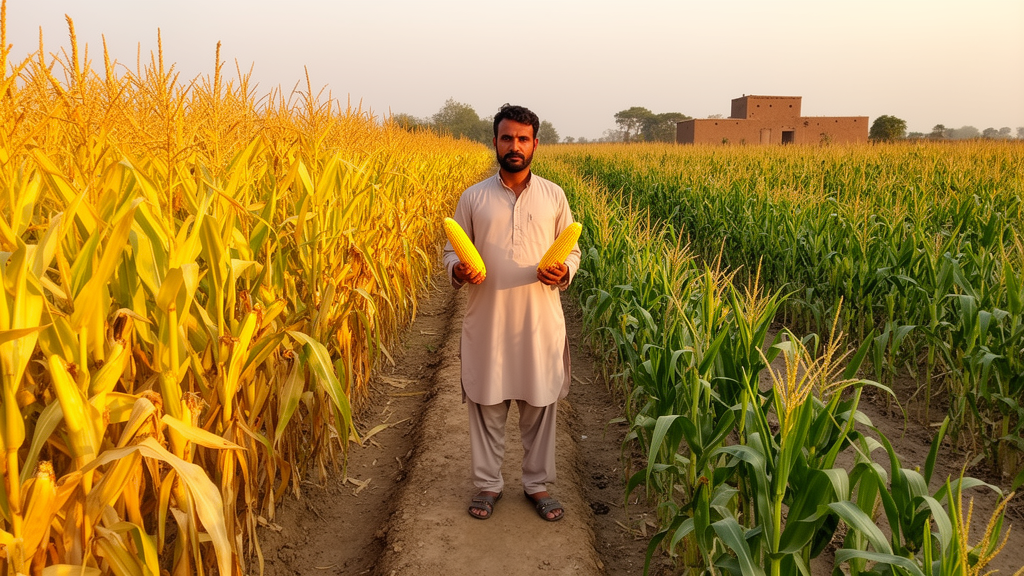
A breeding study at the Cereal Crop Research Institute in Pirsabaq, Nowshehra, Pakistan, has identified yellow maize hybrid combinations with strong yield performance, with one cross, YL-2 × YD-4, recording 15.1 percent economic heterosis and 3.30 percent commercial heterosis for grain yield. The work was carried out during the Kharif 2022 season and is published in Scientific Reports.

The research team, including Abbas Ali, Sher Aslam Khan and colleagues, crossed ten inbred maize lines with three testers in a line-by-tester mating design, producing thirty F1 hybrids. These crosses, together with two check entries, were evaluated in a randomized complete block design with three replications. The aim was to estimate general combining ability (GCA) and specific combining ability (SCA) effects, along with heterotic effects, for morphological and yield-related traits of yellow maize.

Statistical analysis showed significant differences among both parents and crosses for all traits studied, a result the authors interpret as indicating that further selection is possible. GCA and SCA estimates were significant for all studied traits except ear diameter.

Three inbred lines showed desirable negative GCA values for earliness: YL-1, YL-2 and YL-8 RC. Separately, the parental lines YL-1, YL-2 and YL-6 displayed desirable and significant positive GCA values for ear length, 100-grain weight and grain yield, which the study attributes to favorable additive genetic effects for these traits.

Among the thirty F1 crosses, three combinations delivered the highest grain yields. YL-2 × YD-4 reached 8629.5 kilograms per hectare, YL-6 × YD-4 produced 7617.5 kilograms per hectare, and YL-1 × YL-07 RC yielded 7602.8 kilograms per hectare. All three showed positive and significant SCA effects for grain yield.

The top performer, YL-2 × YD-4, recorded positive and significant economic heterosis of 15.1 percent and commercial heterosis of 3.30 percent for grain yield, and the study highlights its potential for further evaluation.

Assessment of combining ability variances revealed a predominance of SCA variance over GCA variance for most traits. Baker’s ratio values below unity likewise indicated a greater contribution of non-additive genetic effects to the expression of the traits studied in this population.

The study is a single-location trial conducted over one season at one institute, so the reported yields and heterosis values describe performance under those specific Kharif 2022 conditions. The abstract does not report multi-environment testing of the crosses.

Within the scope of the trial, the findings supply breeders with measured GCA values for individual inbred lines, significant SCA effects for specific cross combinations, and quantified heterosis for the leading hybrid, all based on the observed performance of the thirty crosses and two checks in the 2022 season.

Subject of Research: Combining ability and heterosis in yellow maize hybrids evaluated in Pakistan

Article Title: Genetic components and heterotic performance of yellow maize hybrids for morphological and yield traits

Article References: Ali, A., Khan, S. A., Khalili, A., Ali, N., Ali, S., Hussain, I., & Qayyum, A. (2026). Genetic components and heterotic performance of yellow maize hybrids for morphological and yield traits. Scientific Reports. https://doi.org/10.1038/s41598-026-75670-2

Image Credits: AI Generated

DOI: 10.1038/s41598-026-75670-2

Keywords: maize, hybrid breeding, heterosis, combining ability, GCA, SCA, grain yield, inbred lines, line-by-tester, genetics, Pakistan, plant breeding

News Source: Alan Morgan. (October 26, 2026). Yellow Maize Cross Shows 15 Percent Heterosis in Pakistani Hybrid Trial. Scienmag.


Tags: combining abilityGCAGeneticsgrain yieldheterosishybrid breedinginbred linesline-by-testermaizePakistanplant breedingSCA
Share12Tweet7Share2ShareShareShare1

Related Posts

Engineered Human Cell-Derived Matrix Outperforms Recombinant Collagen, but Senescence Looms

Engineered Human Cell-Derived Matrix Outperforms Recombinant Collagen, but Senescence Looms

October 27, 2026
Cellular RNA archive lets researchers reconstruct gene activity from days past

Cellular RNA archive lets researchers reconstruct gene activity from days past

October 27, 2026

Phosphate-Loaded PVA Nanofibers Show Enhanced Bone-Like Mineralization

October 27, 2026

Why Gamified Fitness Apps in Dutch Municipalities Rarely Move Beyond the Pilot Stage

October 27, 2026

POPULAR NEWS

  • Blood Flow Restriction Training After Stroke Shows Modest Gains, Review Finds

    Blood Flow Restriction Training After Stroke Shows Modest Gains, Review Finds

    29 shares
    Share 12 Tweet 7
  • Research report: Estimating metabolic pathway overlap in precision oncology: integrating pharmacogenetics and polypharmacy

    29 shares
    Share 12 Tweet 7
  • Two-Thirds of Medical Records Correctly Coded Under Ethiopia’s Simplified ICD-11, Study Finds

    29 shares
    Share 12 Tweet 7
  • East African Jewels: Six New Bush-Cricket Species Reveal Inflated Ears Built for Duetting

    29 shares
    Share 12 Tweet 7

About

We bring you the latest biotechnology news from best research centers and universities around the world. Check our website.

Follow us

Recent News

Two-Thirds of Medical Records Correctly Coded Under Ethiopia’s Simplified ICD-11, Study Finds

Blood Flow Restriction Training After Stroke Shows Modest Gains, Review Finds

Research report: Estimating metabolic pathway overlap in precision oncology: integrating pharmacogenetics and polypharmacy

Subscribe to Blog via Email

Enter your email address to subscribe to this blog and receive notifications of new posts by email.

Join 85 other subscribers
  • Contact Us

Bioengineer.org © Copyright 2023 All Rights Reserved.

Welcome Back!

Login to your account below

Forgotten Password?

Retrieve your password

Please enter your username or email address to reset your password.

Log In
No Result
View All Result
  • Homepages
    • Home Page 1
    • Home Page 2
  • News
  • National
  • Business
  • Health
  • Lifestyle
  • Science

Bioengineer.org © Copyright 2023 All Rights Reserved.