• HOME
  • NEWS
  • EXPLORE
    • CAREER
      • Companies
      • Jobs
    • EVENTS
    • iGEM
      • News
      • Team
    • PHOTOS
    • VIDEO
    • WIKI
  • BLOG
  • COMMUNITY
    • FACEBOOK
    • INSTAGRAM
    • TWITTER
Tuesday, October 27, 2026
BIOENGINEER.ORG
No Result
View All Result
  • Login
  • HOME
  • NEWS
  • EXPLORE
    • CAREER
      • Companies
      • Jobs
        • Lecturer
        • PhD Studentship
        • Postdoc
        • Research Assistant
    • EVENTS
    • iGEM
      • News
      • Team
    • PHOTOS
    • VIDEO
    • WIKI
  • BLOG
  • COMMUNITY
    • FACEBOOK
    • INSTAGRAM
    • TWITTER
No Result
View All Result
Bioengineer.org
No Result
View All Result
Home NEWS Science News Chemistry

Co-precipitation Temperature Fine-Tunes Industrial Cu-Zn-Al Catalysts for Methanol Synthesis

by
October 27, 2026
in Chemistry
Reading Time: 2 mins read
0
Co-precipitation Temperature Fine-Tunes Industrial Cu-Zn-Al Catalysts for Methanol Synthesis

Co-precipitation Temperature Fine-Tunes Industrial Cu-Zn-Al Catalysts for Methanol Synthesis

Share on FacebookShare on TwitterShare on LinkedinShare on RedditShare on Telegram

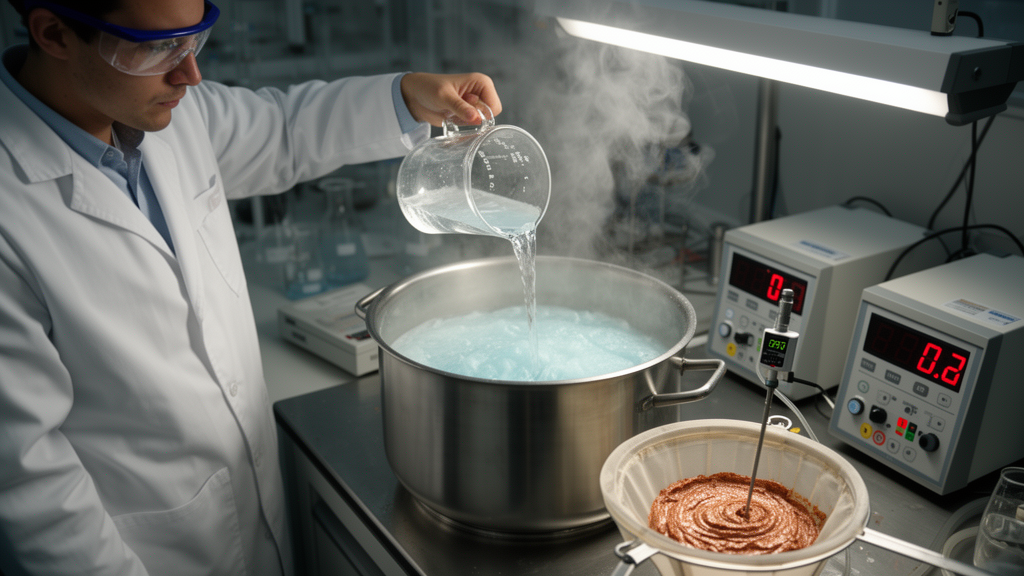
Researchers have shown that a single, easily controlled variable in catalyst manufacturing — the temperature at which metal salts are co-precipitated — can decisively shape the performance of industrial Cu-Zn-Al (CZA) catalysts used to make methanol from syngas. The study, published in Catalysis Letters, systematically prepared a series of catalysts at different precipitation temperatures and linked their structure to their catalytic activity. The team, led by Wuxing Yang and colleagues, used X-ray diffraction, transmission electron microscopy, scanning electron microscopy and X-ray photoelectron spectroscopy to characterize the materials, and then evaluated them in a fixed-bed reactor for methanol synthesis from syngas.

The central finding is that precipitation temperature determines the phase composition of the catalyst precursors. That precursor chemistry, in turn, governs two critical features of the final calcined catalyst: how finely the copper is dispersed, and how strongly the copper interacts with zinc oxide. The new work shows that the recipe's thermal history during precipitation is a master switch controlling that partnership.

Performance testing revealed a clear optimum. The catalyst prepared at 69 °C delivered the highest CO conversion, 76.1 percent, and the highest methanol space-time yield, 1.51 grams of methanol per gram of catalyst per hour, under conditions of 10,000 per hour space velocity, 5 MPa pressure and 230 °C. Notably, the window of good performance was broad rather than a narrow peak.

Catalysts prepared across the range of 61 to 85 °C showed both optimal methanol synthesis activity and stability, suggesting the synthesis is robust enough for practical process control. The study is limited to laboratory-scale fixed-bed testing under the stated conditions, and the reported figures reflect those specific operating parameters. Nevertheless, the structure-activity relationship established here offers a practical design rule: control the precipitation temperature to control precursor phases, and thereby control copper dispersion and Cu-ZnO interaction strength.

Subject of Research: Effect of co-precipitation temperature on the structure and activity of Cu-Zn-Al methanol synthesis catalysts

Article Title: Impact of Co-precipitation Temperature on the Structure-Activity Relationship of Industrial CZA Catalysts for Methanol Synthesis from Syngas

Article References: Yang, W., Zhou, J., Zhang, K., Chen, P., Hu, Z., Ouyang, L., Zhao, A., & Zheng, H. (2026). Impact of Co-precipitation Temperature on the Structure-Activity Relationship of Industrial CZA Catalysts for Methanol Synthesis from Syngas. Catalysis Letters, 156(11), Article 310. https://doi.org/10.1007/s10562-026-05487-1

Image Credits: AI Generated

DOI: 10.1007/s10562-026-05487-1

Keywords: methanol synthesis, CZA catalyst, co-precipitation, syngas, Cu-ZnO interaction, copper dispersion, catalysis, heterogeneous catalysis, precursor phases, fixed-bed reactor, Catalysis Letters, Impact

News Source: Bethany Barker. (October 26, 2026). Co-precipitation Temperature Fine-Tunes Industrial Cu-Zn-Al Catalysts for Methanol Synthesis. Scienmag.


Tags: CatalysisCatalysis Lettersco-precipitationcopper dispersionCu-ZnO interactionCZA catalystfixed-bed reactorHeterogeneous catalysisimpactmethanol synthesisprecursor phasessyngas
Share12Tweet7Share2ShareShareShare1

Related Posts

Chemists Isolate Elusive Terbium State Under Everyday Lab Conditions

Chemists Isolate Elusive Terbium State Under Everyday Lab Conditions

October 27, 2026
Tandem quantum-dot photodiodes bring fast, glare-resistant 1550 nm LiDAR closer

Tandem quantum-dot photodiodes bring fast, glare-resistant 1550 nm LiDAR closer

October 27, 2026

Molecular Cage Traps Planar Aromatic Molecules by Shape Alone

October 26, 2026

Terahertz-Sensing Design Framework Aims to Make Plastic Containers Easier to Recycle

October 26, 2026

POPULAR NEWS

  • Chemists Isolate Elusive Terbium State Under Everyday Lab Conditions

    Chemists Isolate Elusive Terbium State Under Everyday Lab Conditions

    29 shares
    Share 12 Tweet 7
  • AI Pioneer Christina Theodoris Wins 2026 Seldin-Smith Award

    29 shares
    Share 12 Tweet 7
  • Antipsychotic Olanzapine Disrupts Insulin Signaling in Muscle Cells in a Way a Fission Blocker Cannot Fix

    29 shares
    Share 12 Tweet 7
  • Co-precipitation Temperature Fine-Tunes Industrial Cu-Zn-Al Catalysts for Methanol Synthesis

    29 shares
    Share 12 Tweet 7

About

We bring you the latest biotechnology news from best research centers and universities around the world. Check our website.

Follow us

Recent News

Chemists Isolate Elusive Terbium State Under Everyday Lab Conditions

AI Pioneer Christina Theodoris Wins 2026 Seldin-Smith Award

Antipsychotic Olanzapine Disrupts Insulin Signaling in Muscle Cells in a Way a Fission Blocker Cannot Fix

Subscribe to Blog via Email

Enter your email address to subscribe to this blog and receive notifications of new posts by email.

Join 85 other subscribers
  • Contact Us

Bioengineer.org © Copyright 2023 All Rights Reserved.

Welcome Back!

Login to your account below

Forgotten Password?

Retrieve your password

Please enter your username or email address to reset your password.

Log In
No Result
View All Result
  • Homepages
    • Home Page 1
    • Home Page 2
  • News
  • National
  • Business
  • Health
  • Lifestyle
  • Science

Bioengineer.org © Copyright 2023 All Rights Reserved.