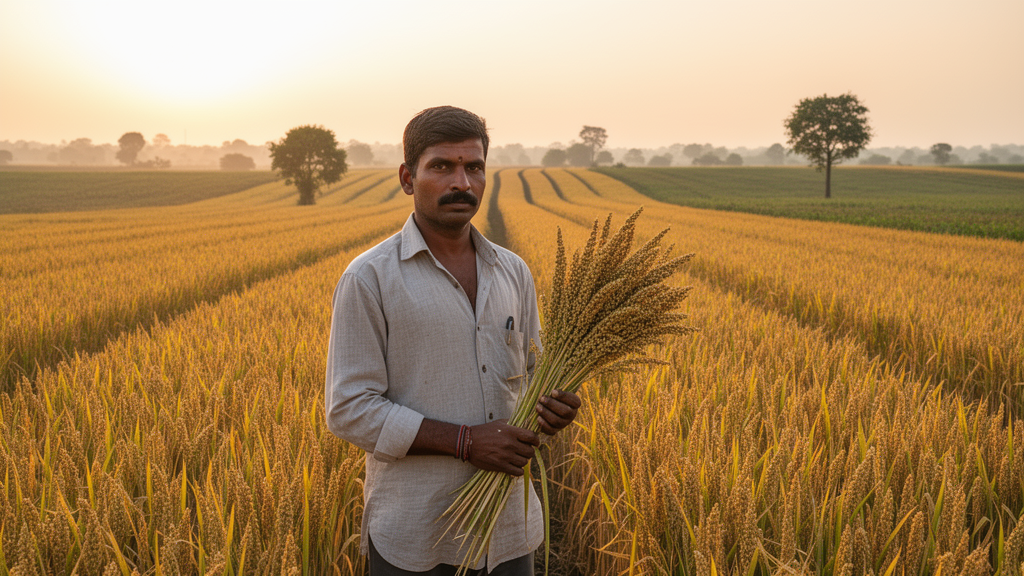
A multi-environment trial of 72 foxtail millet genotypes across six environments in eastern India has identified a shortlist of lines that combine high grain yield with stable performance, using a combination of AMMI, GGE biplot, and BLUP-based statistical methods. The study, published in BMC Plant Biology, was conducted at three locations—Paralakhemundi, Vizianagaram, and Birbhum—over two successive rabi seasons, from November 2024 to March 2025 and from November 2025 to March 2026.
The trials were laid out in an alpha lattice design, allowing the researchers to test not only whether genotypes differed in average grain yield, but whether their relative rankings shifted from one location or season to the next. Combined analysis of variance showed statistically significant effects for genotype, environment, and the genotype-by-environment interaction (GEI). That interaction is the central challenge for breeders: when a variety that performs best in one environment falls behind in another, mean yield alone becomes an unreliable guide to selection.
The Additive Main Effects and Multiplicative Interaction (AMMI) analysis decomposed the interaction into principal component axes. The first two interaction principal component axes jointly accounted for 76.7 percent of the GEI variance, meaning the model captured most of the environment-driven reshuffling of genotype performance. Six entries—G70 (WFx-15), G63 (RPCAU-XM-27), G9 (GPUF-20), G15 (SiA 4253), G54 (K2), and G67 (IIMR FXM-25 (FX 24042/24062))—showed low interaction principal component axis scores and were characterized as having superior stability.
The Genotype plus Genotype-by-Environment (GGE) biplot analysis grouped all six tested environments into a single mega-environment and identified environments E3 and E4 as the most representative of the testing network. Within this framework, genotype G17 (SiA 4389) demonstrated consistent adaptability to all environments and high yield stability. The mean-versus-stability graph distinguished G17 (SiA 4389), G31 (SiA 3085), G70 (WFx-15), G54 (K2), G61 (KIFXG-22-27), G52 (CFXMV-3 (FXV 652/GPUF)), and G34 (GPUF 19) as high-yielding and stable entries, based on their proximity to the Average Environment Coordination line.
The third analytical layer used best linear unbiased prediction (BLUP) to estimate genotypic values while accounting for environmental effects. Four BLUP-based selection indices—the Harmonic Mean of Genotypic Values (HMGV), the Relative Performance of Genotypic Values (RPGV), the Harmonic Mean of Relative Performance of Genotypic Values (HMRPGV), and the Weighted Average of Absolute Scores and Best Yield (WAASBY)—consistently identified the same group of promising genotypes: G17 (SiA 4389), G31 (SiA 3085), G70 (WFx-15), G54 (K2), and G61 (KIFXG-22-27). This convergence across indices that weight yield and stability differently strengthens confidence that these lines combine productivity with adaptability rather than excelling on a single metric.
Because grain yield alone can mask performance differences in other traits, the team also applied two multi-trait selection tools, MGIDI and MTSI, at a 15 percent selection intensity. Each method selected 11 of the 72 genotypes, and their rankings agreed strongly, with a Spearman rank correlation of 0.792. Six genotypes appeared in both selections: G52 (CFXMV-3 (FXV 652/GPUF)), G16 (SiA 4216), G34 (GPUF 19), G65 (BRFoM 4), G41 (HMT 100-1), and G15 (SiA 4253).
When the authors integrated all of the evidence—AMMI stability indices, GGE biplot positioning, BLUP-based indices, and the multi-trait rankings—three genotypes emerged as the most desirable overall: G15 (SiA 4253), G70 (WFx-15), and G54 (K2). According to the study, these lines paired competitive mean grain yield with low sensitivity to environmental shifts, the combination breeders seek when targeting varieties for release across heterogeneous regions.
The authors state that the findings help identify foxtail millet genotypes with high grain yield and stable performance across the tested environments, providing a basis for their further evaluation in multi-location trials. The scope of the evidence remains limited to the two rabi seasons and three Indian locations tested, so the identified genotypes require broader testing before any wider recommendation. Still, the agreement of four independent analytical frameworks on a consistent group of elite lines suggests the signal is robust, and the selected genotypes now move forward as candidates for the next round of yield trials.
Subject of Research: Multi-environment evaluation of yield stability and adaptability in foxtail millet genotypes
Article Title: Multi-environment evaluation of yield stability and adaptability of foxtail millet (Setaria italica (L.) Beauv.) genotypes using AMMI, GGE biplot, and BLUP methods
Article References: Lydia, N. M., Rout, S., Swapnil, Singla, S., Anuradha, N., Indumathi, G., Thukuna, B., Bhavana, R., Teja, P. S., Naidu, T. R., Sharma, S. S., & Masika, F. B. (2026). Multi-environment evaluation of yield stability and adaptability of foxtail millet (Setaria italica (L.) Beauv.) genotypes using AMMI, GGE biplot, and BLUP methods. BMC Plant Biology. https://doi.org/10.1186/s12870-026-10273-7
Image Credits: AI Generated
DOI: 10.1186/s12870-026-10273-7
Keywords: foxtail millet, Setaria italica, genotype-by-environment interaction, yield stability, AMMI, GGE biplot, BLUP, MGIDI, MTSI, multi-environment trials, plant breeding, India
News Source: Alan Morgan. (October 26, 2026). Foxtail Millet Genotypes Show Stable High Yields Across Six Indian Environments. Scienmag.