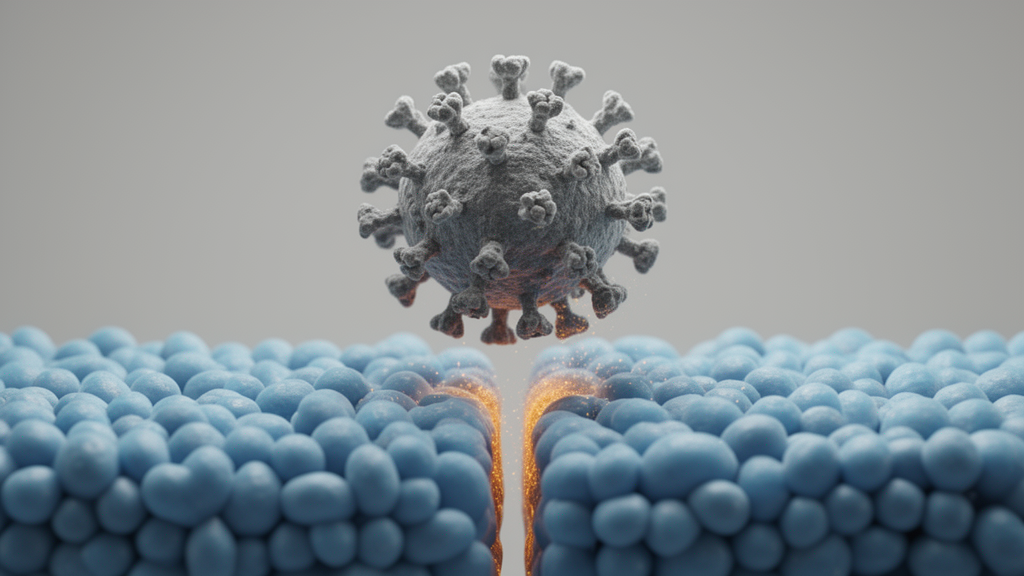
The SARS-CoV-2 Omicron subvariant JN.4 carries a unique A475V substitution in the receptor binding domain (RBD), yet has shown limited expansion compared with its parallel descendant JN.1. A new study investigates how hydrophobic remodeling within the RBD large loop, spanning residues 475 to 490, modulates receptor engagement and spike function, offering a structural explanation for the variant’s constrained fitness.
Using cryo-electron microscopy, the researchers found that A475V induces local remodeling of the receptor-binding motif and alters the geometry of the RBD–ACE2 interaction. Local refinement showed that the bulky valine substitution disrupts the interaction network surrounding residue 475, producing a 3.5-fold reduction in ACE2-binding affinity relative to BA.2.86. Unlike the L455S substitution in JN.1, which primarily alters the receptor-binding interface, A475V within the flexible large loop influences both local loop conformation and global spike conformational properties.
Systematic mutagenesis identified A475 and F486 as functionally constrained hydrophobic residues that preserve the structural framework of ACE2 engagement despite extensive sequence variation in the surrounding loop. Molecular dynamics simulations and functional assays supported these structural observations, indicating that the loop tolerates sequence change only within limits set by receptor recognition and conformational stability.
The findings establish the RBD 475–490 large loop as a structurally plastic yet functionally constrained element that balances receptor recognition, conformational stability, and antigenic diversification. The authors present this as a mechanistic framework for understanding region-specific evolutionary constraints that shape SARS-CoV-2 RBD adaptation. Because the work combines structural biology, simulation, and functional testing, it links a single amino acid change to measurable effects on receptor binding and spike behavior, clarifying why JN.4 has not followed the same expansion trajectory as JN.1 despite sharing recent ancestry within the Omicron radiation.
Subject of Research: Structural and functional effects of the A475V substitution in the SARS-CoV-2 receptor binding domain large loop
Article Title: Hydrophobic remodeling of the SARS-CoV-2 RBD large loop attenuates ACE2 engagement and viral fitness
Article References: Wang, A., Guo, H., Yang, H., Chen, H., Imojara, A., Ju, B., Zhang, Z., & Yan, R. (2026). Hydrophobic remodeling of the SARS-CoV-2 RBD large loop attenuates ACE2 engagement and viral fitness. PLOS Pathogens, 22(10), e1014742. https://doi.org/10.1371/journal.ppat.1014742
Image Credits: AI Generated
DOI: 10.1371/journal.ppat.1014742
Keywords: SARS-CoV-2, Omicron, JN.4, receptor binding domain, ACE2, A475V, cryo-electron microscopy, molecular dynamics, spike protein, viral fitness, mutagenesis, Hydrophobic
News Source: Drew Townsend. (October 26, 2026). Hydrophobic loop remodeling weakens ACE2 binding in SARS-CoV-2 JN.4. Scienmag.