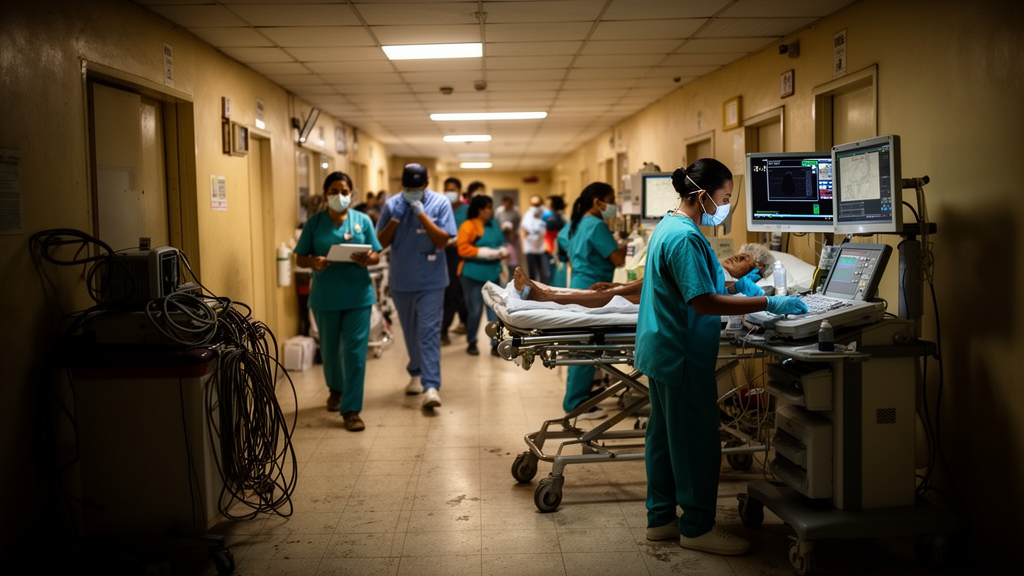
A nationwide assessment of Ecuador’s trauma care system has found a measurable mismatch between the country’s hospital infrastructure and the actual operational readiness of the specialists who treat injured patients. The study, led by Doris Sarmiento-Altamirano and colleagues, combined a structural audit of public hospitals with a survey of trauma-facing physicians to evaluate how the system performs under real conditions.
The research team conducted a multicomponent cross-sectional study between 2025 and 2026. It included a complete structural audit of 49 eligible public hospitals at Levels II and III of care, alongside a Knowledge, Attitudes, Practices, and Safety (KAPS) survey of 215 medical specialists drawn from 36 institutions, corresponding to a 73.5 percent institutional participation rate. To capture a dimension of trauma care that is often overlooked, the researchers also measured the physical transit distances between emergency departments and computed tomography scanners.
The institutional audit revealed substantial operational constraints. Just over half of the hospitals, 51.0 percent, lacked 24/7 radiological coverage, meaning imaging support was not continuously available despite the round-the-clock nature of trauma presentations. In addition, 16.3 percent of hospitals experienced periods of CT scanner downtime, a critical vulnerability given that rapid imaging is central to modern trauma decision-making.
Spatial analysis added a further layer of concern. Emergency department-to-CT transit distances were significantly greater in Level III tertiary centers, reaching up to 300 meters, a difference that was statistically significant (p = 0.006). Longer transfer routes within the largest hospitals impose additional physical barriers on the movement of critically injured patients.
Among the 215 surveyed specialists, the researchers examined whether individual KAPS dimensions tracked with provincial trauma volume. The ecological associations were imprecise: knowledge correlated weakly and non-significantly with volume (rho = 0.113, 95% CI: -0.39 to 0.61), and reported practice showed a similarly uncertain negative association (rho = -0.160, 95% CI: -0.66 to 0.34). The authors attribute these wide confidence intervals to the low statistical precision inherent in macro-level aggregation, and the results should be read as inconclusive rather than as evidence of no relationship.
The clearest signal emerged from dimension-specific multivariable Poisson regression models, which evaluated each KAPS domain separately while accounting for institutional clustering and professional seniority. Emergency physicians stood out sharply relative to general surgeons. They showed lower adjusted rates on the knowledge dimension (aIRR = 0.61; 95% CI: 0.50 to 0.74), yet higher rate ratios in reported practices (aIRR = 1.48; 95% CI: 1.34 to 1.65), attitudes (aIRR = 1.12; 95% CI: 1.09 to 1.16), and safety (aIRR = 1.18; 95% CI: 1.12 to 1.25).
This divergence indicates that emergency physicians scored lower on objective knowledge measures while reporting more favorable practices, attitudes, and safety behaviors than their general surgery counterparts. The authors interpret this as a broader discrepancy between practitioners’ subjective perceptions and their objective decision-making skills, a gap that could affect clinical performance even where equipment is nominally available.
Taken together, the findings indicate that Ecuador’s trauma network is constrained not only by physical and architectural barriers, such as long ED-to-CT distances and absent overnight radiology, but also by a workforce-level divergence between confidence and competence. The study is cross-sectional, so it captures system capacity at a point in time and cannot establish causal relationships between infrastructure, training, and outcomes.
The researchers propose strategic priorities to close these gaps: a unified national trauma registry to support evidence-based planning, integrated teleradiology to extend imaging coverage to hospitals without 24/7 radiologists, and continuous scenario-based training to align practitioners’ knowledge with the demands of frontline trauma care.
Subject of Research: National assessment of trauma care system capacity in Ecuador
Article Title: National assessment of trauma care system capacity in Ecuador: Evaluating institutional resources and practitioner KAPS domains
Article References: Sarmiento-Altamirano, D., Angamarca-Angamarca, E., Salamea, J. C., Rodas, E. B., & Moyano-Vidal, L. M. (2026). National assessment of trauma care system capacity in Ecuador: Evaluating institutional resources and practitioner KAPS domains. PLOS Global Public Health, 6(10), e0007065. https://doi.org/10.1371/journal.pgph.0007065
Image Credits: AI Generated
DOI: 10.1371/journal.pgph.0007065
Keywords: trauma care, Ecuador, hospital infrastructure, KAPS survey, emergency medicine, radiology coverage, CT scanner, cross-sectional study, health systems, teleradiology, trauma registry, medical training
News Source: Courtney Benton. (October 26, 2026). Ecuador’s Trauma Hospitals Face Gaps Between Equipment and Real-World Capacity. Scienmag.