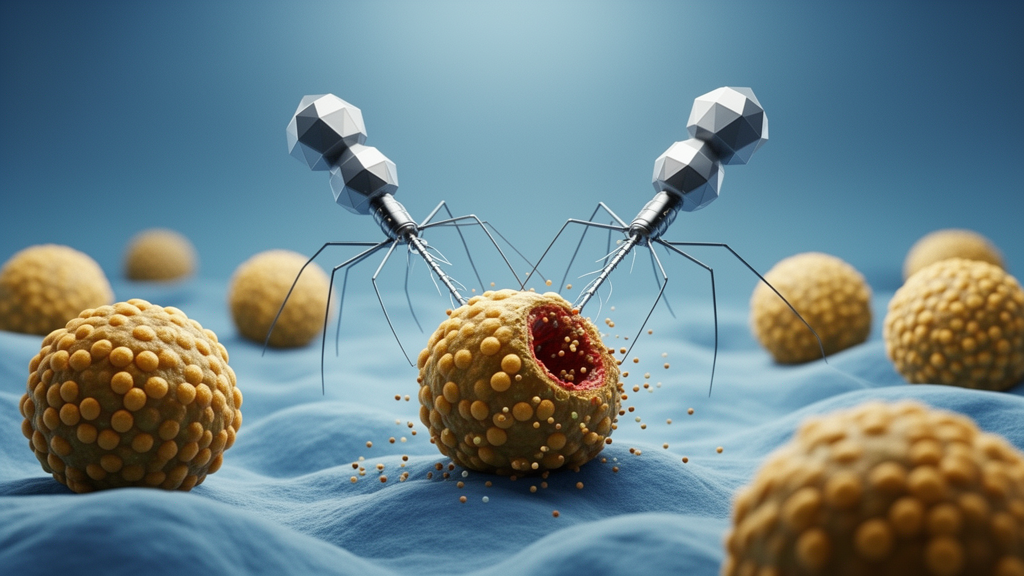
Researchers in India have isolated and characterized two novel bacteriophages, CARØ0038 and CARØ0046, that efficiently lyse methicillin-resistant Staphylococcus aureus (MRSA) under laboratory conditions. The phages were recovered from sewage in Davangere, Karnataka, using MRSA as the host, and are described in a study published in Scientific Reports. With multidrug-resistant S. aureus an increasing clinical concern, the authors position the work as a foundation for further investigation of phage-based antimicrobial candidates rather than a ready-made therapy.
Transmission electron microscopy showed icosahedral heads with short tails, a morphology consistent with members of the class Caudoviricetes. Whole-genome sequencing revealed genomes of 120,939 base pairs for CARØ0038 and 136,667 base pairs for CARØ0046, carrying 227 and 225 predicted coding sequences respectively, with GC contents of 29.5 percent and 29.1 percent. Whole-genome phylogenomic and taxonomic analyses placed both phages within the genus Silviavirus and supported their distinction from closely related reference phages, although the available analyses did not establish a definitive species-level assignment.
Functional testing highlighted the lytic potential of the two isolates. In one-step growth experiments, the phages showed apparent latent periods of 15 to 20 minutes and burst sizes of 49 and 47 plaque-forming units per cell for CARØ0038 and CARØ0046, respectively. An multiplicity of infection of 0.1 yielded the highest experimentally observed titres, indicating efficient replication under the tested conditions.
Stability profiling defined relatively narrow environmental tolerances. Both phages retained high infectivity up to 37 degrees Celsius, but showed marked reductions in infectivity at 45 to 50 degrees Celsius and no detectable recovery after exposure to 60 degrees Celsius. Maximum recovery occurred at pH 7, with no detectable infectious phage outside the pH range of 6 to 8, a constraint that would need consideration in any future formulation work.
Host-range analysis demonstrated clear lysis against all 28 MRSA isolates tested, along with activity against methicillin-susceptible S. aureus. No detectable lysis was observed against S. epidermidis or S. saprophyticus under the conditions tested, suggesting a degree of specificity within the tested staphylococcal panel. The authors note that no known antimicrobial resistance-associated or virulence-associated genes were identified in either genome, a relevant consideration for safety assessment of phage candidates.
Collectively, the genomic and phenotypic data support CARØ0038 and CARØ0046 as distinct Silviavirus phages with efficient lytic activity against S. aureus, including MRSA. The findings provide a basis for further investigation of their potential as phage-based antimicrobial candidates, while the observed temperature and pH sensitivities and the unresolved species-level taxonomy mark out the questions that subsequent work will need to address.
Subject of Research: Isolation and genomic and phenotypic characterization of two novel Silviavirus bacteriophages with lytic activity against methicillin-resistant Staphylococcus aureus
Article Title: Two novel Silviavirus phages with lytic activity against methicillin-resistant Staphylococcus aureus: genomic and phenotypic characterization
Article References: VinodKumar, C. S., Veni Emilda, J. K., Prasad, B. S., Arunkumar, A., Jayasimha, V. L., Nachimuthu, R., Veeraraghavan, B., & Kalasuramath, S. (2026). Two novel Silviavirus phages with lytic activity against methicillin-resistant Staphylococcus aureus: genomic and phenotypic characterization. Scientific Reports. https://doi.org/10.1038/s41598-026-75050-w
Image Credits: AI Generated
DOI: 10.1038/s41598-026-75050-w
Keywords: bacteriophage, MRSA, Silviavirus, Staphylococcus aureus, antimicrobial resistance, phage therapy, genomics, Caudoviricetes, host range, lytic activity, novel, phages
News Source: Denise Maddox. (October 26, 2026). Two Novel Silviavirus Phages Show Lytic Activity Against MRSA. Scienmag.