A research team has engineered a “spatially decoupled” electrocatalyst that generates its own oxygen supply during water purification, eliminating the need for energy-intensive external aeration. According to the study published in Science Bulletin, the self-aeration system removed 98% of the antibiotic sulfamethazine from water—nearly twice the rate achieved with traditional external aeration—while cutting treatment costs by 95 to 98% compared with conventional advanced oxidation processes.
The innovation centers on a cathode made of nitrogen-doped carbon embedded with cobalt clusters and rich in oxygen vacancies. In conventional catalyst designs, the same catalytic sites must handle both oxygen capture and electron donation, creating an activity-selectivity trade-off that limits performance. The new design resolves this conflict through a nanoscale division of labor: oxygen vacancies on the catalyst surface trap oxygen molecules, while the cobalt core delivers a steady flow of electrons through the nitrogen-doped carbon matrix to regenerate these sites and drive the reaction forward.
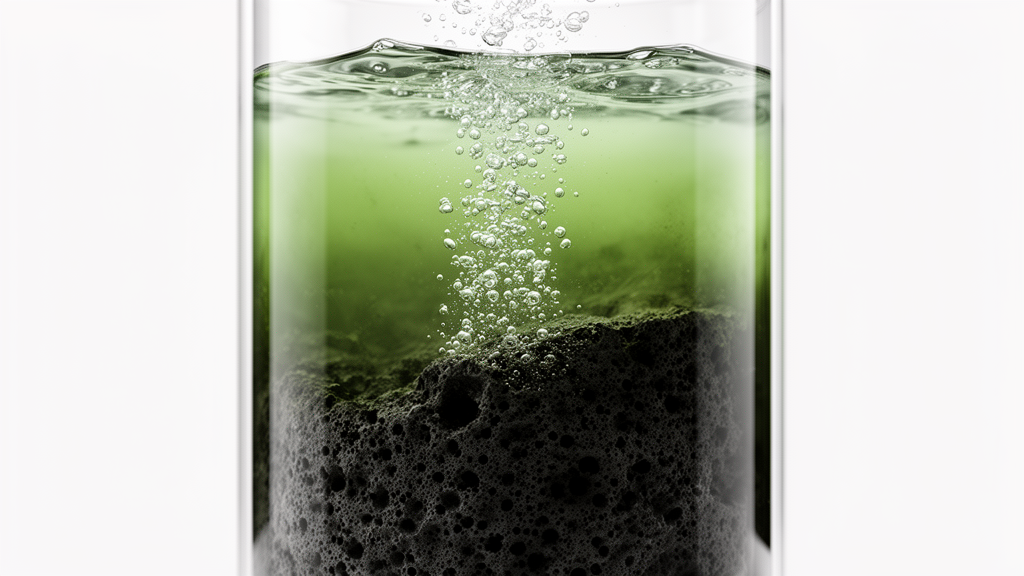
When paired with an anode, the system splits water molecules at the anode to produce oxygen in situ. This internally generated oxygen is then transported to the cathode, where it is captured by the oxygen vacancies and reduced to hydrogen peroxide. The hydrogen peroxide is subsequently activated at adjacent cobalt-nitrogen sites to produce singlet oxygen, a highly reactive species capable of destroying organic pollutants such as antibiotics. Because the oxygen is produced and consumed within the same electrochemical cell, the entire purification process operates without the blowers and air-pumping equipment that typically dominate operational budgets.
The performance gains were substantial across multiple metrics. Beyond the 98% sulfamethazine removal, the self-aeration system eliminated more than 90% of total organic carbon, indicating near-complete mineralization of pollutants into harmless end products. By contrast, the externally aerated system mineralized less than 4% of the total organic carbon under the same conditions, leaving the bulk of the organic contamination intact.
The economic analysis proved equally striking. A comprehensive techno-economic assessment calculated a treatment cost of $0.25 per cubic meter of wastewater, representing a 95 to 98% reduction relative to conventional advanced oxidation processes. The savings stem primarily from eliminating energy-hungry aeration blowers and the continuous supply of chemical reagents that conventional systems require. A companion carbon footprint analysis found an 82% reduction in indirect carbon emissions, reflecting the reduced energy and chemical demands of the process.
The system’s practical viability was tested on real-world samples rather than only laboratory solutions. In trials with raw hospital wastewater—a matrix containing complex mixtures of pharmaceuticals and other contaminants—the system achieved 92% removal of total organic carbon and met official discharge standards. This performance under realistic conditions suggests the technology could be deployed in settings where antibiotic residues pose persistent risks to downstream ecosystems and public health.
The broader significance of the work lies in its catalyst design philosophy. By decoupling oxygen capture from electron donation at the interface, the researchers sidestepped a trade-off that has constrained electrocatalyst performance in advanced oxidation processes. The authors suggest this spatial decoupling strategy could be extended to other critical electrochemical reactions, including carbon dioxide and nitrogen reduction, where similar conflicts between adsorption and electron transfer currently limit efficiency.
Persistent antibiotic contamination of water sources remains a growing threat to global health and ecosystems, driving demand for purification methods that avoid both high operational costs and continuous chemical inputs. The study, an experimental study published in Science Bulletin with DOI 10.1016/j.scib.2026.08.071, presents the self-aeration approach as a route toward addressing those barriers. As with any laboratory and pilot-scale demonstration, further work would be needed to confirm long-term stability and scalability across diverse wastewater treatment contexts, but the reported combination of near-complete mineralization, real-world performance, and dramatic cost reduction marks a notable advance in electrocatalytic water treatment.
Subject of Research: A self-aerating decoupled-interface electrocatalyst for antibiotic removal and mineralization in wastewater treatment
Article Title: Self-aeration system with decoupled interface purifies water, slashing energy costs by 95%
Article References: Self-aeration system with decoupled interface purifies water, slashing energy costs by 95%. Original publication (Bibliographic details unavailable.)
Image Credits: AI Generated
DOI: Not provided
Keywords: water purification, electrocatalysis, advanced oxidation processes, singlet oxygen, antibiotic contamination, oxygen vacancies, cobalt-nitrogen carbon catalyst, wastewater treatment cost, techno-economic analysis, hospital wastewater, total organic carbon, Science Bulletin
News Source: Bethany Barker. (October 26, 2026). Self-aerating catalyst purifies water while cutting treatment costs by 95%. Scienmag.