Engineers at the University of Michigan Transportation Research Institute are developing a crash-prevention system for intersections with $5.66 million in funding from the U.S. Department of Transportation. The project, called Safety Actions for Everyone at Traffic Intersections, or SAFETI, builds on roadside perception technology that detects vehicles, pedestrians and cyclists on roads and sidewalks. According to figures cited by the U.S. DOT, roughly one quarter of traffic fatalities and about one half of all traffic injuries in the United States are attributed to intersections, making them one of the most persistent safety challenges on American roads. The team’s stated goal is to predict conflicts in real time and respond through warnings, in-pavement lights or signal changes, while also learning where recurring risks concentrate so that agencies can address them permanently.
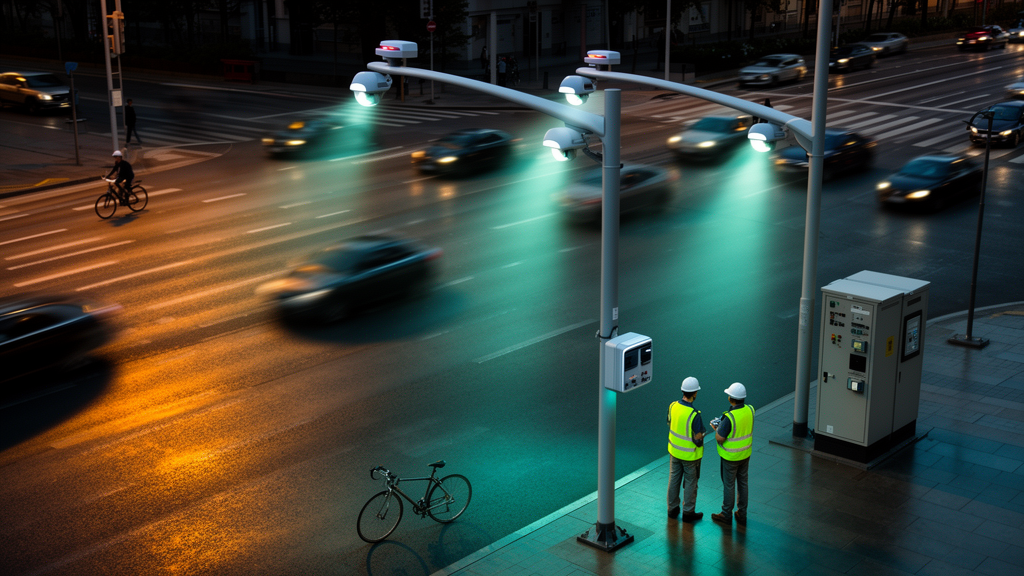
At the core of the effort is MSight, an open-source roadside perception framework developed in-house at University of Michigan Engineering. The researchers plan to advance MSight from a perception system into a near-miss prediction system capable of anticipating collisions before they happen. The design draws on infrastructure and technology already in place in many cities: traffic signal controls, vehicle-to-everything communication, onboard sensing equipment, city traffic cameras, smartphone alerts and in-vehicle dashboards. In a scenario described by the project team, cameras posted at an intersection and a vehicle’s LiDAR sensors detect a distracted pedestrian approaching the edge of the sidewalk without slowing down. Almost simultaneously, the driver could receive a dashboard warning or see lights embedded in the pavement activate, while the pedestrian might receive a cellphone notification similar in urgency to a severe weather alert. The same architecture could also address vehicle-to-vehicle conflicts: when a vehicle appears likely to run a red light, the system could alert all approaching drivers, and the traffic control system could respond by extending the green light for that approach while holding cross traffic at a red.
Because SAFETI is part of an open-source project, the underlying technology is intended to be made available for anyone to use and adapt, a design choice the researchers hope will support wide adoption beyond the initial deployment sites. Privacy protections are built into the data pipeline. The sensor and camera data collected by the system does not allow individual vehicles to be identified. In Ann Arbor, the traffic cameras use fisheye lenses, which cannot resolve specific license plates or facial details, and SAFETI’s algorithm classifies objects only as a vehicle, bicycle or pedestrian. In cities that use pinhole cameras, the view can be blurred by those accessing the dashboard.
The project will unfold over three and a half years in two phases. During the first phase, roughly 18 months, engineers will prototype the MSight system using Mcity’s physical and virtual testing environments, with in-vehicle integration provided by partners General Motors, Volkswagen and Ford. A central focus of this phase is the human element of intersection safety: the research team will evaluate not only whether SAFETI can detect and predict conflicts, but also whether drivers and people outside the vehicle can recognize, understand and respond appropriately to the system’s warnings and interventions. At the Mcity Test Facility, pedestrians and cyclists will be represented by robots, allowing the team to study how the system performs for human drivers without placing people at risk. The second phase will move the technology into the real world, deploying MSight at four intersections in Ann Arbor. If that deployment succeeds, the researchers say the system could eventually be rolled out nationwide.
The award brings together a broad coalition of public and private partners. Alongside General Motors, Volkswagen and Ford, U-M’s private sector collaborators include Ouster, a sensing company. Public sector partners include the Michigan Department of Transportation, the City of Ann Arbor and the Southeast Michigan Council of Governments. The combination of automaker involvement, municipal deployment sites and state transportation oversight reflects the multi-layered nature of the challenge: preventing a single intersection crash may require a vehicle’s onboard sensors, roadside cameras, signal timing logic and a pedestrian’s phone to act on the same prediction within seconds. The researchers emphasize that the system’s value lies in both immediate intervention, warning road users of a developing conflict in the moment, and longer-term insight, using accumulated near-miss data to identify intersections where engineering changes could eliminate recurring hazards. As the project moves from Mcity’s controlled test environments to live Ann Arbor streets, its performance in detecting conflicts, delivering understandable warnings and avoiding crashes will determine whether the technology graduates from a university testbed to a scalable national deployment.
Subject of Research: Development of an intersection crash-prevention system using roadside perception, V2X communication and near-miss prediction
Article Title: U-M to improve pedestrian, vehicle safety at intersections with $5.66M from USDOT
Article References: U-M to improve pedestrian, vehicle safety at intersections with $5.66M from USDOT. Original publication (Bibliographic details unavailable.)
Image Credits: AI Generated
DOI: Not provided
Keywords: intersection safety, SAFETI, MSight, University of Michigan, U.S. Department of Transportation, LiDAR, vehicle-to-everything, near-miss prediction, open-source technology, Ann Arbor, Mcity, traffic fatalities
News Source: Denise Maddox. (October 26, 2026). University of Michigan Wins $5.66 Million to Build Crash-Preventing Smart Intersections. Scienmag.