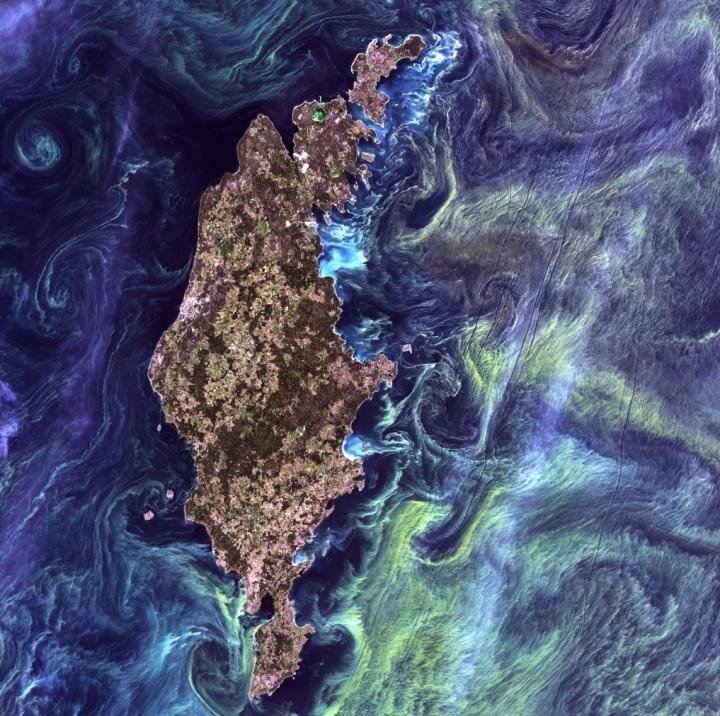
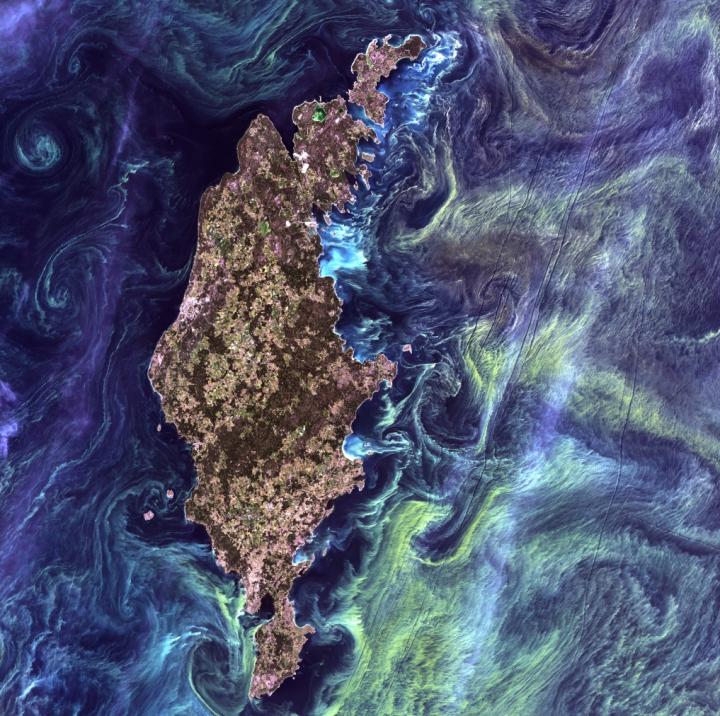
Credit: Credit: NASA via Flickr
Researchers have found a way to chart changes in the speed of deep-ocean currents using the most modest of materials – mud. The approach, reported in the journal Deep-Sea Research Part I, could provide scientists with a better basis for understanding the behaviour of ancient ocean currents and, in an age of mounting apprehension over climate change, could help them to judge what level of fluctuation can be considered cause for concern.
Acting like giant conveyor belts, ocean currents transport water warmed by the sun's powerful rays over the equator towards the poles. As the water cools and releases its warmth into the atmosphere, areas in the North and South benefit from the warm air. In turn, currents regulate temperatures along the equator by offering an escape route for some of the heat.
The speed of ocean currents is hugely variable, but scientists are increasingly concerned that man-made climate change is altering their natural flow. If rising sea temperatures and increased levels of fresh water from melting ice caps slow down currents, this could wreak havoc on global weather systems and impede the vital role they play in counteracting the uneven distribution of solar radiation that reaches the Earth's surface.
In order to fully understand what is happening to currents today and whether it is extraordinary, researchers need to build a picture of how they have behaved over time.
Modern current meters made from steel and plastic have only been widely used to track currents far beneath the surface since the 1960s, so to get a sense of how currents naturally fluctuate over long periods, scientists rely on proxies – such as changes over time in the natural radioactivity of particles.
Now, new research led by Professor Nick McCave, Fellow at St John's College and Emeritus Professor at the Department of Earth Sciences, University of Cambridge, has found a way to use the size of mud particles deposited on the ocean floor to measure changes in the speed at which ocean currents flow, offering another means for scientists to identify patterns in ancient current speeds.
Currents pick up and carry mud particles, dropping out larger grains as they slow down. Over time, a record of the size of particles deposited on the ocean floor is built up in layers of sediment.
For the study, McCave visited various deep sea mud deposits near the east coast of the United States, Iceland and Portugal where there have been modern current meters in operation. From research ships the researchers sent instruments down to depths of up to four kilometres beneath the water and extracted "cores", or samples of sediment, from the ocean floor.
The average rate of sedimentation in the world's oceans is about two to three centimetres per thousand years, but in the mounds of mud McCave was investigating up to 50 centimetres is deposited per thousand years, providing the researchers with a cross section of sediment layers with a much more clearly-defined picture of how strata of mud particles correspond with periods of time.
McCave obtained the records from the current meters and examined them for an average flow speed. Then, from the cores, he took the top two centimetres of sediment and looked for tiny particles measuring over 10 microns, where one micron is equal to one millionth of a meter.
By comparing the size of the mud grains to the data from the current meters, McCave was able to calibrate how the size of mud particles relates to the current speed.
McCave said: "While the calibration was not precise enough to say what the exact current speed was during a specific year of history, it can give an accurate measurement of how much current speed has changed between two points in time – for example between an ice age and a warm period like the present. That's about 20,000 years. But the variability of Atlantic current flow since the early 1800s can also be tracked and shown to be closely related to temperature changes.
"Using mud as a current meter gives us another means to look at long-term trends and could result in improved computer modelling that better incorporates deep ocean flow. We know that ocean current speeds can vary enormously, but having data that shows patterns going further back in time than the last 50 years could tell us what level of fluctuation should set off alarm bells."
###
Relation of sortable silt grain-size to deep-sea current speeds: Calibration of the 'Mud Current Meter' is available in full via: http://www.sciencedirect.com/science/article/pii/S0967063717300754
Media Contact
Shelley Hughes
[email protected]
44-012-233-38711
@stjohnscam
http://www.joh.cam.ac.uk/
Related Journal Article
http://dx.doi.org/10.1016/j.dsr.2017.07.003