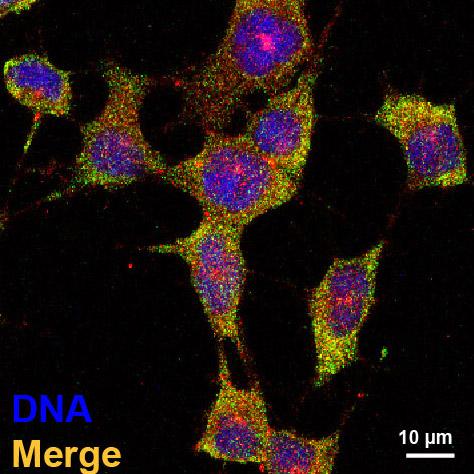
Credit: Yingwei Mao lab, Penn State University
University Park, PA — A gene associated with the risk of schizophrenia regulates critical components of early brain development, according to a new study led by researchers from Penn State University. The gene is involved in the translation of proteins from RNA and in the proliferation and migration of neurons in the brain. Understanding the function of this gene — described this month in journal Molecular Psychiatry — could lead to more effective treatments for schizophrenia.
"A recent study identified over 100 genes associated with schizophrenia risk, but their functions are largely unknown," said Yingwei Mao, associate professor of biology at Penn State and lead author of the study. "We investigated one of these genes that is known to be significantly associated with schizophrenia: ZNF804A. In this study, we provide molecular evidence showing that ZNF804A could contribute to psychiatric disorders like schizophrenia."
Schizophrenia is a severe mental disorder that affects approximately 1 percent of the world's population. Treatments tend to focus on alleviating symptoms, which include delusions and hallucinations, rather than addressing the underlying causes. Like many human diseases, schizophrenia is complex, and no single genetic or environmental factor has been identified as the cause of the disease.
"We found that ZNF804A affects brain structure and function during early fetal development," said Mao. "This supports the idea that changes early in neurodevelopment can produce effects that may not be triggered until adulthood. Although schizophrenia symptoms typically appear in late adolescence or early adulthood, genetic mutations affecting early neurodevelopment could embed risk for future behavioral changes."
The research team identified genes that interact with ZNF804A, which include 9 genes involved in controlling the translation of RNA to proteins. This suggests an influential role of ZNF804A in this important decoding process. Using a mouse model, the team also demonstrated that two processes during neurodevelopment are regulated by the gene: proliferation — the replication of neuronal stem cells that have the potential to become multiple different kinds of cells, including neurons — and migration — the movement of neurons to specific locations in the brain during development.
"ZNF804A is critical to regulating proliferation and migration," said Mao. "Disturbances to these processes may cause neuronal stem cells to develop into different types of cells or may cause neurons to migrate to different locations in the brain, changing neuronal circuitry and potentially leading to behavioral disorders like schizophrenia."
ZNF804A also interacts with and modulates expression of other genes known to be associated with schizophrenia. "Determining the role of ZNF804A is the first step in understanding how schizophrenia-associated genes contribute to abnormal brain development," said Mao. "Understanding how these genes interact to contribute to the development of schizophrenia may allow us to identify the general pathway of the disease, potentially providing a better target for treatment."
###
In addition to Mao, the research team includes Yijing Zhou, Fengping Dong, Ming Li, and Long Liu at Penn State; Thomas Lanz, Veronica Reinhart, and Hualin Xi at Pfizer; and Jizhong Zou at the National Institute of Health. This research was funded by the National Institutes of Health and supported by the Brain & Behavior Research Foundation, the American Heart Association, the National University of Defense Technology, and the Huck Institutes of the Life Sciences.
CONTACTS:
Yingwei Mao: [email protected], (814) 867-4739
Barbara K. Kennedy (PIO): [email protected], (814) 863-4682
Media Contact
Barbara K. Kennedy
[email protected]
814-863-4682
@penn_state
http://live.psu.edu
Original Source
http://science.psu.edu/news-and-events/2017-news/Mao9-2017 http://dx.doi.org/10.1038/mp.2017.166