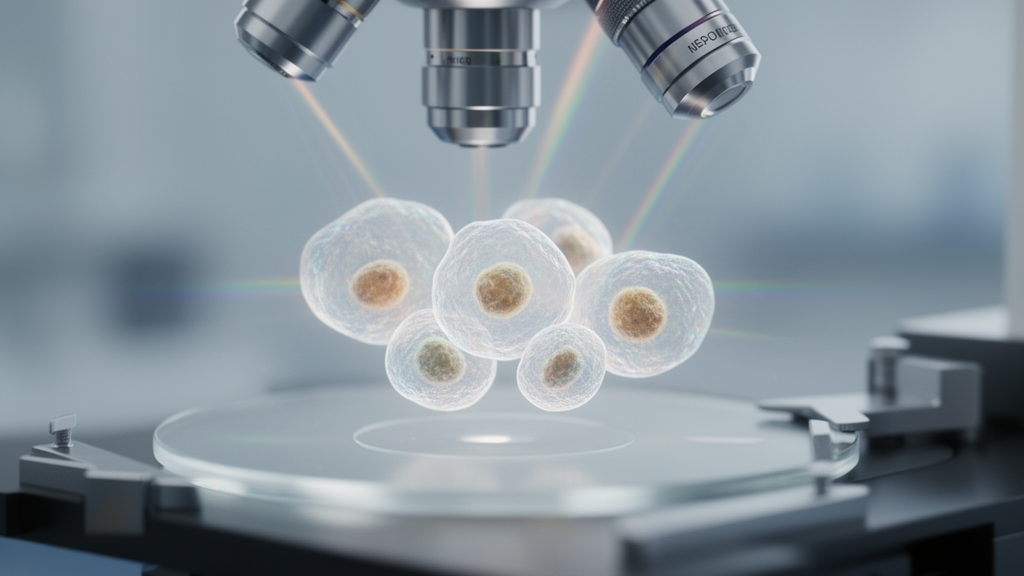
A machine learning system identified cancerous mesothelioma cells from reactive mesothelial cells with about 91% accuracy in patient-based validation by analyzing how the cells scatter white light. The peer-reviewed experimental study, led by Assistant Professor Yuka Tsuri at Nara Institute of Science and Technology and published in Scientific Reports on August 3, 2026, demonstrates a proof-of-concept approach for augmenting cytology with optical measurements. It does not establish performance in routine clinical diagnosis, and the authors describe the additional cancer-cell applications as showing potential rather than a uniform diagnostic result.
Cytology tests examine cells collected from bodily fluids for signs of malignancy, including enlarged nuclei and abnormal cell shapes. Pathologists interpret stained samples using microscopes, and the outcome can depend on the skill of the person performing the assessment. In some cases, cancerous and normal cells can appear identical under conventional microscopy even though differences exist at scales smaller than those microscopes resolve. Such changes may involve nanometric structures, including actin filaments and microtubules that form the internal cellular scaffolding, potentially altering how a cell scatters light.
For the main experiment, researchers examined cytology specimens containing mesothelioma cells and reactive mesothelial cells, which can have very similar appearances. They used dark-field microscopy, a technique that captures light scattered by an object rather than light absorbed while passing through it. White light with wavelengths between 420 and 720 nanometers was used to illuminate the specimens, and the researchers recorded the resulting scattered-light spectra. The spectral data were first condensed with principal component analysis and then passed to a support vector machine classifier that distinguished between the cell types. In patient-based validation after training, the pipeline separated mesothelioma cells from reactive mesothelial cells with approximately 91% accuracy.
The system also showed potential for distinguishing gastric and urothelial cancer cells and several types of lung and thoracic cancer, although its performance varied with tumor type and validation approach. Those exploratory results should not be read as evidence of the same performance across all cancers or as proof that the method improves diagnoses in routine practice. The researchers’ interpretation was that light-scattering spectra contain information at the submicron scale and can be sensitive to differences between cell types. The experiment therefore supports the technical feasibility of combining dark-field spectroscopy, dimensionality reduction and machine learning in a cytology workflow.
Assistant Professor Tsuri said that integrating the spectroscopic system with a microscope could serve as an aid to pathologists and potentially improve diagnostic accuracy. The team presented the approach as a complement to pathologists’ skill and judgment rather than a replacement for them. Researchers are working to optimize the optical settings and operating protocol and are applying more advanced machine-learning methods to improve diagnostic accuracy further. The present study remains an experimental proof of concept: the reported 91% result concerns mesothelioma versus reactive mesothelial cells in patient-based validation, while performance in other tumor groups was variable. Its broader significance lies in showing that subtle differences in cellular light scattering can be converted into spectral features for computational classification, providing a basis for subsequent evaluation of the method.
Subject of Research: Machine learning analysis of white-light scattering spectra for identifying cancerous cells in cytology specimens
Article Title: A machine learning system that identifies cancer cells based on how they scatter light
Article References: A machine learning system that identifies cancer cells based on how they scatter light. Original publication (Bibliographic details unavailable.)
Image Credits: AI Generated
DOI: Not provided
Keywords: machine learning, cancer identification, cytology, dark-field microscopy, light scattering, mesothelioma, spectroscopy, principal component analysis, support vector machine, pathology, machine, learning
News Source: Nathaniel Bowman. (October 26, 2026). AI identifies mesothelioma cells by scattered-light spectra. Scienmag.