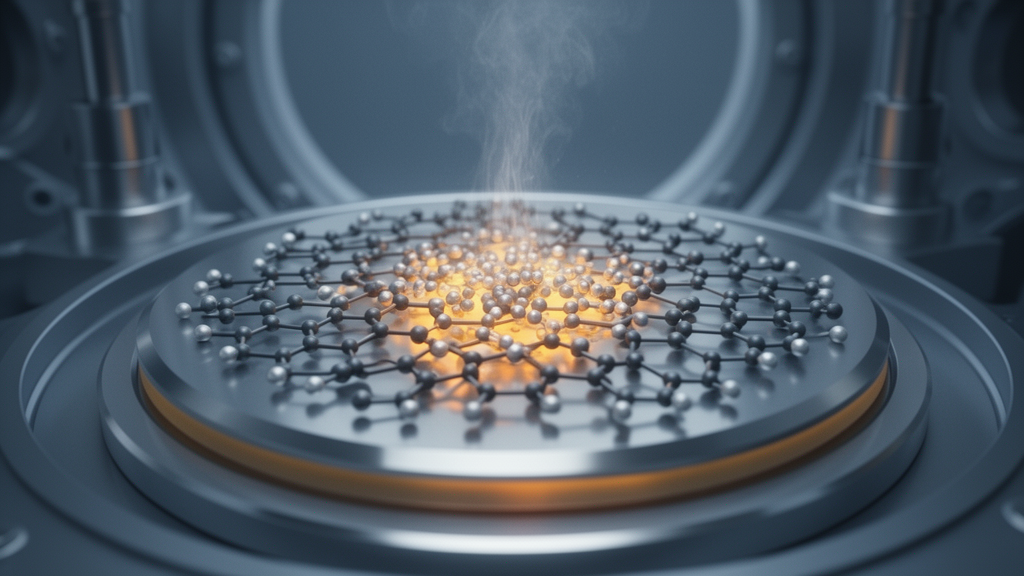
A peer-reviewed study in Nature Materials reports that a chemical doping method generated up to 100 times more mobile electrical charges in the organic semiconductor P3HT than conventional doping. The strategy, called degradation-assisted doping, or DAD, relies on tris(pentafluorophenyl)borane (BCF), a Lewis acid that breaks down after transferring an electron to P3HT. Its decomposition removes the original dopant from the reaction while allowing additional electrons to be transferred.
Experiments on the P3HT-BCF system also found higher conductivity with BCF than with other commonly used dopants. Organic semiconductors are carbon-based materials that conduct electricity and may be used to make flexible, lightweight and potentially low-cost electronic devices. Their conductivity can be increased through doping, a process that adds mobile electrical charges to the material.
Conventional chemical dopants eventually reach a limit in the number of charges they can supply, restricting the achievable charge concentration and conductivity. The new method was investigated by researchers at Concordia University, the Institut national de la recherche scientifique (INRS) and York University. To examine how degradation-assisted doping works, the team combined laboratory experiments with computer simulations.
The researchers studied P3HT, the organic semiconductor, and BCF, the chemical dopant. They used nuclear magnetic resonance, optical spectroscopy, electron paramagnetic resonance and calorimetry to follow the system after BCF transferred an electron to P3HT. Computational modelling was also used to investigate the chemical reactions involved.
Together, these approaches showed that BCF breaks down after accepting an electron, with its reaction products leaving the process and permitting further electron transfer to occur. In the reported P3HT system, degradation-assisted doping produced mobile-charge concentrations up to 100 times greater than those obtained through conventional doping. BCF also yielded higher conductivity than other commonly tested dopants.
The findings therefore demonstrate a substantial increase in charge concentration and conductivity in the studied materials combination. The experiments do not establish how broadly the mechanism will work across other semiconductors, dopants or device structures, nor do they show the performance of completed commercial components. The study was jointly led by Melissa Berteau-Rainville of INRS and Ingo Salzmann, an associate professor in Concordia University’s Departments of Physics and Chemistry and Biochemistry.
Berteau-Rainville conducted her doctoral research under the co-supervision of Salzmann and Emanuele Orgiu, a professor at INRS. The work also involved Thomas Baumgartner, Christopher Caputo and Taylor Cosby at York University, along with additional researchers at INRS. The authors describe the results as establishing degradation-assisted doping as a strategy for improving organic-semiconductor performance, with possible relevance to flexible electronics, optoelectronic devices and thermoelectric technologies.
Those applications remain prospective: the reported evidence concerns a semiconductor-dopant system rather than finished devices. The paper, “Degradation-assisted doping of organic semiconductors enabled by Lewis acids,” was published in Nature Materials on 14 August 2026. The authors declared no competing interests.
Subject of Research: Degradation-assisted doping of the P3HT organic semiconductor using BCF
Article Title: New doping method could boost the performance of organic semiconductors
Article References: New doping method could boost the performance of organic semiconductors. Original publication (Bibliographic details unavailable.)
Image Credits: AI Generated
DOI: Not provided
Keywords: organic semiconductors, degradation-assisted doping, P3HT, BCF, Lewis acids, mobile charges, electrical conductivity, flexible electronics, optoelectronics, thermoelectric materials, doping, method
News Source: Bethany Barker. (October 26, 2026). Research report: New doping method could boost the performance of organic semiconductors. Scienmag.