A standardized Global Alliance for Musculoskeletal Health survey module was operationally feasible in a hospital-adjacent adult sample in Kerala, India, where 1,229 of 1,300 invited people enrolled and 1,192 datasets were included in the analysis, according to a cross-sectional study conducted from November 2023 through October 2024. Participation reached 94.5%, overall missingness was 3.0%, and the survey was administered with direct electronic data entry, supporting the practical use of the module for structured musculoskeletal surveillance in this setting. The study also generated preliminary estimates of four-week musculoskeletal pain, but its non-probability hospital-adjacent sampling means the results are not population-representative for Kerala or India.
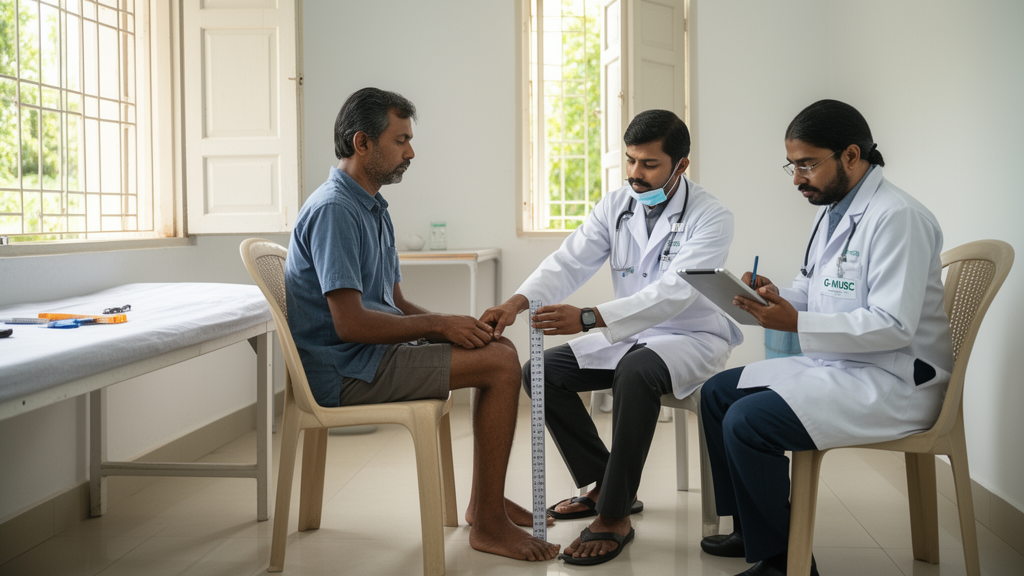
Adults aged 18 years or older were recruited through hospital-adjacent convenience sampling. Trained physicians specializing in physical medicine and rehabilitation and a research coordinator administered the module in an interviewer-assisted format. Questions were verbally explained and translated into Malayalam when needed, while responses were recorded directly in a secure REDCap form through a tablet or mobile phone. The instrument captured four-week occurrence of pain in the low back, neck, hip or knee, and upper limb, together with associated activity limitation. Its operational feasibility was evaluated alongside descriptive prevalence estimates and 95% confidence intervals.
Neck pain was the most frequently reported of the four pain outcomes in the analyzed sample, occurring in 16.8% of participants within the preceding four weeks (95% CI, 14.8%–19.0%). Low back pain affected 15.4% (95% CI, 13.4%–17.5%), hip or knee pain affected 12.8% (95% CI, 11.0%–14.8%), and upper-limb pain affected 10.5% (95% CI, 8.9%–12.4%). These figures describe the hospital-adjacent study sample and were not designed as national prevalence estimates. They provide an initial standardized picture of musculoskeletal pain across several anatomical regions in Kerala.
Activity-limiting pain was less frequent than pain itself. The proportion reporting activity limitation associated with musculoskeletal pain ranged from 1.6% for upper-limb pain to 4.8% for neck pain. In adjusted analyses, female participants had higher odds of activity-limiting musculoskeletal pain than male participants, with an adjusted odds ratio of 1.86 (95% CI, 1.24–2.78; p = 0.002). Participants aged 60 or older also had higher odds than those aged 18–29, with an adjusted odds ratio of 2.84 (95% CI, 1.20–6.76; p = 0.018). These are adjusted associations within this observational sample and do not show that sex or age caused the reported differences.
The study’s primary focus was operational feasibility rather than population prevalence. Its high participation, inclusion of 1,192 analyzed datasets, low missingness and brief administration support implementation of the G-MUSC module in a healthcare-adjacent setting. At the same time, convenience sampling restricts how broadly the estimates can be generalized. The authors call for larger community-based and nationally representative studies to establish robust population estimates and assess whether standardized musculoskeletal surveillance can be integrated into non-communicable disease monitoring systems in India. For now, the findings show that a common instrument can be applied in a hospital-adjacent adult population while producing region-specific pain estimates and measures of activity limitation, with the extent of its value in wider surveillance still to be tested.
Subject of Research: Operational feasibility and preliminary musculoskeletal pain estimates from a G-MUSC survey of adults in Kerala, India
Article Title: Musculoskeletal surveillance in India using the G-MUSC survey module: a feasibility study
Article References: Devaraj Sushama, A. R., Fernandez, M., Dane, A., Dane, D., de Luca, K., & Sankaran, R. (2026). Musculoskeletal surveillance in India using the G-MUSC survey module: a feasibility study. BMC Public Health. https://doi.org/10.1186/s12889-026-29884-8
Image Credits: AI Generated
DOI: 10.1186/s12889-026-29884-8
Keywords: G-MUSC survey, musculoskeletal pain, activity limitation, public health surveillance, Kerala, India, cross-sectional study, neck pain, low back pain, noncommunicable diseases, Musculoskeletal, surveillance
News Source: Phoebe Ingram. (October 26, 2026). G-MUSC survey supports standardized musculoskeletal surveillance in Kerala. Scienmag.