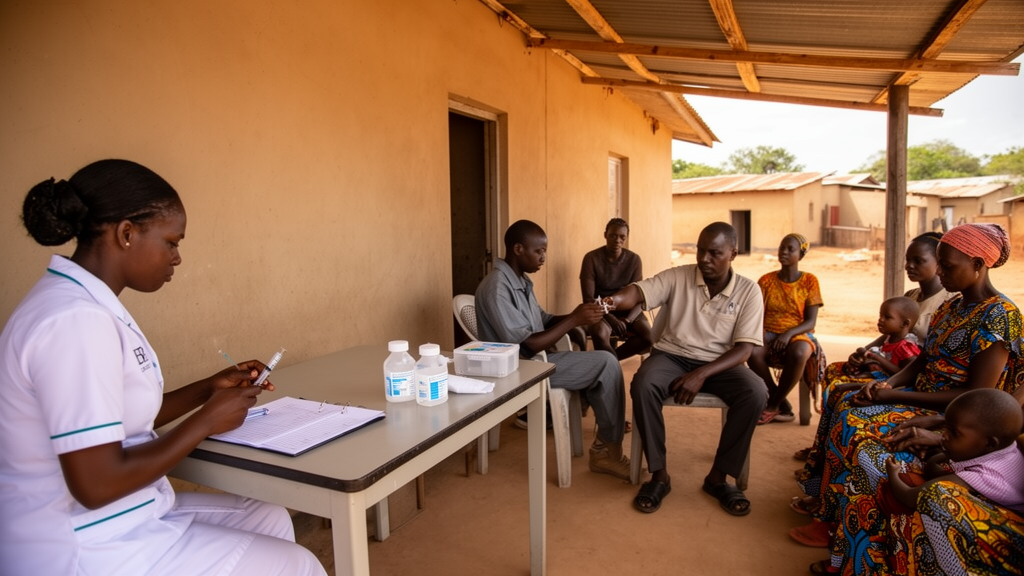
A pooled analysis of Demographic and Health Survey data from eight sub-Saharan African countries found that only 38.3% of children aged 5–35 months had received the full hepatitis B vaccination schedule, while 46.2% were partially vaccinated and 15.6% had received no doses. Just 49.7% had a recorded birth dose, and coverage varied sharply among countries, ranging from 3.4% for full vaccination in Burundi and 11.4% in Sierra Leone to 89.7% in The Gambia. Nigeria had the largest proportion of unvaccinated children, at 35.3%.
The researchers analyzed the most recent surveys conducted from 2016 through 2024 in countries whose records included all four relevant vaccination points: the birth dose and three doses of pentavalent vaccine containing the hepatitis B antigen. The sample comprised 49,075 children nested within 41,476 households and 5,580 communities, with a survey-weighted sample of 48,124 children. Because vaccination was measured as an ordered outcome—not vaccinated, partially vaccinated or fully vaccinated—the study used three-level random-intercept ordinal logistic regression to examine how individual, household and community characteristics were associated with progression through the vaccination schedule. The model included country fixed effects and accounted for survey weights, strata and clusters.
Several factors were associated with a higher vaccination category after adjustment. Children whose vaccination was delivered through a health facility had nearly three times the odds of being in a higher category than children whose doses were not facility-based (adjusted odds ratio, aOR, 2.83; 95% confidence interval, 2.66–3.02). Higher maternal education was also strongly associated with uptake: children of mothers with higher education had 3.20 times the adjusted odds of a higher vaccination category compared with children whose mothers had no education. Greater household wealth showed a similar gradient, with the richest households having 1.60 times the adjusted odds of the poorest households. Media exposure (aOR 1.29), maternal employment (aOR 1.27), older maternal age and older child age were also associated with higher vaccination status.
Conversely, rural residence was associated with a lower vaccination category (aOR 0.78; 95% CI, 0.70–0.86), as was a preceding birth interval of less than 24 months (aOR 0.86; 95% CI, 0.79–0.94). Health insurance coverage was not associated with vaccination once country was accounted for (aOR 0.98; 95% CI, 0.89–1.07). The country differences appeared to mirror national birth-dose policies: the highest coverage occurred in The Gambia, while Burundi and Sierra Leone, where the birth dose was not part of the national schedule, recorded the lowest full-vaccination levels. The study did not establish that any individual factor caused the observed differences, and its cross-sectional design could not determine whether the associations reflected changes in vaccination over time.
Community context was especially prominent. Communities accounted for 32% of the residual variance in vaccination status, with households accounting for a further 3%. A multilevel model fitted substantially better than a single-level model (likelihood-ratio chi-square, 5978.93; p<0.001), indicating that clustering within households and communities contained important information about vaccination uptake. The researchers tested the proportional-odds assumption and also fitted design-based, threshold-specific and country-stratified models as sensitivity analyses. Their findings suggest that strategies reaching children outside facilities, supporting less-advantaged mothers and reducing gaps in lagging communities may be relevant to improving hepatitis B vaccination coverage, but the observational evidence does not demonstrate that those strategies would produce better outcomes. The results also apply only to the eight countries and survey periods included, rather than establishing trends across sub-Saharan Africa as a whole.
Subject of Research: Multilevel analysis of childhood hepatitis B vaccination coverage in eight sub-Saharan African countries
Article Title: Hepatitis B vaccination coverage and factors associated with higher uptake among children aged 5–35 months in eight selected sub-Saharan African countries: a multilevel ordinal logistic regression analysis
Article References: Ochagu, V. A., Ekholuenetale, M., Barrow, A., & Arora, A. (2026). Hepatitis B vaccination coverage and factors associated with higher uptake among children aged 5–35 months in eight selected sub-Saharan African countries: a multilevel ordinal logistic regression analysis. BMC Public Health. https://doi.org/10.1186/s12889-026-30010-x
Image Credits: AI Generated
DOI: 10.1186/s12889-026-30010-x
Keywords: hepatitis B, childhood vaccination, birth dose, sub-Saharan Africa, vaccine coverage, multilevel analysis, maternal education, health facilities, DHS data, public health, Hepatitis, vaccination
News Source: Kristina Jarvis. (October 26, 2026). Hepatitis B vaccination gaps cluster by community in eight African countries. Scienmag.