• HOME
  • NEWS
  • EXPLORE
    • CAREER
      • Companies
      • Jobs
    • EVENTS
    • iGEM
      • News
      • Team
    • PHOTOS
    • VIDEO
    • WIKI
  • BLOG
  • COMMUNITY
    • FACEBOOK
    • INSTAGRAM
    • TWITTER
Monday, October 26, 2026
BIOENGINEER.ORG
No Result
View All Result
  • Login
  • HOME
  • NEWS
  • EXPLORE
    • CAREER
      • Companies
      • Jobs
        • Lecturer
        • PhD Studentship
        • Postdoc
        • Research Assistant
    • EVENTS
    • iGEM
      • News
      • Team
    • PHOTOS
    • VIDEO
    • WIKI
  • BLOG
  • COMMUNITY
    • FACEBOOK
    • INSTAGRAM
    • TWITTER
No Result
View All Result
Bioengineer.org
No Result
View All Result
Home NEWS Science News Technology

Clay Strength With Polyester Resin Depends Strongly on Initial Moisture

by
October 26, 2026
in Technology
Reading Time: 2 mins read
0
Clay Strength With Polyester Resin Depends Strongly on Initial Moisture

Clay Strength With Polyester Resin Depends Strongly on Initial Moisture

Share on FacebookShare on TwitterShare on LinkedinShare on RedditShare on Telegram

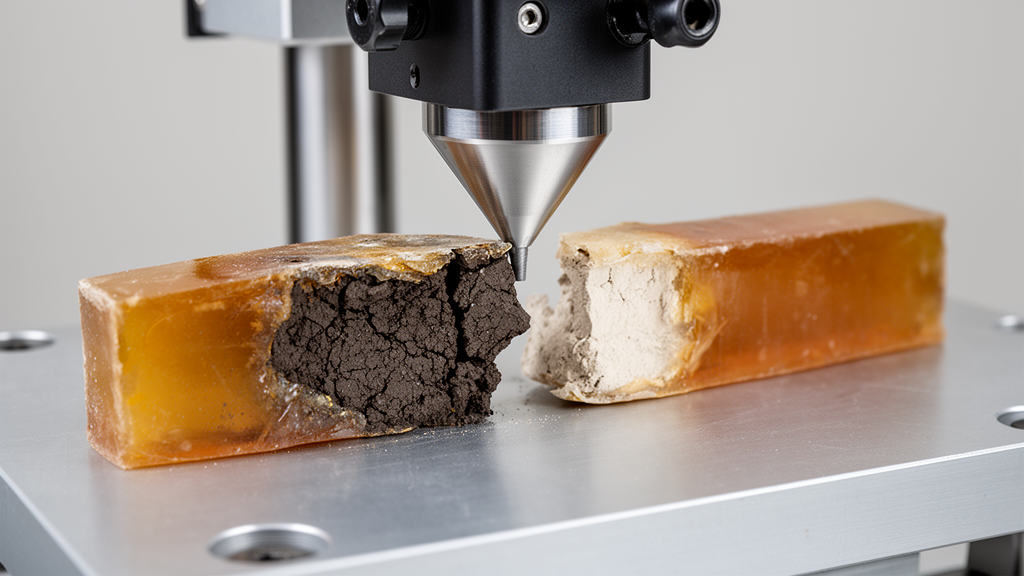
Adding unsaturated polyester resin to low-plasticity clay can substantially increase its unconfined compressive strength, but the outcome depends strongly on the clay’s starting water content. In tests reported in Scientific Reports, specimens containing 20% resin achieved 9.88 megapascals after 14 days of curing when prepared at 0.5 times the liquid limit. By contrast, specimens prepared at the liquid limit reached their maximum strength of 5.52 megapascals with 10% resin, after which additional resin was associated with lower compressive strength.

The researchers prepared clay at two initial water contents, 0.5 LL and LL, and treated the samples with resin contents ranging from 0% to 20%. They then measured unconfined compressive strength after 14 days and used scanning electron microscopy with energy-dispersive X-ray spectroscopy, X-ray diffraction and Fourier-transform infrared spectroscopy to examine selected specimens. The results show that moisture did more than alter the amount of strength gained: it changed the dosage-response pattern and the organization of the material at the microscopic scale.

Scanning electron microscopy and elemental analysis indicated that the drier clay developed polymer-rich domains and a more integrated fabric. Samples prepared at the liquid limit had a more heterogeneous microstructure, which was consistent with their lower peak strength and the decline observed when resin content rose beyond 10%. The evidence therefore associates moisture-dependent differences in polymer distribution and binding with the mechanical performance of the tested clay–polymer system, rather than establishing a simple rule that more resin always produces stronger material.

Mineralogical and chemical analyses did not indicate a distinct new crystalline reaction product. X-ray diffraction patterns did not show evidence of such products, while infrared spectroscopy confirmed a polyester-related ester carbonyl response near 1,720 reciprocal centimeters. Taken together, the observations suggest that the strength changes were linked primarily to how effectively resin-associated binding formed within the clay, not to the creation of a new crystalline phase. The study was limited to one low-plasticity clay, two initial water contents, a 0–20% resin range and 14-day curing, so the results do not establish how the system would perform under other soils, moisture conditions, formulations or longer curing periods.

Subject of Research: Effects of initial moisture and polyester resin dosage on the strength and microstructure of stabilized low-plasticity clay

Article Title: Moisture-dependent strength and microstructural response of clay stabilized with unsaturated polyester resin

Article References: Yurtcan, U. E. (2026). Moisture-dependent strength and microstructural response of clay stabilized with unsaturated polyester resin. Scientific Reports. https://doi.org/10.1038/s41598-026-77420-w

Image Credits: AI Generated

DOI: 10.1038/s41598-026-77420-w

Keywords: clay stabilization, unsaturated polyester resin, unconfined compressive strength, soil moisture, microstructure, polymer binding, SEM–EDX, X-ray diffraction, FTIR spectroscopy, Moisture-dependent, strength, microstructural

News Source: Denise Maddox. (October 26, 2026). Clay Strength With Polyester Resin Depends Strongly on Initial Moisture. Scienmag.

Tags: clay stabilizationFTIR spectroscopyMicrostructuralmicrostructureMoisture-dependentpolymer bindingSEM-EDXsoil moisturestrengthunconfined compressive strengthunsaturated polyester resinX-ray diffraction
Share12Tweet7Share2ShareShareShare1

Related Posts

Career support linked to student well-being, but moderation evidence remains exploratory

Career support linked to student well-being, but moderation evidence remains exploratory

October 26, 2026
Deeper Foundation Treatment Increases Uneven Settlement in Coastal Soil Model

Deeper Foundation Treatment Increases Uneven Settlement in Coastal Soil Model

October 26, 2026

AI model sharpens entrepreneurial project recommendations from sparse user data

October 26, 2026

Fireworks-Optimized Clustering and SVM Tested for Enterprise Budget Control

October 26, 2026

POPULAR NEWS

  • Career support linked to student well-being, but moderation evidence remains exploratory

    Career support linked to student well-being, but moderation evidence remains exploratory

    29 shares
    Share 12 Tweet 7
  • Clay Strength With Polyester Resin Depends Strongly on Initial Moisture

    29 shares
    Share 12 Tweet 7
  • Multidisciplinary program linked to fewer neonatal PICC bloodstream infections

    29 shares
    Share 12 Tweet 7
  • Deeper Foundation Treatment Increases Uneven Settlement in Coastal Soil Model

    29 shares
    Share 12 Tweet 7

About

We bring you the latest biotechnology news from best research centers and universities around the world. Check our website.

Follow us

Recent News

Career support linked to student well-being, but moderation evidence remains exploratory

Clay Strength With Polyester Resin Depends Strongly on Initial Moisture

Multidisciplinary program linked to fewer neonatal PICC bloodstream infections

Subscribe to Blog via Email

Enter your email address to subscribe to this blog and receive notifications of new posts by email.

Join 85 other subscribers
  • Contact Us

Bioengineer.org © Copyright 2023 All Rights Reserved.

Welcome Back!

Login to your account below

Forgotten Password?

Retrieve your password

Please enter your username or email address to reset your password.

Log In
No Result
View All Result
  • Homepages
    • Home Page 1
    • Home Page 2
  • News
  • National
  • Business
  • Health
  • Lifestyle
  • Science

Bioengineer.org © Copyright 2023 All Rights Reserved.