An electric field can change which process limits superconductivity at a layered oxide interface, according to an experimental study in Science Bulletin. Researchers found that when the superconducting state was weak, the transition temperature tracked the material’s superfluid stiffness, indicating that collective phase coherence was the main constraint. At higher stiffness, the transition temperature became largely independent of that measure, suggesting that electron-pair formation had become the principal limitation. The result points to a possible way for gate voltage to tune superconductivity within an exceptionally thin electronic layer.
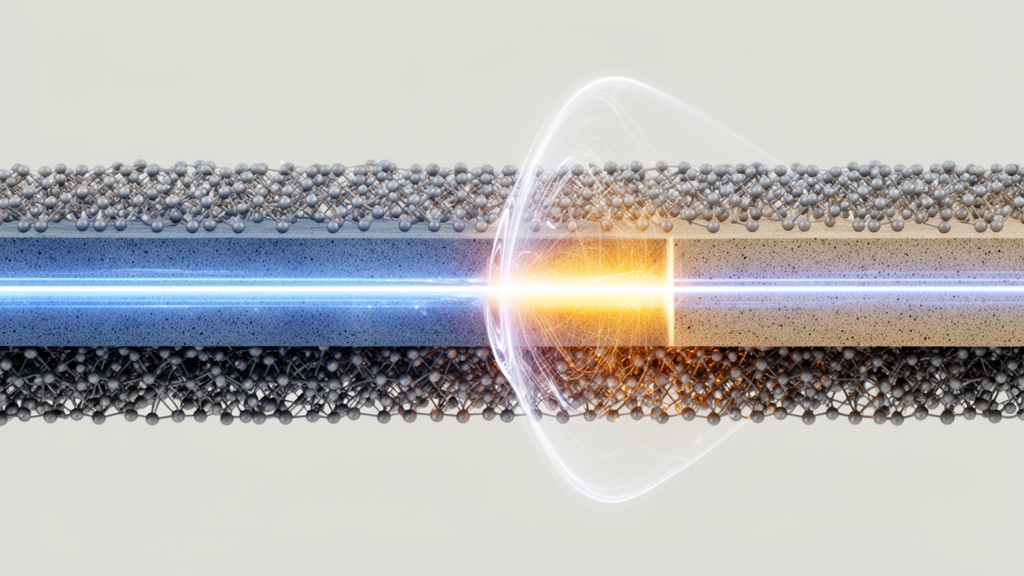
The investigation focused on the interface between lanthanum aluminate, LaAlO3, and potassium tantalate, KTaO3, with the interface oriented along the (111) plane. Superconductivity in this LaAlO3/KTaO3(111) structure is confined to a layer approximately four nanometers thick. Such a two-dimensional system has relatively few charge carriers and limited thickness through which superconducting regions can interact. Electron pairing is therefore necessary but insufficient: the paired carriers must also establish a shared quantum phase, allowing the entire superconducting region to behave coherently rather than as a collection of unrelated patches.
To measure this collective behavior, the team developed a highly sensitive two-coil mutual-inductance apparatus designed for ultralow temperatures. One coil produced an alternating magnetic field, and the second detected changes in how effectively the sample screened that field. The weak magnetic signature of the ultrathin interface made conventional measurements difficult. By varying the gate voltage from minus 900 to plus 900 volts, the researchers compared the temperature at which a diamagnetic response became detectable with the superfluid stiffness, a measure of how robustly the system maintains phase coordination. In the low-stiffness regime, that transition temperature increased almost linearly with stiffness, consistent with Bose–Einstein-condensate-like behavior in which the onset of phase coherence sets the limit. In the higher-stiffness regime, the transition temperature was nearly independent of stiffness, consistent with Bardeen–Cooper–Schrieffer-like behavior in which pair formation dominates.
The magnetic response supplied additional evidence for a granular superconducting landscape. Under small static magnetic fields, the researchers detected a paramagnetic Meissner effect close to the transition, meaning that the response enhanced rather than screened part of the measured magnetic flux. The sample also showed saturated diamagnetic screening under weak alternating fields. Together, these observations support a model in which superconducting “islands” are linked by weak Josephson coupling, although the term refers here to spatial variation in the electronic state rather than necessarily to structural grains. In this interpretation, the applied electric field strengthens the connections among the islands. Once those links are sufficiently robust, maintaining a common phase is no longer the main obstacle, and the process of forming electron pairs becomes the limiting factor. The observations motivate measurements at related oxide interfaces and spatially resolved studies of the superconducting gap and stiffness, which the researchers say could test the proposed island-network picture.
Subject of Research: Gate-controlled superconductivity at LaAlO3/KTaO3(111) interfaces
Article Title: What is the secret ingredient for interface superconductivity?
Article References: What is the secret ingredient for interface superconductivity?. Original publication (Bibliographic details unavailable.)
Image Credits: AI Generated
DOI: Not provided
Keywords: interface superconductivity, LaAlO3/KTaO3, superfluid stiffness, electron pairing, phase coherence, Josephson coupling, gate voltage, mutual inductance, oxide heterostructures, secret, ingredient, interface
News Source: Bethany Barker. (October 26, 2026). Electric field shifts the bottleneck in oxide-interface superconductivity. Scienmag.