In a small cross-sectional pilot study involving nine participants, ultrasound-measured synovial membrane thickness was strongly associated with reduced pain-free mouth opening in temporomandibular joint arthralgia. The finding identifies thickness as a candidate ultrasound-derived correlate of functional limitation, but it does not establish a validated biomarker or diagnostic test.
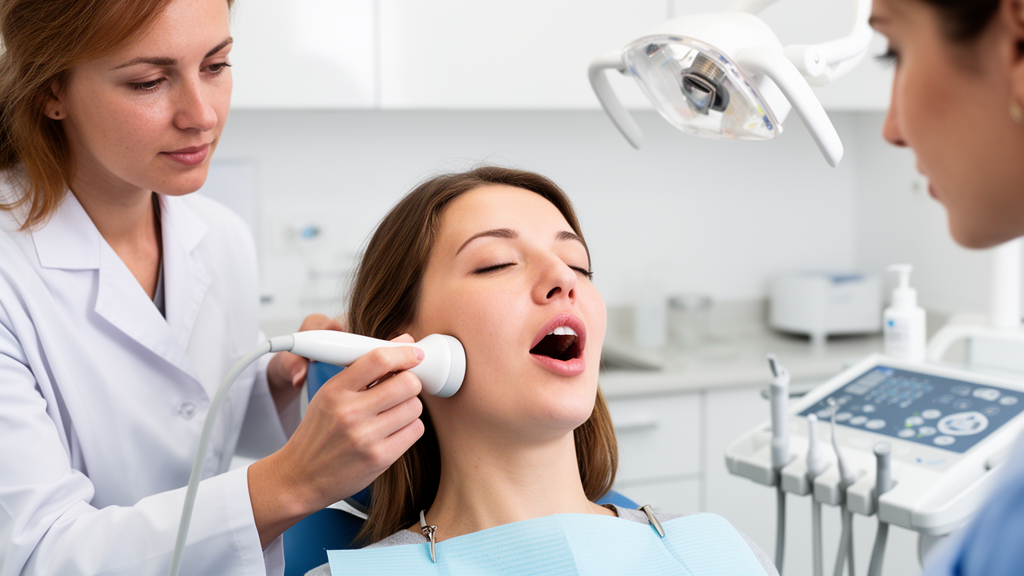
The cohort included five participants with temporomandibular joint arthralgia and four asymptomatic controls. The participant was the statistical unit. For people with unilateral arthralgia, investigators analyzed the symptomatic joint; otherwise, they used the mean measurement from both joints. Using point-of-care ultrasound, the team measured synovial membrane thickness and condyle–capsule distance, then assessed their statistical associations with pain-free mouth opening and pressure pain thresholds.
Greater synovial membrane thickness showed a strong inverse association with pain-free mouth opening, meaning that thicker membranes were associated with more restricted opening in this sample. The Pearson correlation was −0.923, with a 95% confidence interval of −0.984 to −0.669 and a p-value of 0.0004. The corresponding Spearman correlation was −0.803, with a p-value of 0.009. Condyle–capsule distance had a weaker and statistically uncertain association: its Pearson correlation was −0.502, with a 95% confidence interval of −0.875 to 0.243 and a p-value of 0.168.
A secondary exploratory receiver operating characteristic analysis showed complete separation between groups in this dataset, yielding an apparent area under the curve of 1.00 and a sample-derived synovial thickness threshold of 1.70 mm. The researchers stated that this result should not be interpreted as diagnostic accuracy. Pressure pain thresholds on the right and left sides were also strongly associated, with a Pearson correlation of 0.880, a 95% confidence interval of 0.519 to 0.975, and a p-value of 0.002; however, the findings did not permit attribution to central sensitization. Published in Scientific Reports on 21 October 2026, the study concludes that synovial membrane thickness may warrant validation in larger cohorts as a correlate of functional limitation in temporomandibular joint arthralgia.
Subject of Research: Ultrasound-measured synovial thickness as a correlate of functional limitation in temporomandibular joint arthralgia
Article Title: Ultrasound assessment of synovial hypertrophy as a potencial functional biomarker in temporomandibular joint arthralgia: a pilot correlation study
Article References: Calcia, T. B. B., Fortunato, R. E., Noel, J. D. D. S. D. M., de Goffredo Filho, G. S., & de Souza Tesch, R. (2026). Ultrasound assessment of synovial hypertrophy as a potencial functional biomarker in temporomandibular joint arthralgia: a pilot correlation study. Scientific Reports. https://doi.org/10.1038/s41598-026-73614-4
Image Credits: AI Generated
DOI: 10.1038/s41598-026-73614-4
Keywords: temporomandibular joint, joint arthralgia, point-of-care ultrasound, synovial thickness, mouth opening, pressure pain threshold, pilot study, cross-sectional study, functional limitation, Ultrasound, assessment, synovial
News Source: Denise Maddox. (October 26, 2026). Ultrasound Synovial Thickness Correlates With TMJ Functional Limitation in Pilot Study. Scienmag.