Ultrasound-assisted precipitation produced submicron simvastatin particles that dissolved 6.6 times faster in laboratory testing than particles from a commercially available formulation, according to a study published in the peer-reviewed journal Current Topics in Chemistry. The best-performing formulation, designated F2, had particles measuring 874 nanometres. Simvotin served as the commercial comparison. The experiment assessed dissolution in vitro; it did not test absorption, blood concentrations, treatment effects or safety in people.
Simvastatin is a widely used cholesterol-lowering medication that dissolves poorly in water. The news release reports that only about 5% of an oral dose remains available to the body after much of the dissolved drug is broken down in the liver and intestines before it can act. Dissolution can therefore limit the amount of a poorly water-soluble medicine available for absorption, although a faster laboratory dissolution test does not by itself demonstrate improved clinical benefit. Rather than chemically modifying simvastatin, the researchers pursued a physical formulation strategy: reducing the size of its particles so that more solid drug is exposed to the surrounding fluid.
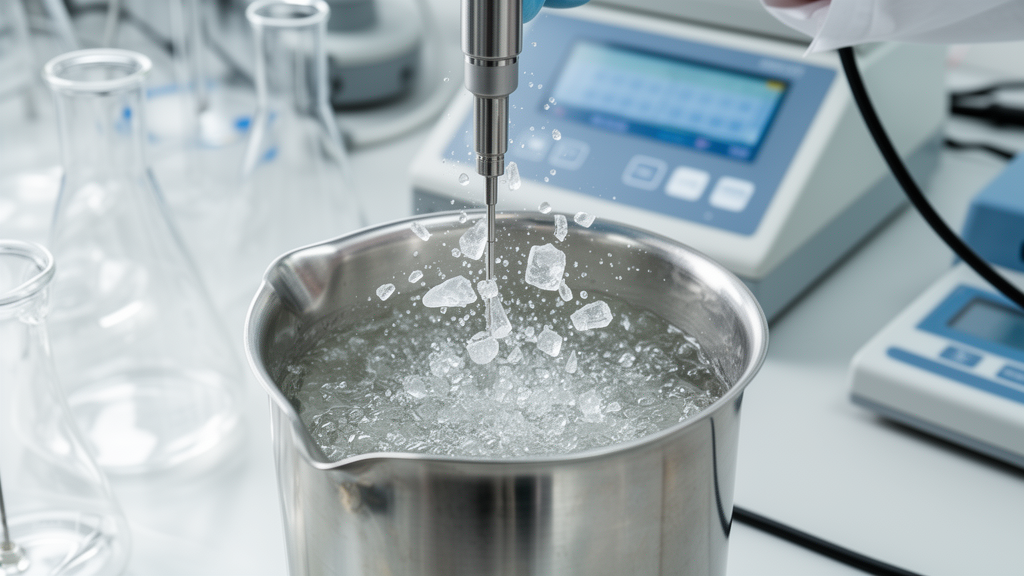
The technique, called sono-precipitation, combined a solvent-antisolvent process with ultrasound. Raw simvastatin was first dissolved in a solvent and filtered to remove impurities. The resulting solution was introduced into an antisolvent—a liquid in which simvastatin does not dissolve—inside a device called a sonoreactor. At the same time, the mixture was exposed to ultrasonic energy at different voltage strengths for five minutes. The sudden change in solubility caused the drug to precipitate, while the physical action of the ultrasound helped generate fine particles instead of larger crystals. The particles were subsequently filtered and dried for 12 hours at 50°C.
Among the formulations evaluated, F2 produced the strongest reported result, with its particles measuring 874 nanometres and its in vitro dissolution rate reaching 6.6 times that of Simvotin. The researchers also checked whether preparation had altered the drug or its crystal structure. Fourier-transform infrared spectroscopy showed no evidence of unwanted interaction between simvastatin and the formulation’s other ingredients. X-ray diffraction detected no change in the drug’s crystal structure. On the basis of these measurements, the researchers attributed the improved dissolution to the reduction in particle size rather than chemical modification or a detectable change in crystal form. Smaller particles present more surface area to the fluid, which supports faster dissolution of the solid drug.
The authors describe sono-precipitation as a comparatively straightforward option because it produces submicron particles directly without requiring lipid- or polymer-based nanocarriers of the kind used in some other nanoformulation approaches. They also propose that the method could be applied to other poorly water-soluble drugs. That wider application is a proposed potential advantage, not an outcome demonstrated in the reported experiment. The study was limited to simvastatin and laboratory dissolution measurements. The supplied report does not indicate testing in animals or humans, and it provides no evidence that the faster-dissolving formulation would produce higher blood concentrations, require different doses or improve cholesterol management. What the study establishes is a laboratory improvement in dissolution for a submicron formulation, while its relevance to clinical use remains to be evaluated in further research.
Subject of Research: In vitro enhancement of simvastatin dissolution through ultrasound-assisted submicron particle production
Article Title: Sound waves help shrink a cholesterol drug's particles, boosting how well it dissolves
Article References: Sound waves help shrink a cholesterol drug's particles, boosting how well it dissolves. Original publication (Bibliographic details unavailable.)
Image Credits: AI Generated
DOI: Not provided
Keywords: simvastatin, cholesterol, sono-precipitation, ultrasound, drug dissolution, submicron particles, drug formulation, bioavailability, nanomedicine, Sound, waves, help
News Source: Bethany Barker. (October 26, 2026). Ultrasound produces faster-dissolving simvastatin particles in laboratory study. Scienmag.