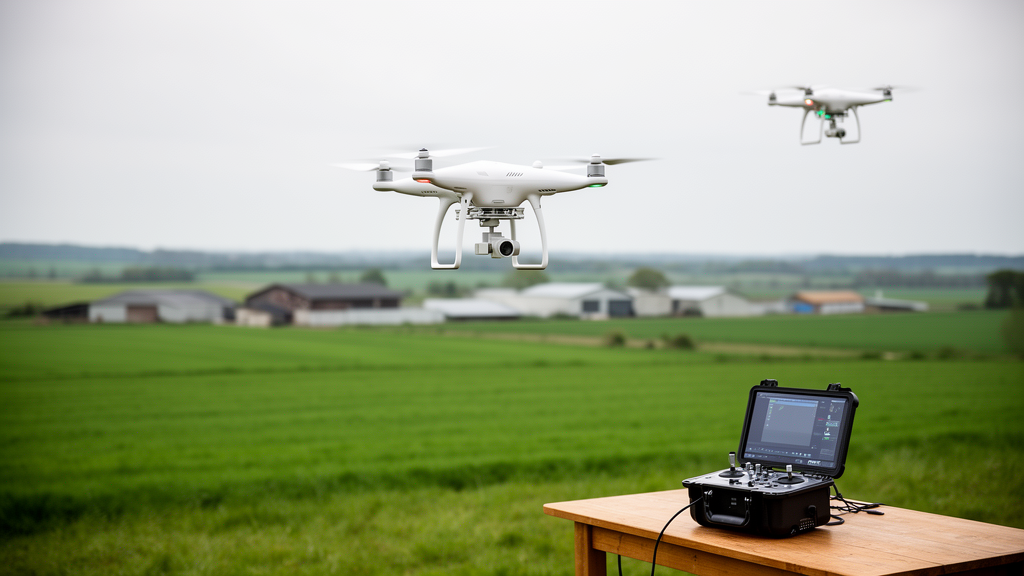
A newly published study in Aerospace Systems presents ASSURE-BVLOS, a runtime assurance framework designed to support beyond-visual-line-of-sight (BVLOS) unmanned aircraft operations. The framework links five operational domains—communications, perception, external information, environment and vehicle condition—to a bounded risk index, and pairs that index with visible uncertainty penalties, predefined authority states, deterministic hard-limit overrides and configuration-linked evidence. The aim is to give supervisory decisions a single, auditable structure that accounts for all of these factors together rather than in isolation.
The paper supplies analytical properties of the framework together with a newly implemented computational evaluation. The authors note that this new evaluation replaces an earlier numerical assessment, because the previous executable implementation was unavailable for verification. All newly specified parameters are disclosed in the study, a step intended to make the configured supervisory model reproducible by others.
In the computational evaluation, the framework was tested across 100,000 independent synthetic states. The estimated hazardous-outcome probability was 10.739% for a static hard-limit baseline and 8.083% for ASSURE-BVLOS, a difference of 2.656 percentage points with a 95% paired-bootstrap interval of 2.557 to 2.757. The authors are explicit that the direction of this difference is structurally favoured by assumed mitigation factors and therefore does not constitute independent evidence of safety effectiveness. Ten random seeds produced differences ranging from 2.534 to 2.711 percentage points, indicating stability of the estimate across repeated runs.
Performance under nominal conditions was more modest. Critical-state recall reached 40.20% at an intervention burden of 9.77%. Threshold, weight, surrogate and adverse-intervention analyses exposed substantial trade-offs among the framework’s settings, and an arithmetic fusion of scores achieved slightly higher recall at a matched intervention burden. In separate prescribed-score tests, mean switching fell from 97.56 to 5.84 transitions while protected-state occupancy rose from 29.70% to 63.73%, showing how the authority-state design changes how often the supervisor intervenes and how long the system remains in protected modes.
Twenty-eight implementation tests passed, supporting the correctness of the software realisation. The authors caution, however, that these findings establish reproducible behaviour of the configured supervisory model only—not flight safety, causal intervention effectiveness or certification compliance. Closed-loop simulation, hardware- and human-in-the-loop testing, and controlled flight validation remain necessary before any operational claims could be made. For BVLOS operations, where supervisory decisions must weigh communications quality, perception reliability, external information, environmental conditions and vehicle health simultaneously, the study offers a documented, testable structure for such decisions, along with a candid account of the trade-offs and the limits of what synthetic evaluation can demonstrate.
Subject of Research: Runtime assurance for BVLOS unmanned aircraft operations
Article Title: ASSURE-BVLOS: runtime assurance for risk-adaptive space–air–ground unmanned aircraft operations
Article References: Barua, N. (2026). ASSURE-BVLOS: runtime assurance for risk-adaptive space–air–ground unmanned aircraft operations. Aerospace Systems. https://doi.org/10.1007/s42401-026-00565-z
Image Credits: AI Generated
DOI: 10.1007/s42401-026-00565-z
Keywords: BVLOS, unmanned aircraft, runtime assurance, risk index, aerospace systems, computational evaluation, ASSURE-BVLOS, runtime, assurance, risk-adaptive, space, ground
News Source: Denise Maddox. (October 26, 2026). Runtime Assurance Framework Quantifies Risk Trade-offs for BVLOS Drone Operations. Scienmag.