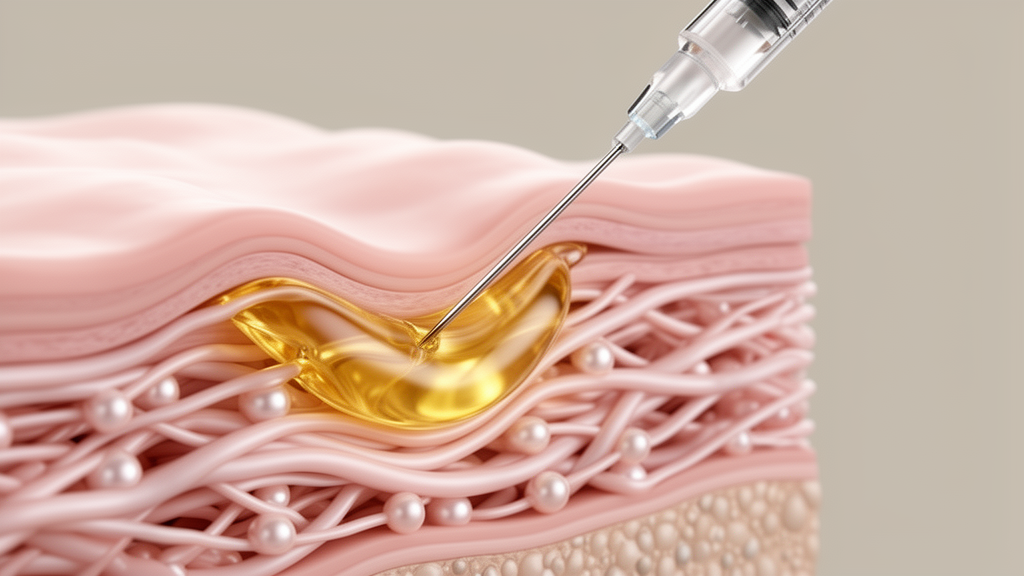
Vocal fold atrophy, scarring and paralysis can strip the larynx of its ability to close the glottis, producing breathy dysphonia, reduced vocal intensity, vocal fatigue and diminished pitch control. A review published in Frontiers in Bioengineering and Biotechnology by researchers at the University of Szeged now maps the landscape of injectable biomaterials used to treat these conditions, and its central message is striking: the fillers that dominate clinical practice today are essentially mechanical props, restoring volume and position without repairing the degenerated tissue beneath. The authors argue that the next generation of vocal fold injectables must do far more than push the folds together; they must regenerate the specialized extracellular matrix that makes human voice possible.
The procedure at the heart of this field, injection laryngoplasty, is elegantly simple. A biocompatible material is delivered transorally or percutaneously into the paraglottic space or the thyroarytenoid muscle, restoring vocal fold bulk and improving glottic closure. Together with medialization thyroplasty and arytenoid adduction lateropexy, it has become a cornerstone treatment for mild to moderate glottic insufficiency, prized for its safety, technical simplicity and minimally invasive nature. Advances in imaging and delivery techniques have steadily expanded its applications. Yet the review is blunt about the ceiling of current therapy: available injectables provide passive medialization and do not reverse the degeneration of the vocal fold extracellular matrix or the muscle atrophy that often drives the problem, which means patients frequently need repeat interventions as materials resorb.
Understanding why vocal fold repair is so difficult requires appreciating the extraordinary microstructure of the tissue itself. The vocal fold is an anisotropic, viscoelastic structure whose layered extracellular matrix enables rapid oscillation during phonation, and the superficial lamina propria exhibits exceptionally compliant behaviour with a very low Young’s modulus. Any injected material must replicate this native elasticity almost precisely, because a filler that is too stiff impairs vibration and degrades voice quality rather than improving it. The material must also preserve the delicate mucosal wave, the travelling ripple along the fold surface that gives voice its clarity. Excessive scar formation disrupts this wave by altering tissue stiffness, which is why biomaterials must support favourable host integration while minimizing fibrotic remodelling.
Beyond mechanics, the review outlines a demanding set of design criteria that distinguish vocal fold injectables from ordinary soft-tissue fillers. Materials should display low shear viscosity to pass through fine-gauge needles, and modern hydrogel systems increasingly use tunable crosslinking strategies that facilitate minimally invasive delivery while improving in situ retention and mechanical durability. Biocompatibility is equally critical: injectables must not provoke chronic inflammation, fibrosis, granuloma formation, migration or adverse foreign-body reactions, and emerging evidence suggests that materials promoting anti-inflammatory, pro-regenerative cellular responses are more likely to support functional healing rather than fibrotic scar. Degradation kinetics must be synchronized with the host’s rate of new extracellular matrix synthesis, preventing premature volume loss during regeneration, although the authors emphasize there is no universally optimal resorption time, since transient paralysis and progressive atrophy demand different persistence profiles.
Among currently available materials, hyaluronic acid stands out on purely rheological grounds. Rheological studies have demonstrated that hyaluronic acid-based injectables most closely replicate the viscoelastic properties of the native human vocal fold, which is unsurprising given that hyaluronic acid is itself a major component of the lamina propria. As a natural polysaccharide, it supplies structural components for extracellular matrix synthesis while providing volume restoration. Commercial formulations such as Restylane, Hylaform and Juvederm typically deliver clinical benefit for four to six months, although some studies report effects lasting up to twelve months. This combination of viscoelasticity, biocompatibility and reversibility makes hyaluronic acid fillers widely favoured, particularly when temporary augmentation is preferred, such as when neural recovery is expected or diagnostic augmentation is needed.
Calcium hydroxylapatite offers a different bargain: durability at the price of rigidity risk. Injected as microspheres suspended in a carboxymethylcellulose-based gel carrier, the material provides sustained medialization for twelve to twenty-four months or longer, with a mean clinical duration of approximately eighteen months. The carrier gel resorbs within roughly one to three months, but the microspheres continue to provide structural support, and the review notes that calcium hydroxylapatite may promote limited tissue remodelling through interactions with the surrounding extracellular matrix. The trade-off is real, however: excessive injection volume or improper placement may increase tissue stiffness and adversely affect vocal fold vibration. Shorter-lived options persist alongside these fillers, including micronized cadaveric dermis such as Cymetra, which augments for approximately two to three months and is used in age-related vocal fold atrophy, and bovine-derived gelatin products such as Gelfoam and Surgifoam, which provide effective short-term augmentation lasting roughly four to ten weeks.
Autologous materials occupy a privileged position because they are non-immunogenic and biologically compatible by definition. Autologous fat, most commonly harvested from the periumbilical subcutaneous tissue, preserves the viscoelastic properties of the vocal fold and may produce durable clinical benefits lasting three years or longer, leading many authors to consider it a permanent injectable. But fat resorption is unpredictable, so overinjection is generally recommended, which may cause temporary postoperative dysphonia or a foreign-body sensation. Autologous lipoinjection remains one of the most commonly recommended options for vocal fold atrophy. Autologous fascia, harvested from sites including the fascia lata, temporalis fascia or rectus abdominis sheath, offers greater metabolic stability, resistance to resorption and negligible risk of rejection or disease transmission, with clinical studies reporting durable effects lasting approximately three to ten years. Combined fat and fascia grafts have recently been introduced to pair the regenerative and structural characteristics of fascia with the viscoelastic properties of adipose tissue.
The most regenerative turn in the review concerns blood-derived biomaterials. Platelet-rich plasma, prepared by centrifuging whole blood to achieve supraphysiological platelet concentrations, delivers a concentrated payload of growth factors including platelet-derived growth factor, transforming growth factor-beta, vascular endothelial growth factor, epidermal growth factor and insulin-like growth factor, which promote cell proliferation, angiogenesis, collagen synthesis and tissue repair. In laryngology, platelet-rich plasma has been increasingly investigated for vocal fold scarring, sulcus vocalis, atrophy, presbyphonia and glottic insufficiency, and both preclinical and clinical studies indicate it may improve vocal fold pliability, enhance mucosal wave propagation, reduce fibrosis and promote restoration of the lamina propria extracellular matrix. Platelet-rich fibrin, a second-generation concentrate prepared without anticoagulants, forms a dense fibrin matrix that entraps platelets, leukocytes and growth factors within a three-dimensional scaffold, enabling slower and more sustained release of bioactive molecules while providing structural support for cell migration. It has been explored for scarred and atrophic folds and as an adjunct to autologous fat injection.
Synthetic polymers complete the clinical spectrum, and their history carries a warning. Polydimethylsiloxane, a non-biodegradable silicone-based polymer marketed as Bioplastique, provides permanent augmentation with favorable long-term safety reported in clinical studies, though stable outcomes were documented over follow-up periods of up to ten months. By contrast, paraffin and polytetrafluoroethylene, the historical materials paraffin and Teflon, have been abandoned because of high rates of foreign-body granulomatous reactions, rigidity and irreversible tissue damage. The frontier now lies in biodegradable, biostimulatory polymers such as poly-L-lactic acid and polycaprolactone. Poly-L-lactic acid induces a controlled foreign-body response that stimulates fibroblast activation and collagen deposition, evidence drawn largely from aesthetic and reconstructive medicine, but excessive collagen formation could potentially increase stiffness and compromise mucosal wave propagation, a major concern. Polycaprolactone’s prolonged degradation and favorable mechanics make it an attractive scaffold for cell delivery, though its long-term persistence requires careful optimization to avoid excessive rigidity that could impair phonation.
Clinical outcomes across all these materials follow a consistent pattern. Acoustic analyses typically reveal reductions in jitter and shimmer, aerodynamic assessments show improved glottal closure efficiency and decreased mean airflow rate, and patient-reported measures such as the Voice Handicap Index consistently reflect enhanced vocal performance and reduced vocal effort. Complications are relatively uncommon but include overinjection, implant migration, inflammatory reactions, granuloma formation and localized stiffness impairing the mucosal wave. The review also cautions that outcomes should not always be attributed to a single material, since patients may receive concomitant substances, combined augmentation agents, repeat injections or adjunctive procedures, and it calls for standardized reporting of material composition, injection technique, follow-up duration and complications to improve comparison between studies.
The future envisioned by the Szeged team is one in which injectables act as regenerative scaffolds rather than passive fillers. Injectable hydrogels incorporating stem cells, extracellular vesicles, growth factors and biomimetic matrix components are being developed to restore not only glottal closure but the layered microstructure of the vocal fold, and preclinical studies indicate regenerative biomaterials may achieve more durable tissue integration and better preservation of vibratory properties than conventional fillers. Particular attention is directed toward hyaluronic acid composite hydrogels, decellularized extracellular matrix scaffolds and bioengineered polymers combining structural with biochemical cues. While selective reinnervation and laryngeal pacing remain the theoretical ideal for restoring active motion in paralysis, their technical complexity suggests static rehabilitation will dominate for the foreseeable future, aided by advances in endoscopic imaging and office-based procedures under local anaesthesia. The review’s conclusion is a challenge to the field: injection laryngoplasty effectively compensates for glottic insufficiency, but until injectables can recreate the layered viscoelastic architecture essential for normal vibration, voice restoration remains symptomatic rather than truly regenerative.
Subject of Research: Injectable biomaterials for vocal fold augmentation, their biomechanical design requirements, clinical outcomes and emerging regenerative strategies
Article Title: Injectable biomaterials for vocal fold augmentation: biomechanical principles, clinical outcomes, and emerging regenerative strategies
Article References: Szalenko-Tokes, A., Rovo, L., & Keller-Pinter, A. (2026). Injectable biomaterials for vocal fold augmentation: biomechanical principles, clinical outcomes, and emerging regenerative strategies. Frontiers in Bioengineering and Biotechnology, 14, Article 1851460. https://doi.org/10.3389/fbioe.2026.1851460
Image Credits: AI Generated
DOI: 10.3389/fbioe.2026.1851460
Keywords: vocal fold, injection laryngoplasty, biomaterials, hyaluronic acid, calcium hydroxylapatite, platelet-rich plasma, regenerative medicine, extracellular matrix, viscoelasticity, glottic insufficiency, autologous fat, hydrogels
News Source: Matthew Wilson. (October 26, 2026). Voice fillers: injectable biomaterials reshape the science of vocal fold repair. Scienmag.