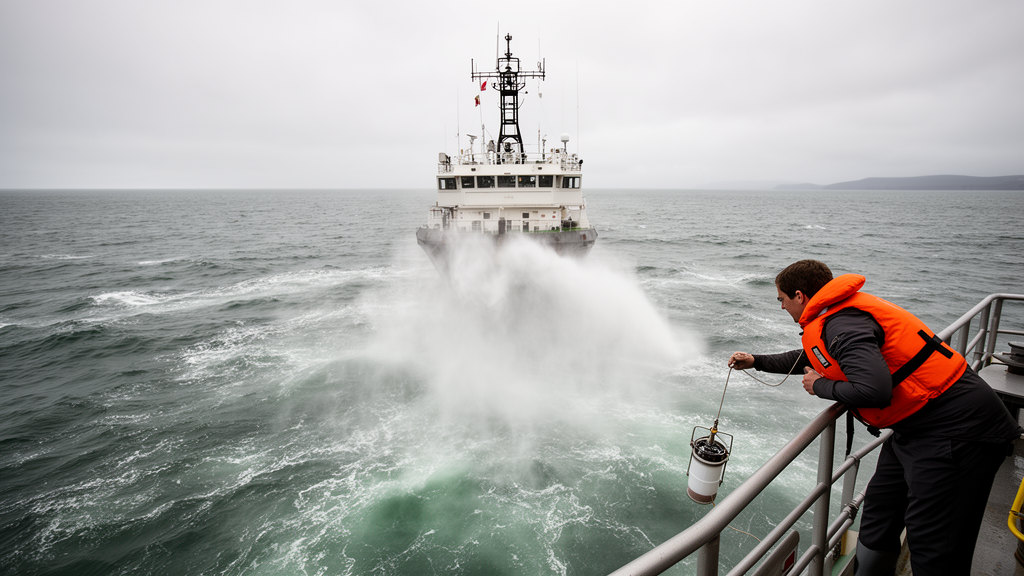
Ocean alkalinity enhancement, one of the most heavily promoted marine carbon dioxide removal strategies, may deliver far less carbon capture than laboratory studies have suggested, and the difference appears to hinge on something as simple as how fast the water moves. A new six-month laboratory study published in Biogeosciences by Charly Andre Moras, Matias Saez Moreno, Peggy Bartsch and Jens Hartmann of the University of Hamburg shows that gentle water circulation dramatically changes how much alkalinity dissolves into seawater, how quickly atmospheric carbon dioxide enters the ocean, and whether unwanted mineral precipitation sabotages the whole process. The findings suggest that closed, stirred bottle experiments, the workhorse of alkalinity enhancement research to date, may systematically misrepresent what happens in the real ocean.
The concept behind ocean alkalinity enhancement is chemically elegant. Adding alkaline materials such as calcium hydroxide, magnesium hydroxide or sodium hydroxide raises the total alkalinity of seawater, shifting its carbonate chemistry so the ocean can absorb more carbon dioxide from the atmosphere. Modelling studies have estimated a theoretical ceiling of up to 100 gigatonnes of carbon dioxide per year, with moderate costs compared with other removal approaches. But the chemistry has a well-known Achilles heel: when alkalinity climbs too high, calcium carbonate can precipitate spontaneously, consuming alkalinity and potentially even driving carbon dioxide out of the ocean rather than into it. Earlier work with reactive hydroxide feedstocks had found precipitation once alkalinity was raised by roughly 500 micromoles per kilogram.
Most previous laboratory experiments with these fast-reacting materials ran for minutes to weeks in sealed vessels stirred with magnetic stir bars, with no pathway for atmospheric carbon dioxide to enter. The Hamburg team suspected such setups distorted reality. They built a new apparatus using 84 one-litre polypropylene bottles filled with sterile-filtered natural Indian Ocean seawater collected about 400 kilometres southeast of Sri Lanka. One set of bottles sat motionless on a table; the other sat on a shaking table rotating at 125 revolutions per minute, a circular motion chosen after dye tests showed it produced turbulent vertical mixing without splashing. The team calculated a Reynolds number of roughly 1.7 times ten to the fourth, comfortably in the turbulent regime, and derived an equivalent open-ocean wind speed of about 3 metres per second for the gas exchange it produced.
To mimic the open ocean more faithfully, the bottles were left open to the air, but their headspaces were continuously flushed with water-saturated ambient air to suppress evaporation, and ultraviolet lamps switched on twice weekly limited microbial growth. Targeted alkalinity additions ranged from 100 to 600 micromoles per kilogram in steps of 100 for the two solid powders, which had closely matched grain sizes of about 30 and 32 micrometres, while a liquid sodium hydroxide treatment was run at the highest dose. Triplicate bottles per treatment allowed the researchers to track pH, total alkalinity, dissolved inorganic carbon and calculated carbon dioxide partial pressure over a full six months, far longer than typical hydroxide experiments.
The first surprise came within 24 hours. In every experiment, the measured alkalinity increase fell short of the theoretical maximum, but the shortfall was far worse in the still bottles. Under gentle advection, the realised alkalinity was 2.5 times higher for calcium hydroxide and 4.3 times higher for magnesium hydroxide than in the static treatments. At the modest target of 100 micromoles per kilogram, advected bottles achieved 55 to 58 percent of the expected increase, while static bottles at the highest target of 600 managed only 3 to 8 percent. Efficiency also declined as the dose rose, and magnesium hydroxide generally dissolved less completely than calcium hydroxide but held up better under circulation.
The researchers attribute this pattern to the diffusive boundary layer, the thin film of water clinging to each dissolving particle. Without advection, that film thickens, dissolved hydroxide and calcium ions accumulate around the particle, and local saturation states spike, simultaneously slowing dissolution and triggering calcium carbonate nucleation on the particle surfaces. The team stresses that they did not directly measure these micro-environments, but the dissolution and precipitation patterns match what boundary-layer theory predicts. Their measured alkalinity gains were, at most, half of those reported in earlier stir-bar studies, implying that expected alkalinity generation cannot be inferred from mineral properties alone but emerges from the interplay of material and hydrodynamics.
Carbon dioxide ingassing proved equally decisive. In the advected bottles, the partial pressure of carbon dioxide in seawater, which plunged after alkalinity addition, rebounded to control levels within about three days for calcium hydroxide and at most six days for the higher magnesium hydroxide and sodium hydroxide doses. In the static bottles, significantly depressed carbon dioxide levels persisted for at least six days and in some cases up to 35 days. This matters twice over. Faster ingassing rebuilds dissolved inorganic carbon, which buffers supersaturation and curbs precipitation; it also shortens what the authors name the critical alkalinity period, the window of high pH and low carbon dioxide that earlier mesocosm work has linked to reduced growth of coccolithophores and diatoms when levels fall below roughly 100 to 120 microatmospheres.
Scanning electron microscopy revealed that precipitation occurred in nearly all solid-amended bottles but took strikingly different forms. Calcium hydroxide produced needle-like aragonite crystals, while magnesium hydroxide yielded dense, broccoli-shaped spherulitic structures, most likely aragonite precipitating onto slowly dissolving magnesium hydroxide particles. Energy-dispersive X-ray analysis confirmed calcium, oxygen and carbon as the dominant elements. In the sodium hydroxide bottles, transient magnesium hydroxide flakes formed but redissolved under advection, eventually delivering essentially the full targeted alkalinity increase of about 100 percent, whereas the static sodium hydroxide bottles peaked at only about 56 percent as calcium carbonate precipitation took over. Once the critical alkalinity period ended, freshly precipitated calcium carbonate did not redissolve during the experiment.
The team also derived gas-transfer velocities from changes in dissolved inorganic carbon, correcting for carbon locked into precipitating carbonate. After correction, the static and advected treatments yielded gas-transfer velocities of 0.8 and 2.8 centimetres per hour, equivalent wind speeds of about 1.7 and 3.1 metres per second, well below the open-ocean average of roughly 6 metres per second and typical gas-transfer velocities of 14 to 20 centimetres per hour. The authors caution these are gas-exchange equivalents rather than direct hydrodynamic analogues, but they offer a useful first-order constraint for modelling low-wind deployment scenarios where both dissolution and carbon dioxide uptake would be sluggish.
The implications reach into the thorny problem of monitoring, reporting and verification for commercial deployments. Incomplete dissolution and calcium carbonate precipitation leave distinguishable fingerprints in alkalinity and dissolved inorganic carbon, but atmospheric carbon dioxide entering the water erases the stoichiometric signature, making realised removal hard to quantify. The authors argue that verification protocols, including the one under which the first independently verified coastal alkalinity enhancement carbon credits were recently issued, should treat these coupled processes explicitly. They also note that their simplified bottles excluded biology, particle transport and large-scale dilution, so the results are process-based laboratory observations that inform rather than reproduce field conditions. If confirmed at sea, the message is cautiously optimistic: realistic ocean mixing and gas exchange may shorten the risky high-pH window and preserve more of alkalinity enhancement’s promised carbon removal than stagnant laboratory vessels ever allowed.
Subject of Research: Laboratory testing of how water advection and CO2 exchange control the carbon dioxide removal efficiency of ocean alkalinity enhancement
Article Title: Impacts of water advection and CO2 exchange on the carbon dioxide removal potential of ocean alkalinity enhancement
Article References: Moras, C. A., Saez Moreno, M., Bartsch, P., & Hartmann, J. (2026). Impacts of water advection and CO 2 exchange on the carbon dioxide removal potential of ocean alkalinity enhancement. Biogeosciences, 23(20), 7523-7544. https://doi.org/10.5194/bg-23-7523-2026
Image Credits: AI Generated
Keywords: ocean alkalinity enhancement, carbon dioxide removal, calcium carbonate precipitation, CO2 ingassing, hydrodynamics, critical alkalinity period, calcium hydroxide, magnesium hydroxide, sodium hydroxide, gas transfer velocity, carbonate chemistry, marine carbon capture
News Source: Violet Maxwell. (October 26, 2026). Water Movement and CO2 Uptake Reshape the Carbon Removal Promise of Ocean Alkalinity Enhancement. Scienmag.