• HOME
  • NEWS
  • EXPLORE
    • CAREER
      • Companies
      • Jobs
    • EVENTS
    • iGEM
      • News
      • Team
    • PHOTOS
    • VIDEO
    • WIKI
  • BLOG
  • COMMUNITY
    • FACEBOOK
    • INSTAGRAM
    • TWITTER
Monday, October 26, 2026
BIOENGINEER.ORG
No Result
View All Result
  • Login
  • HOME
  • NEWS
  • EXPLORE
    • CAREER
      • Companies
      • Jobs
        • Lecturer
        • PhD Studentship
        • Postdoc
        • Research Assistant
    • EVENTS
    • iGEM
      • News
      • Team
    • PHOTOS
    • VIDEO
    • WIKI
  • BLOG
  • COMMUNITY
    • FACEBOOK
    • INSTAGRAM
    • TWITTER
No Result
View All Result
Bioengineer.org
No Result
View All Result
Home NEWS Science News Technology

3D-Printed MnZn Ferrite Core Achieves Magnetic Performance Comparable to Conventional Parts

by
October 26, 2026
in Technology
Reading Time: 2 mins read
0
3D-Printed MnZn Ferrite Core Achieves Magnetic Performance Comparable to Conventional Parts

3D-Printed MnZn Ferrite Core Achieves Magnetic Performance Comparable to Conventional Parts

Share on FacebookShare on TwitterShare on LinkedinShare on RedditShare on Telegram

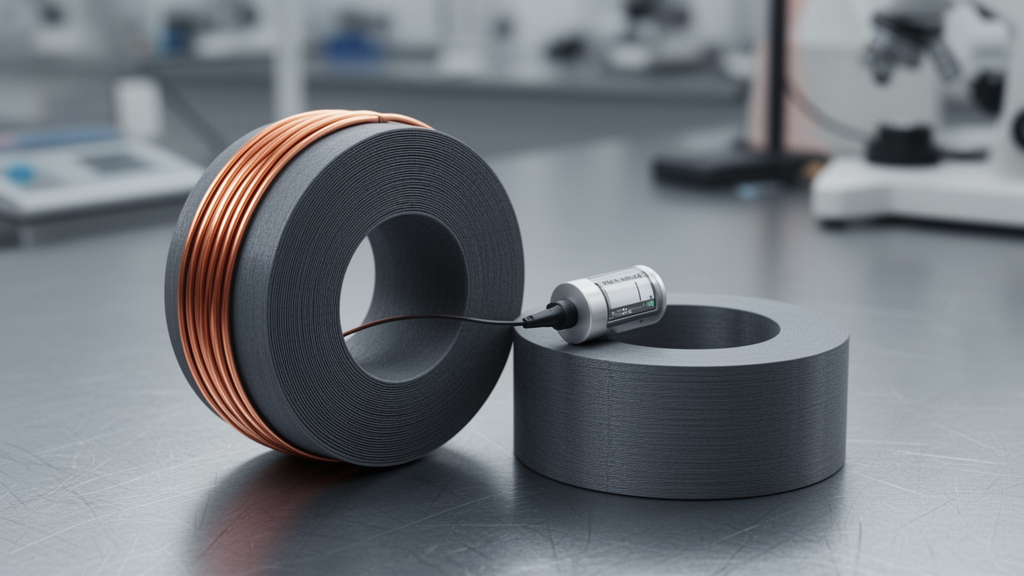
Researchers have fabricated and magnetically characterized a manganese-zinc (MnZn) soft ferrite toroidal core produced by additive manufacturing, reporting in Scientific Reports that the finished part reaches magnetic performance comparable to that of a conventional ferrite. The team describes the route as an original process for the production of soft ferrite parts, adding a magnetic ceramic to the set of materials that additive manufacturing can currently print for electrical engineering. The manufacturing route is described as PIM-like additive manufacturing, in which the 3D printing step is performed using polymer pellets filled with ferrite powder.

Once printed, the green part passes through debinding and sintering steps, after which the researchers obtained a dense core. According to the study, this dense core is what delivers magnetic performance comparable to a conventionally produced ferrite, rather than the part remaining a porous intermediate. Characterization of the printed component proceeded along two lines.

Microstructurally, the team determined the material's grain size. Magnetically, they measured the core's hysteresis loops and the associated power losses as a function of induction and frequency, the two operating variables along which the ferrite's behaviour is reported in the study. These measurements together establish the main magnetic properties of the printed material.

The combination of grain size, hysteresis loops, power losses and temperature behaviour forms the reported description of what the PIM-like printing route produces in a MnZn soft ferrite. The authors frame additive manufacturing as offering flexibility in terms of shapes while currently enabling the printing of a variety of materials for electrical engineering. Within that context, the demonstrated toroidal core serves as the case study for the process: a powder-filled-pellet printing step, followed by debinding and sintering, yielding a dense MnZn ferrite whose measured magnetic properties sit alongside those of a conventional ferrite.

The work is published as an open-access article in Scientific Reports, with the fabrication process and the full characterization dataset presented as the study's core contribution.

Subject of Research: PIM-like additive manufacturing and magnetic characterization of a MnZn ferrite toroidal core

Article Title: PIM-like additive manufacturing and characterization of a MnZn ferrite magnetic core

Article References: Sqalli, G., Martin, V., Gillon, F., Soupremanien, U., Najjar, D., Witz, J.-F., Benabou, A., & Hecquet, M. (2026). PIM-like additive manufacturing and characterization of a MnZn ferrite magnetic core. Scientific Reports. https://doi.org/10.1038/s41598-026-76367-2

Image Credits: AI Generated

DOI: 10.1038/s41598-026-76367-2

Keywords: PIM-like, additive, manufacturing, characterization, MnZn, ferrite, magnetic, core, scientific research

News Source: Denise Maddox. (October 26, 2026). 3D-Printed MnZn Ferrite Core Achieves Magnetic Performance Comparable to Conventional Parts. Scienmag.


Tags: additivecharacterizationcoreferritemagneticmanufacturingMnZnPIM-likescientific research
Share12Tweet7Share2ShareShareShare1

Related Posts

Graph features boost short-term urban CO forecasting, not full-day prediction

Graph features boost short-term urban CO forecasting, not full-day prediction

October 26, 2026
Diabetes AI combines knowledge graphs with language models for traceable answers

Diabetes AI combines knowledge graphs with language models for traceable answers

October 26, 2026

Clinically guided machine learning stratifies dental implant risk in European dataset

October 26, 2026

SALF-Net outperforms baselines on 30,000 short-video music clips

October 26, 2026

POPULAR NEWS

  • Carbapenemase and ESBL Genes Found Across Iranian Acinetobacter baumannii Isolates

    Carbapenemase and ESBL Genes Found Across Iranian Acinetobacter baumannii Isolates

    29 shares
    Share 12 Tweet 7
  • Three Baseline Gene-Expression Endotypes Track With Healing in Ulcerative Colitis

    29 shares
    Share 12 Tweet 7
  • AI Video Analysis Flags Newborns at Risk of Impaired Breast Crawl

    29 shares
    Share 12 Tweet 7
  • Child development data scattered across silos leaves Africa’s youngest children invisible, review finds

    29 shares
    Share 12 Tweet 7

About

We bring you the latest biotechnology news from best research centers and universities around the world. Check our website.

Follow us

Recent News

Carbapenemase and ESBL Genes Found Across Iranian Acinetobacter baumannii Isolates

Three Baseline Gene-Expression Endotypes Track With Healing in Ulcerative Colitis

AI Video Analysis Flags Newborns at Risk of Impaired Breast Crawl

Subscribe to Blog via Email

Enter your email address to subscribe to this blog and receive notifications of new posts by email.

Join 85 other subscribers
  • Contact Us

Bioengineer.org © Copyright 2023 All Rights Reserved.

Welcome Back!

Login to your account below

Forgotten Password?

Retrieve your password

Please enter your username or email address to reset your password.

Log In
No Result
View All Result
  • Homepages
    • Home Page 1
    • Home Page 2
  • News
  • National
  • Business
  • Health
  • Lifestyle
  • Science

Bioengineer.org © Copyright 2023 All Rights Reserved.