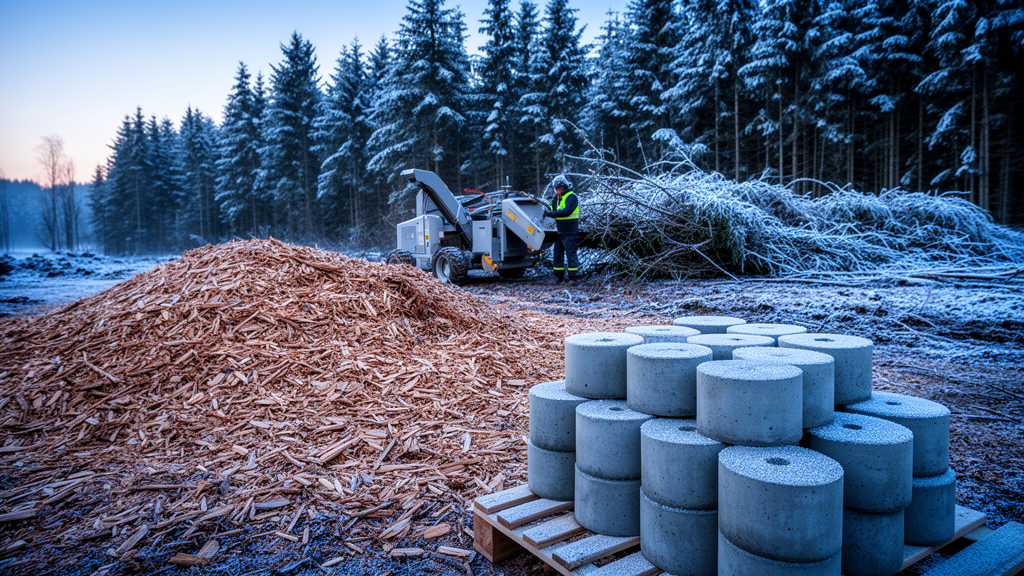
Concrete’s enormous carbon footprint has pushed researchers toward an unlikely resource: the wood left behind by forestry, timber processing, combustion, and biomass conversion. A new review published in Frontiers in Materials argues that forest-residue-derived constituents deserve a place in low-carbon cementitious materials, but only if they are treated as three chemically and mechanically distinct material classes rather than lumped together as interchangeable waste substitutes. The authors, led by Wenbo Fan of Harbin University in China, systematically separate wood ash, wood-derived biochar, and wood fiber, showing that each plays a fundamentally different role in cement chemistry and that each carries its own evidence boundaries, dosage trade-offs, and durability risks.
The distinction matters because similar-looking improvements in strength or porosity can arise from completely different mechanisms. Wood ash, the mineral residue of burned wood, behaves as a screened supplementary cementitious material or mineral filler whose performance depends heavily on combustion history, ash fraction, oxide composition, loss on ignition, alkali content, and fineness. Wood-derived biochar, by contrast, is a porous carbonaceous solid with limited direct cementitious reactivity; its value lies in modifying hydration, internal water storage, and pore connectivity at low dosages. Wood fiber does neither of these things. Its primary contribution is mechanical: crack bridging, pull-out energy dissipation, and improved post-cracking behavior, with water absorption, swelling, and long-term fiber–matrix compatibility standing out as persistent weaknesses.
To keep these roles straight, the review draws a sharp line between direct evidence and mechanistic analog evidence. Direct evidence comes from studies in which wood ash, wood bottom ash, wood fly ash, wood-derived biochar, or wood fiber was actually incorporated into cement paste, mortar, concrete, or cement-stabilized matrices. Mechanistic analog evidence, drawn from non-wood biomass ashes and lignocellulosic fibers such as bamboo, hemp, sisal, and coir, is used only to clarify transferable mechanisms like pozzolanicity, swelling, crack bridging, and alkaline degradation, never to set quantitative design limits for wood-derived materials. The authors deliberately avoided a formal meta-analysis because the available studies differ too much in feedstock, processing route, replacement basis, mixture design, curing regime, and exposure protocol for statistical pooling to be reliable.
The quantitative picture that emerges is one of screening ranges rather than universal optima. Wood ash is commonly examined at approximately 5% to 20% cement replacement, but the useful window narrows considerably once water demand, early strength, air entrainment, transport resistance, and freeze–thaw durability are considered together. A recent mortar study cited in the review illustrates the point: wood ash tested at 10% and 30% cement replacement after different pretreatments showed its most favorable response at 10% with sieving and slaking, reaching 28-day compressive and flexural strengths of approximately 56 and 9 megapascals, compared with roughly 62 and 10 megapascals for the reference mortar. Even that best-performing mixture lost more mass during freeze–thaw cycling than the reference after 56 cycles, a reminder that pretreatment can improve wood-ash performance without eliminating the need for direct cold-service qualification.
Biochar shows an even clearer dosage dependence. Published studies typically work at around 0.5 to 3 wt% of binder, and the response is distinctly non-monotonic. Patel and colleagues reported in 2025 that concrete with 0 to 5 wt% biochar cement replacement performed best near 2 wt%, with increases in compressive strength, splitting tensile strength, and flexural load at fracture. Separate work on ultra-high-performance concrete mortars found improved impermeability-related behavior only near 1% biochar, with higher additions increasing capillary porosity, while other research identified a favorable balance among mechanical, freeze–thaw, and environmental performance at approximately 3% to 5% wood-based biochar, beyond which strength declined. The same properties that let fine, well-dispersed biochar act as nucleation sites and support internal curing can, at excessive dosage or poor dispersion, create weak inclusions and connected pores that degrade transport resistance.
Wood fiber occupies its own dosage regime, generally below about 2 vol% in mortar and concrete, with screening ranges near 0.3 to 2.0 vol% depending on fiber length, aspect ratio, dispersion, treatment, and workability. Because fibers modify the fracture process rather than replace clinker, compressive strength is a poor yardstick for their value; flexural and splitting tensile response, fracture energy, residual strength, and crack-width measurements are far more informative. The central technical challenge is chemical compatibility: wood fibers contain cellulose, hemicellulose, lignin, sugars, tannins, and waxes that can absorb water, swell, interfere with hydration, delay setting, and weaken the early fiber–matrix interface. Under repeated wetting, drying, freezing, thawing, and alkaline exposure, swelling-induced stress, debonding, fiber embrittlement, and interfacial microcracking can turn the very cracks the fibers were meant to control into pathways for chloride-bearing water.
The review’s most distinctive move is to treat cold-region exposure not as a separate topic but as a demanding service-qualification case that stress-tests every mechanism the three constituents touch. Repeated freezing and thawing, moisture uptake, de-icing salts, and chloride transport all probe the pore-water system, the air-void structure, the interfacial transition zone, and crack connectivity. Freeze–thaw resistance, the authors emphasize, depends not on total porosity but on how much water can enter, where it is stored, how easily it freezes, and whether the pore network can relieve pressure during phase change. Wood ash may refine capillaries if filler and pozzolanic effects dominate, yet poorly processed ash with high residual carbon or soluble alkalis can increase heterogeneity and destabilize air entrainment. Biochar may redistribute water and buffer moisture, but excessive or agglomerated biochar raises local saturation. Fiber bridging reduces crack connectivity only while the interface survives.
Air-void compatibility receives particular attention. Entrained air voids act as pressure-relief sites during ice formation, and the review is explicit that biochar’s internal pores cannot be assumed to substitute for a designed air-void system, since their size, connectivity, saturation state, and pressure-relief efficiency are not equivalent to intentionally entrained bubbles. Carbon-rich wood ash can adsorb air-entraining agents, biochar’s high surface area and water absorption can destabilize bubbles, and fibers can alter fresh-state rheology and compaction quality. A residue-modified concrete that appears dense and strong in compression may still fail freeze–thaw exposure if the air-void system has been quietly compromised, which is why the authors argue that total air content alone is insufficient and that spacing factor, specific surface, bubble stability, and admixture interaction must be verified.
To translate these mechanisms into practice, the review proposes a staged qualification pathway running from constituent characterization and mixture screening through mechanism verification and exposure-relevant testing to field validation. A minimum cold-service package would combine rapid freeze–thaw testing of the ASTM C666/C666M type, air-void analysis of the ASTM C457/C457M type, sorptivity measurement of the ASTM C1585 type, chloride transport assessment by permeability, migration, or electrical resistivity, deicer-scaling or CDF/CIF-type procedures where salts are expected, and microstructural verification linking observed performance to real densification rather than temporary moisture effects. Deployment is graded by risk: masonry mortar and non-load-bearing boards can proceed with basic characterization, exterior products such as pavers and repair mortars require transport and freeze–thaw evidence plus pilot panels, while reinforced concrete exposed to de-icing salts, bridge decks, and marine splash-zone elements should be used only after staged qualification, independent verification, and field monitoring.
The authors close with a warning about how low-carbon claims are made. A material that lowers clinker demand but introduces greater water sensitivity, premature deterioration, or additional maintenance may deliver little benefit over its service life, and embodied-carbon reduction alone does not capture mixtures that need more repair or fail earlier. Biochar’s potential carbon-storage value likewise depends on feedstock origin, pyrolysis energy, transport distance, dosage, cement reduction, durability retention, and the stability of carbon in the cementitious environment. The review calls for standardized constituent reporting, covering combustion or pyrolysis temperature, ash fraction, particle-size distribution, loss on ignition, alkali content, moisture state, and fiber treatment, alongside performance reporting that pairs mechanical retention with transport, exposure, and microstructural evidence. Only when clinker reduction or carbon storage is accompanied by retained durability and credible service-life assumptions, the authors conclude, can forest residues genuinely earn their place in low-carbon concrete.
Subject of Research: Wood ash, biochar, and wood fiber as distinct forest-residue-derived constituents in low-carbon cementitious materials, with cold-region durability qualification
Article Title: Forest-residue-derived constituents for low-carbon cementitious materials: evidence boundaries, quantitative trade-offs, and cold-region service qualification
Article References: Fan, W., Tao, C., Jiang, S., Zang, M., & Tan, Y. (2026). Forest-residue-derived constituents for low-carbon cementitious materials: evidence boundaries, quantitative trade-offs, and cold-region service qualification. Frontiers in Materials, 13, Article 1879093. https://doi.org/10.3389/fmats.2026.1879093
Image Credits: AI Generated
DOI: 10.3389/fmats.2026.1879093
Keywords: wood ash, biochar, wood fiber, low-carbon concrete, supplementary cementitious materials, freeze-thaw durability, chloride transport, air-void system, pore structure, service qualification, forest residues, cement replacement
News Source: Denise Maddox. (October 26, 2026). Forest residues could cut concrete’s carbon footprint, but only with rigorous cold-region testing. Scienmag.