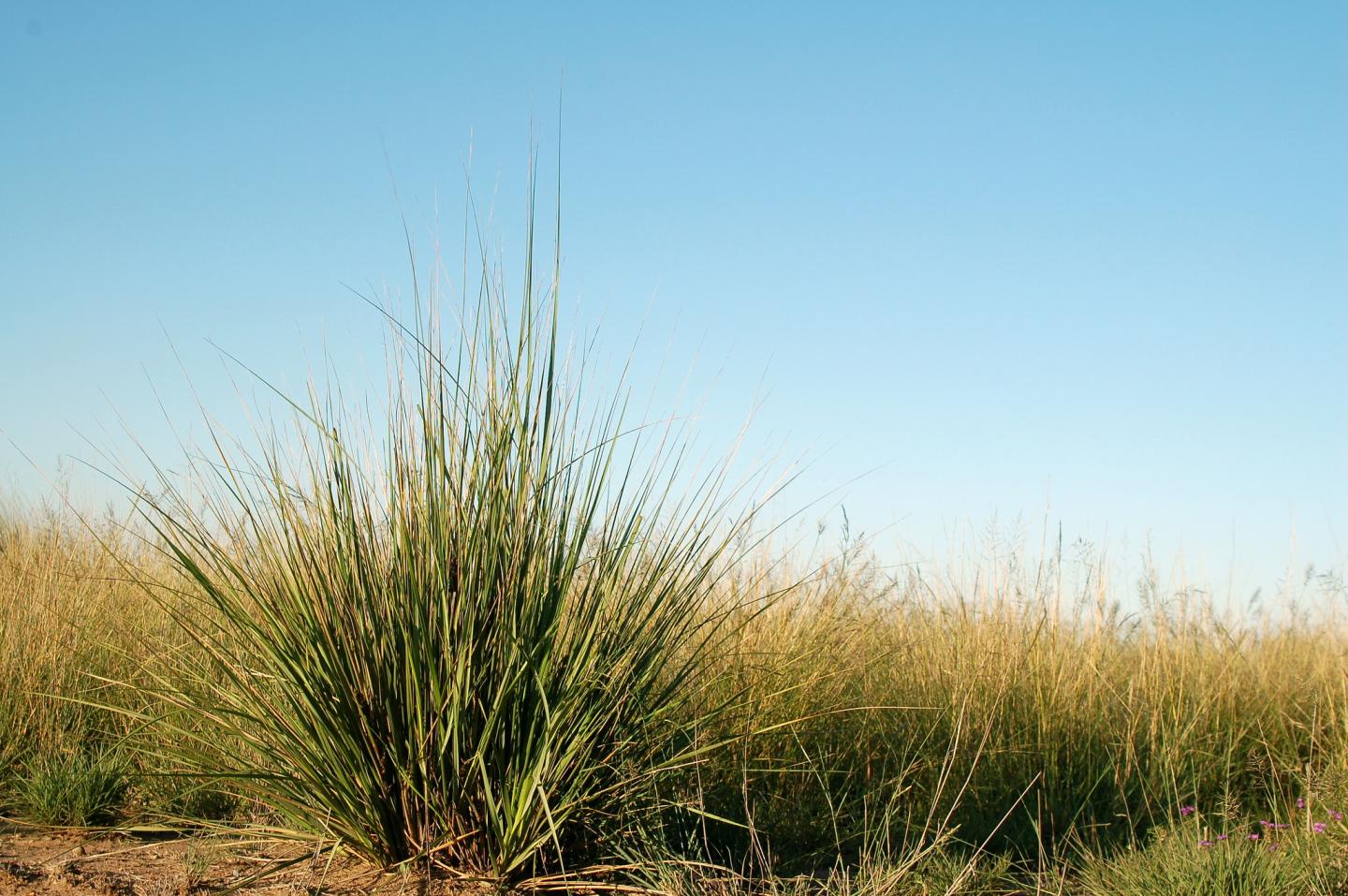
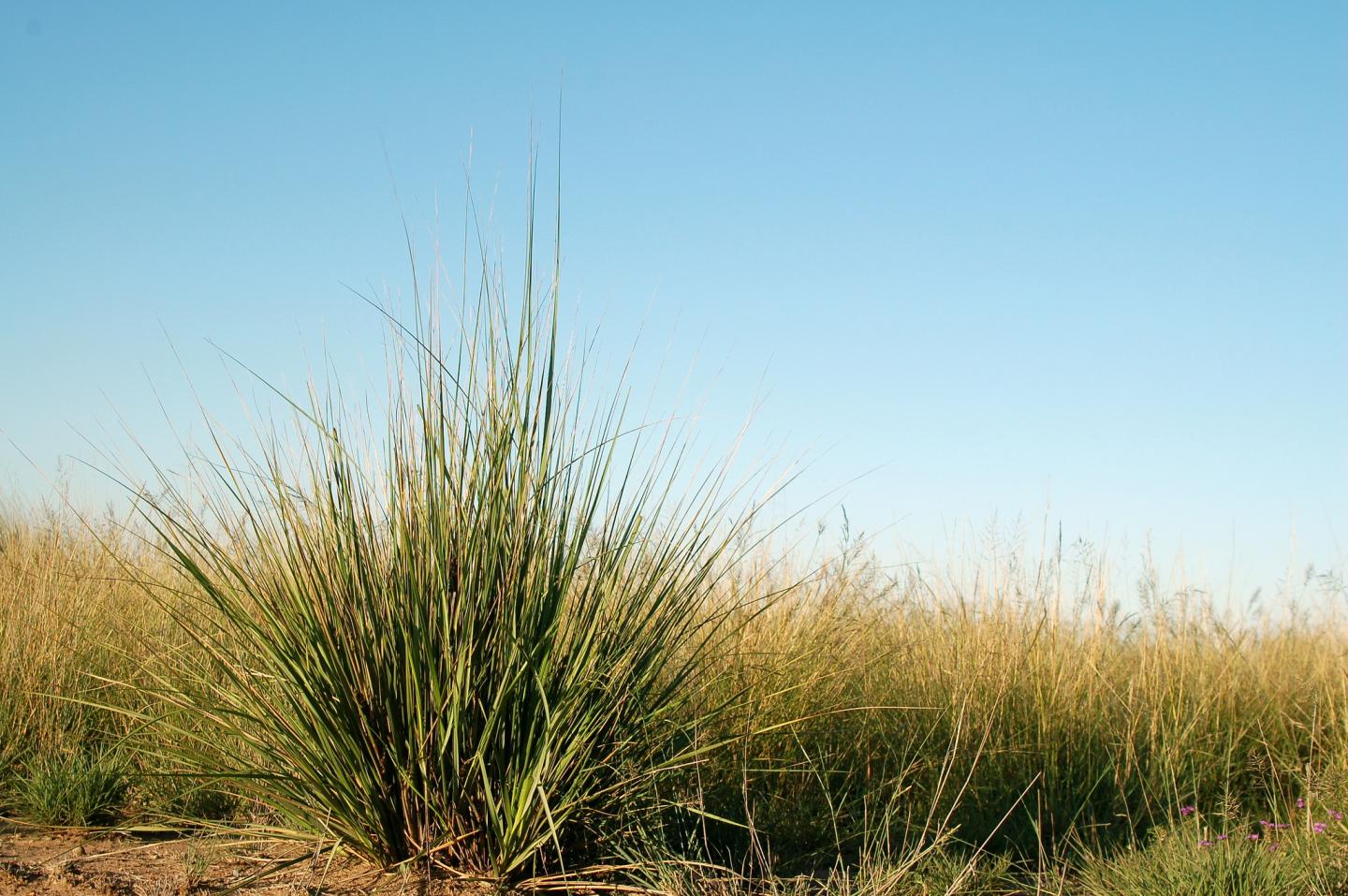
Credit: QUT Marketing & Communication.
A partnership between QUT, the NSW Government and farmers could lead to the eventual eradication of the highly invasive African lovegrass threatening pastures and native grasslands Australia-wide.
What they discovered is that local knowledge is the key to a successful management approach.
The results of a research project by Associate Professor Jennifer Firn from QUT's School of Earth, Environmental and Biological Sciences, Emma Ladouceur from Italy's University of Pavia and Dr Josh Dorrough from the NSW Office of Environment and Heritage, have been published in the esteemed international Journal of Applied Ecology.
"The impact of invasive non-native plant species like African lovegrass is increasing dramatically," said Professor Firn, who has previously tested control methods for the grass in southern Queensland.
"A native of southern Africa, it is very hardy and considered valuable for animal production and soil conservation but in Australia, where it is believed to have first arrived in the 1800s, it is considered by many Landholders to be a pest species because it is not selectively grazed by livestock and tends to dominate native pastures reducing biodiversity and essential ecosystem functions.
"Landholders are in a unique position to witness species turnover in grasslands as well as learn from their own successes and failures in trying to manage invasive grasses.
"For this study, we worked closely with 15 landholders in the Bega region of NSW to examine the changing ecological characteristics of grassy woodlands and the impact on them following the arrival of the non-native African Love Grass which has become an enormous problem for them.
"We then conducted a field study testing seven landholder-generated hypotheses at 57 sites on the 15 Landholders properties, which validated many of their management perceptions."
Professor Firn said seeds for African lovegrass can germinate even up to 17 years of age and are dispersed by grazing animals, slashing, vehicles, water, fodder and wind. It thrives in drought conditions and paddocks with low ground cover are more susceptible to invasion.
"As well as overwhelming endangered native grasses, African lovegrass tussocks can grow so large they restrict the movements of livestock and become a hazard to famers trying to navigate their properties," she said.
"Our project has yielded some extremely helpful information and really highlighted the value of a team effort amongst scientists, governments, land care groups and farmers.
"One theory we tested was whether mechanically slashing African lovegrass and then putting a large number of cattle into the paddock was effective as some farmers think. We found the opposite was true and it only made the lovegrass more abundant. It was also an expensive exercise for farmers.
"Conversely, we discovered that an alternative control technique, "roller-wiping" or spot spraying with herbicide, was effective even with heavy infestations and cost efficient despite its poor reputation.
"Overall, we found local knowledge coupled with scientific methods can act in tandem as a smart approach to developing management solutions to African lovegrass, but this approach would likely be useful for understanding and managing other invasive plants and animals."
###
The full study – Integrating local knowledge and research to refine the management of an invasive non-native grass in critically endangered grassy woodlands – can be viewed on the website of the Journal of Applied Ecology.
Contact:
Amanda Weaver
07-3138-3151
[email protected]
After hours:
Rose Trapnell
0407-585-901
[email protected]
Media Contact
Amanda Weaver
[email protected]
07-3138-3151
@qutmedia
http://www.qut.edu.au
Original Source
https://www.qut.edu.au/news/news?news-id=123058 http://dx.doi.org/10.1111/1365-2664.12928