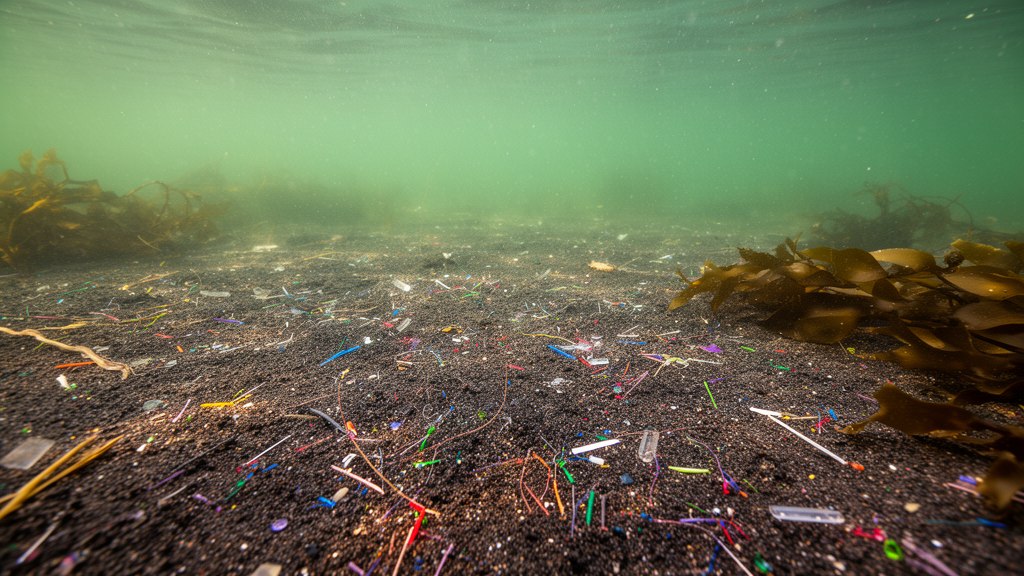
Microplastics were found in every sediment sample taken from a fjord system on the Swedish west coast, according to a new study of surface sediments collected around a major petrochemical industrial complex. Concentrations ranged from 6.7 to 48 particles per gram of dry sediment, and the researchers report that the pollution signature points strongly to local industry rather than distant or diffuse sources. The study, published as open access research in the journal Microplastics and Nanoplastics, focused on primary microplastics: small particles released before consumer use, such as pre-production pellets and powders.
The research team, led by Karin Mattsson together with colleagues including Elisabet Ekstrand, Jeongyeon Yun, Titouan Palluy, Thisal Mandula Sugathapala, Kerstin Magnusson, Kjell Nordberg and Martin Hassellöv, analysed nine surface sediment samples from the coastal archipelago surrounding the industrial area. Polyethylene, polyvinyl chloride and polypropylene dominated the polymer composition, together accounting for more than 90 percent of the particles identified. A striking feature of the findings was the morphology of the recovered particles.
The researchers observed distinct and homogeneous particle shapes, which they interpret as evidence of a strong influence from local industrial sources, particularly for polyethylene and polyvinyl chloride. Spatial patterns reinforced that interpretation. The highest concentrations appeared close to the industrial area, with levels decreasing further away and remaining low at the reference site.
The authors note that local hydrography and sediment dynamics also shaped the distribution, so the picture is not a simple gradient from a single source, but the overall pattern aligns with known emission sources and hydrodynamic conditions in the fjord system. The two dominant polymers behaved differently once released. Polyethylene, which is less dense than seawater, was dispersed more widely across the study area.
The researchers attribute this to its lower density and longer residence time in surface waters before it eventually settles, allowing currents to carry it farther from its point of origin. Polyvinyl chloride, by contrast, showed more localized accumulation. Its higher density means it tends to sink and deposit closer to where it enters the water, producing a more concentrated footprint near the industrial complex.
This observed contrast between a widely dispersed low-density polymer and a locally accumulated high-density polymer is a notable pattern for interpreting sediment contamination in the area. The authors conclude that primary microplastics from industrial activities are a major contributor to sediment contamination in the study area. While the complex fjord geometry influences transport and deposition processes, the observed distributions remain consistent with the known emissions and water movements of the region, giving the findings a solid basis for attribution.
Beyond mapping the pollution, the study carries a direct message for environmental management. The researchers argue that industrial emissions of pre-production plastics deserve specific attention, and they present the work as a scientific foundation for environmental monitoring and management strategies, offering a basis for tracing primary microplastics from their industrial origins to their final resting places on the seafloor.
Subject of Research: Sediment dispersal of PE and PVC primary microplastics in a coastal archipelago surrounding a plastic production industrial complex
Article Title: Sediment dispersal of PE and PVC primary microplastics in a coastal archipelago surrounding a plastic production industrial complex
Article References: Mattsson, K., Ekstrand, E., Yun, J., Palluy, T., Sugathapala, T. M., Magnusson, K., Nordberg, K., & Hassellöv, M. (2026). Sediment dispersal of PE and PVC primary microplastics in a coastal archipelago surrounding a plastic production industrial complex. Microplastics and Nanoplastics. https://doi.org/10.1186/s43591-026-00240-2
Image Credits: AI Generated
DOI: 10.1186/s43591-026-00240-2
Keywords: Sediment, dispersal, primary, microplastics, coastal, archipelago, surrounding, plastic, production, industrial, complex, scientific research
News Source: Denise Maddox. (October 26, 2026). Industrial microplastics blanket sediments of Swedish coastal archipelago. Scienmag.