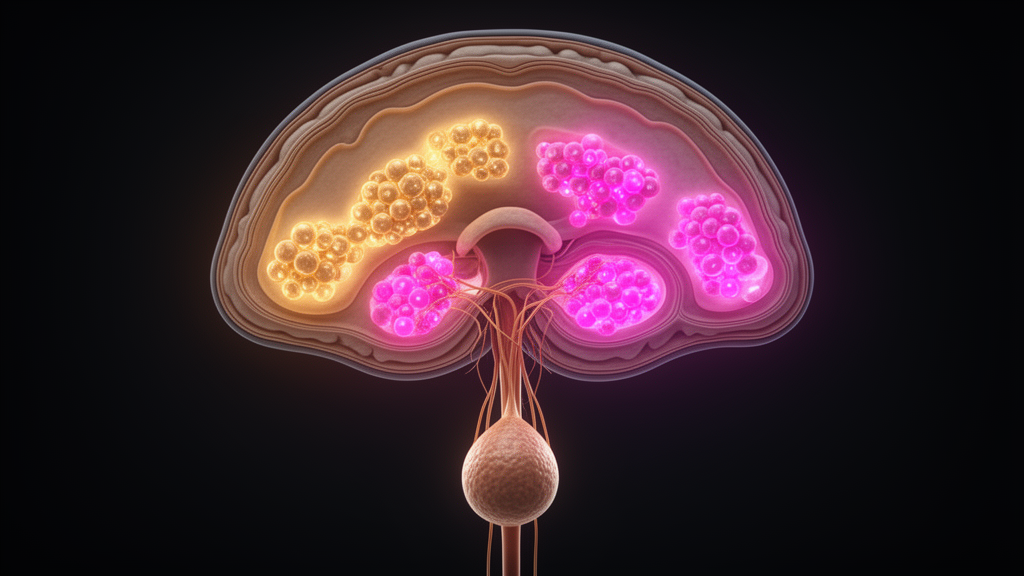
Huntingtin-associated protein 1, or HAP1, has long been known as a cytoplasmic protein that interacts with the huntingtin protein mutated in Huntington’s disease, where it participates in intracellular trafficking and vesicular transport. A new study in Frontiers in Cellular Neuroscience now provides the most detailed map yet of where this protein resides within the neuroendocrine circuits of the adult mouse hypothalamic–pituitary axis, and the answer is strikingly selective: HAP1 turns up in some hormone-producing cell types while being entirely absent from others.
The research team, led by Naoya Horiguchi, Md Nabiul Islam and colleagues at Yamaguchi University and Nagoya University of Arts and Sciences in Japan, examined adult male C57BL/6J mice using three complementary techniques: Western blotting to confirm the presence of the protein, single-label immunoperoxidase histochemistry to visualize its distribution, and double-label immunofluorescence combined with hormone-specific markers to identify exactly which cells contain it.
Across the pituitary gland, the staining pattern was compartmentalized. The anterior lobe showed moderate, scattered labeling; the intermediate lobe displayed diffuse expression; and the posterior lobe accumulated the protein intensely. This gradient alone suggested that HAP1 is not uniformly distributed but concentrated in specific neurosecretory compartments.
The cellular identities revealed by double labeling sharpened the picture considerably. In the anterior and intermediate pituitary, HAP1 was highly expressed in thyrotrophs, which produce thyroid-stimulating hormone; corticotrophs, which produce adrenocorticotropic hormone; and melanotrophs of the intermediate lobe. Gonadotrophs, by contrast, showed only relatively low levels of the protein. Most notably, somatotrophs and lactotrophs — the growth hormone- and prolactin-producing cells — lacked detectable HAP1 immunoreactivity altogether, demonstrating that the protein’s presence follows cell-type boundaries rather than simple lobe geography.
In the posterior pituitary, the story shifted from endocrine cells to neurosecretory axon terminals. HAP1 was absent from S100β-positive pituicytes, the glial cells of the neural lobe, but strongly co-localized with structures containing oxytocin and arginine vasopressin, the two major neuropeptides released from hypothalamic neurons into the bloodstream. The authors interpret these HAP1-rich, peptide-containing structures as putative Herring bodies, the dilated axonal swellings where neuropeptide-filled vesicles are stored before release.
Tracing the pathway upstream, the study found HAP1 prominently expressed in the magnocellular neurons of the paraventricular and supraoptic nuclei of the hypothalamus, the clusters of large neurosecretory cells whose axons project down the pituitary stalk to the posterior lobe. Double-label immunofluorescence showed extensive co-localization of HAP1 with oxytocin- and vasopressin-producing neurons in these nuclei.
Taken together, the findings describe a continuous HAP1-positive pathway running from the cell bodies of hypothalamic magnocellular neurons, along their neurosecretory projections, to the peptide-laden terminals in the posterior pituitary. The authors propose that this anatomical continuity provides a structural basis for investigating potential roles for HAP1 in vesicular trafficking, neuropeptide transport and the regulation of neurosecretion.
The selective pattern also raises questions about cellular vulnerability. HAP1 is considered a neuroprotective protein, and the authors suggest that its cell-type-specific distribution could contribute to selective resilience within neuroendocrine systems — a hypothesis that the current anatomical data motivate but do not test. The study is descriptive in scope: it maps protein localization in adult male mice and does not measure hormone secretion, transport kinetics or disease outcomes.
Because the work was conducted in mice using immunohistochemical detection, the findings establish where HAP1 resides rather than what it does functionally. Even so, the precise overlap with the oxytocin and vasopressin systems gives researchers a concrete anatomical starting point for future experiments on how huntingtin-associated protein 1 supports the logistics of neuropeptide delivery in the hypothalamic–pituitary axis, and how its disruption might affect neuroendocrine function.
Subject of Research: Cell-type-specific localization of huntingtin-associated protein 1 in the mouse hypothalamic–pituitary axis
Article Title: Cell-type-specific localization of huntingtin-associated protein 1 in neuroendocrine and neurosecretory systems of the mouse hypothalamic–pituitary axis
Article References: Horiguchi, N., Islam, M. N., Kobayashi, Y., Yanai, A., Oka, S., Shiraishi, K., & Shinoda, K. (2026). Cell-type-specific localization of huntingtin-associated protein 1 in neuroendocrine and neurosecretory systems of the mouse hypothalamic–pituitary axis. Frontiers in Cellular Neuroscience, 20, Article 1963485. https://doi.org/10.3389/fncel.2026.1963485
Image Credits: AI Generated
DOI: 10.3389/fncel.2026.1963485
Keywords: HAP1, huntingtin-associated protein 1, hypothalamic–pituitary axis, oxytocin, arginine vasopressin, neurosecretion, pituitary gland, magnocellular neurons, immunohistochemistry, neuroendocrinology, vesicular transport, Huntington's disease
News Source: Drew Townsend. (October 26, 2026). Huntingtin-Associated Protein 1 Maps to Specific Hormone Cells in the Mouse Hypothalamic–Pituitary Axis. Scienmag.