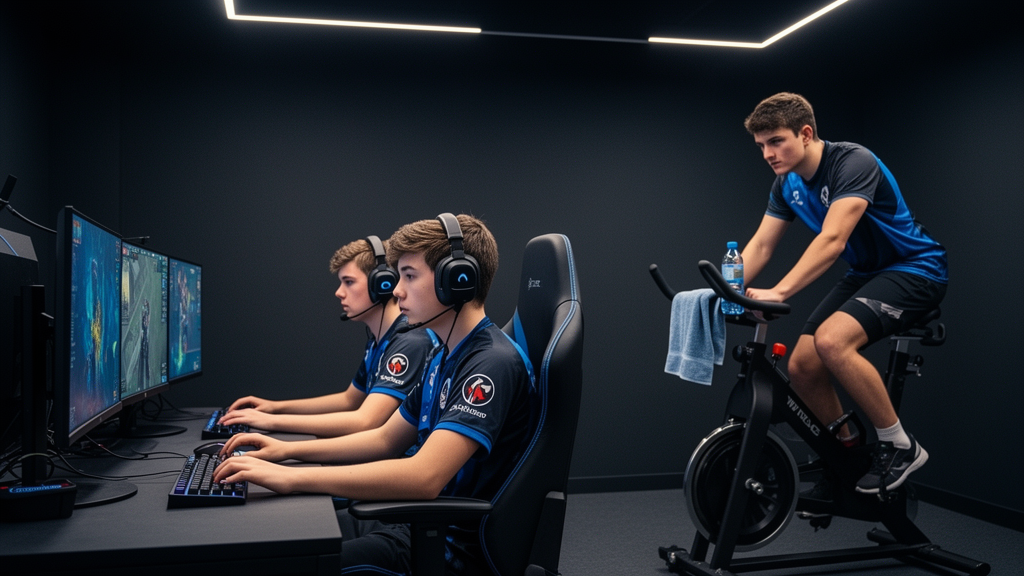
For the first time, researchers have shown that structured high-intensity interval training (HIIT) and cognitive-motor training (CMT) can be delivered to world-class professional esports players in the middle of an active competitive season, and their exploratory results reveal a strikingly mixed picture: a clear improvement in task-based reaction time, but no consistent group-level gains in actual in-game performance or resting cardiovascular measures. The study, published in Sports Medicine – Open, followed five professional League of Legends players and five professional Valorant players from the Karmine Corp organization at their training facility in Berlin between May and July 2024, during the League of Legends EMEA Championship (LEC) Summer Split and the Valorant Champions Tour (VCT) Stage 2, both decisive periods for playoff and world championship qualification.
The ten athletes were genuinely elite. The League of Legends players averaged 23 years of age with roughly 5.9 years of international competitive experience, while the Valorant players averaged 20.2 years with about 2.3 years at that level. Three of the League of Legends players had previously won the LEC or an international equivalent, all five Valorant players had won a VCT title, and nine had competed in at least one major international tournament, some achieving top-four placements. Because both the LEC and the VCT field ten teams of five, the sample represented roughly 10 percent of the player pool across the two leagues, which the authors argue supports the ecological relevance of the study even though it does not confer statistical representativeness. Inclusion required participation in international-level tournaments, a professional contract linked to international competition, a ranking among the top 0.01 percent of European players, and good physical and cognitive health.
The researchers used a longitudinal ecological multiple-baseline design with randomized intervention order and partial crossover, combining A-B, A-B-C, and A-B-C-D sequences. Each player first completed a baseline phase with no intervention, then received either HIIT or dual-task CMT for approximately four weeks, and six players crossed over to the alternate intervention afterward. A short maintenance phase followed the withdrawal of structured training for three participants. The HIIT program consisted of three circuits separated by two one-minute breaks, totaling 21 minutes and 20 seconds, with heart rate continuously monitored to target 70 to 90 percent of age-predicted maximal heart rate. The CMT program comprised six dual-task exercises of 3 minutes 30 seconds each, combining motor or physical tasks with cognitive challenges targeting fine motor skills, inhibitory control, working memory, task switching, and information processing, with difficulty progressing as players reached roughly 60 percent correct trials. The intended dose was two sessions per week for both interventions, with comparable total duration.
Implementation was the study’s most robust achievement. During the first training phase, retention was 100 percent and compliance reached 98.75 percent, with players completing an average of about 2.05 sessions per week. No intervention-related medical adverse events or injuries were documented. Yet delivering the programs required constant adaptation to the professional environment. Sessions were scheduled before, between, or after scrimmage blocks depending on player availability, recovery needs, and staff preferences, and logistical constraints occasionally produced differences of up to three days in session timing between players. One HIIT session was missed because of marked fatigue on the day before an official match and could not be rescheduled under the demanding League of Legends calendar, while another was missed due to transient illness but rescheduled because the Valorant calendar allowed more flexibility. Some HIIT sessions were shortened from three circuits to one or two for one player to account for accumulated fatigue and limited tolerance to the training load.
The competitive season itself reshaped the experiment. The early elimination of the Valorant team from the VCT cut the available study window, so the crossover phase could only include six participants, yielding a retention rate of 60.00 percent and a compliance rate of 81.25 percent for that phase. Only three players entered the maintenance phase, corresponding to a retention rate of 30.00 percent. These constraints, the authors note, are inseparable from the research question: the unforgiving nature of elite competition is precisely the environment in which any training intervention must survive. Notably, baseline questionnaires using the Global Physical Activity Questionnaire showed that none of the ten players met minimum physical activity recommendations, and eight reported no structured physical activity in the previous three months, meaning most entered the study with limited recent exposure to physical training, which may have influenced training tolerance, perceived exertion, and physiological responsiveness.
The clearest group-level result concerned cognition. On the Dots Task, a domain-general executive function test administered two to three times per week, mean reaction time in the full sample fell from 475.88 milliseconds at baseline to 422.81 milliseconds after the first training phase, a mean within-player reduction of 10.42 percent that remained significant after false discovery rate correction (pFDR = .008; d = 1.37). Similar corrected reductions appeared across nonswitch, switch, congruent, and incongruent trial conditions, with within-player reductions ranging from 8.01 to 12.58 percent. In the crossover subsample, reaction time fell by 16.40 percent from baseline to the second training phase, also surviving correction. However, the authors caution that repeated exposure to the same task structure may have contributed through familiarization effects despite randomized trial order, and because the reaction time gains were not accompanied by corresponding changes in in-game outcomes, the extent to which this task-based improvement transfers to professional esports performance remains unclear.
In-game performance told a more complicated story. The researchers built game-specific composite performance scores with Karmine Corp’s data analysts and coaching staff, normalizing context-adjusted ratios of combat contribution, survival, damage output, vision control, and other components for League of Legends, and combat-oriented indicators such as average combat score, KAST percentage, first kills, and first deaths for Valorant, drawing on an average of roughly 60 to 72 scrimmage games per phase against other professional teams. At the group level, no statistically significant differences emerged in any in-game outcome after training. The authors emphasize that players were simultaneously facing progressively stronger opposition, mounting competitive pressure, and accumulating fatigue, so maintaining stable performance under these conditions may itself be practically meaningful, but they stress it cannot be interpreted as evidence that the interventions preserved or improved competitive play, since performance is highly multifactorial and shaped by strategic adaptation, champion selection, teamwork, and natural variability.
Single-case analyses, which track each player’s trajectory against their own baseline trend, revealed substantial heterogeneity. Some patterns clustered around game- and role-relevant metrics: progressive reductions in deaths appeared predominantly among Valorant players, mostly those assigned to CMT, while kill-related improvements were more often seen alongside HIIT. Progressive gains in performance scores emerged mainly in carry-type roles, which combine high damage output with high exposure to opponent pressure. The authors also illustrate why isolated metrics mislead: one League of Legends attack damage carry’s improvement in creep score per minute coincided with a sharp drop in the use of a champion whose “fasting Senna” strategy transfers farming duties to the support, meaning the change may reflect champion selection rather than training effects. A jungler’s declining metrics may similarly reflect a supportive role in which individual output falls as team-oriented play rises, and the Valorant in-game leader’s mixed pattern may reflect the dual cognitive load of mechanical execution and continuous strategic shotcalling.
Physiological monitoring produced small-to-moderate but non-significant descriptive improvements in resting heart rate, heart rate variability score, and RMSSD, with heterogeneous individual patterns. The authors suggest the absence of robust group-level cardiovascular changes may partly reflect variation in the effective training dose, since some players could not complete all circuits on certain days, as well as the short intervention phases and the pervasive influence of competitive stress, irregular sleep, and limited recovery on autonomic state. Perceived exertion ratings underscored the modality contrast: HIIT averaged 7.44 on a 0-to-10 scale compared with 1.89 for CMT, while CMT was rated as more enjoyable, 3.70 versus 2.53 on the combined enjoyment and anticipation scale, a difference the authors link to sustained engagement in physical activity. Single-case analyses showed RT reductions appearing more consistently across task conditions during HIIT phases and more condition-specific during CMT phases, though these modality-specific interpretations are limited by the small, game-imbalanced crossover subsample and the absence of a washout period.
The study’s limitations are considerable and openly acknowledged: ten participants, no non-training control group for ethical reasons, no washout period between interventions, ultra-short one-minute heart rate recordings interpreted with caution, and a game-imbalanced crossover subsample after the Valorant team’s elimination. The authors conclude that structured HIIT and CMT are feasible in world-class professional esports, that responses appear strongly context-dependent across game title, role, individual profile, and daily player state, and that the practical value of any training modality depends not only on its potential benefits but on whether it can be sustainably integrated into the demanding reality of a professional competitive season. The findings, they write, provide preliminary ecological evidence for individualized, context-sensitive training approaches rather than confirmatory proof of efficacy.
Subject of Research: Feasibility and training-related outcomes of HIIT and cognitive-motor training in professional esports players during a competitive season
Article Title: Implementation and Training-Related Outcomes of High-Intensity Interval Training and Cognitive-Motor Training in Professional League of Legends and Valorant Players: A First Exploratory Ecological Study Across In-Game, Cognitive, and Physiological Domains
Article References: Thillier, C., Besombes, N., Agbangla, N. F., & Vitiello, D. (2026). Implementation and Training-Related Outcomes of High-Intensity Interval Training and Cognitive-Motor Training in Professional League of Legends and Valorant Players: A First Exploratory Ecological Study Across In-Game, Cognitive, and Physiological Domains. Sports Medicine – Open, 12(1), Article 160. https://doi.org/10.1186/s40798-026-01134-6
Image Credits: AI Generated
DOI: 10.1186/s40798-026-01134-6
Keywords: esports, League of Legends, Valorant, HIIT, cognitive-motor training, executive functions, reaction time, heart rate variability, in-game performance, competitive gaming, exercise intervention, sports science
News Source: Ophelia Keating. (October 26, 2026). Elite Esports Players Tested HIIT and Cognitive Training During a Real Season. Scienmag.