• HOME
  • NEWS
  • EXPLORE
    • CAREER
      • Companies
      • Jobs
    • EVENTS
    • iGEM
      • News
      • Team
    • PHOTOS
    • VIDEO
    • WIKI
  • BLOG
  • COMMUNITY
    • FACEBOOK
    • INSTAGRAM
    • TWITTER
Monday, October 26, 2026
BIOENGINEER.ORG
No Result
View All Result
  • Login
  • HOME
  • NEWS
  • EXPLORE
    • CAREER
      • Companies
      • Jobs
        • Lecturer
        • PhD Studentship
        • Postdoc
        • Research Assistant
    • EVENTS
    • iGEM
      • News
      • Team
    • PHOTOS
    • VIDEO
    • WIKI
  • BLOG
  • COMMUNITY
    • FACEBOOK
    • INSTAGRAM
    • TWITTER
No Result
View All Result
Bioengineer.org
No Result
View All Result
Home NEWS Science News Biology

Mannose-Coated Selenium Nanoparticles Show Potent Anti-Biofilm Activity Against Foodborne Pathogens

by
October 26, 2026
in Biology
Reading Time: 2 mins read
0
Mannose-Coated Selenium Nanoparticles Show Potent Anti-Biofilm Activity Against Foodborne Pathogens

Mannose-Coated Selenium Nanoparticles Show Potent Anti-Biofilm Activity Against Foodborne Pathogens

Share on FacebookShare on TwitterShare on LinkedinShare on RedditShare on Telegram

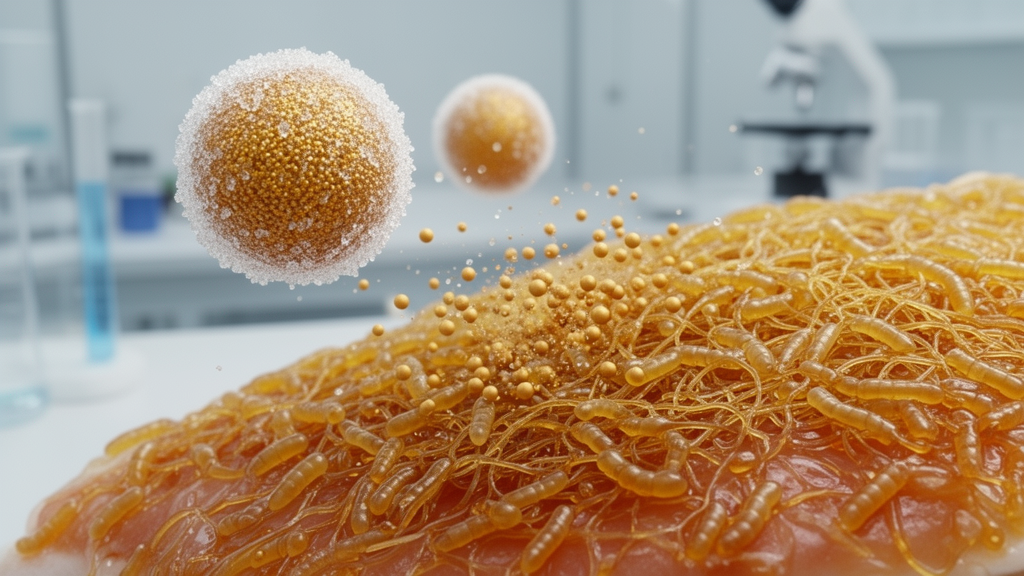
Selenium nanoparticles stabilized by a hyperbranched poly-D-mannose shell have shown strong, species-dependent inhibition of biofilms formed by major foodborne pathogens, according to a research article published in Food Science and Biotechnology. The composite, designated HBPM-SeNPs, was developed to address a persistent weakness of selenium nanoparticles as antimicrobial agents: poor stability.

The team constructed the nanocomposite by using hyperbranched poly-D-mannose (HBPM) as a stabilizer during nanoparticle synthesis. Characterization by dynamic light scattering, transmission electron microscopy, and energy-dispersive X-ray spectroscopy indicated that the three-dimensional topology of HBPM regulates both the formation and the stabilization of the selenium nanoparticles.

The resulting particles measured 89.88 nanometers in diameter with a polydispersity index of 0.133 and a zeta potential of −20 mV, and the formulation maintained its stability for 34 days.

In antibacterial assays, HBPM-SeNPs inhibited planktonic — free-floating — bacteria in a species-dependent manner across five tested foodborne pathogens: Escherichia coli O157:H7, Salmonella typhimurium, Staphylococcus aureus, Pseudomonas aeruginosa, and Bacillus cereus. The strongest activity was recorded against S. aureus.

When the researchers measured effects on biofilm formation, the composite at a concentration of 8.1 micrograms per milliliter achieved 100 percent inhibition against S. aureus and 94.24 percent against B. cereus, exceeding its efficacy against most of the Gram-negative bacteria tested.

The authors attribute this high efficacy to the synergistic action of multivalent mannose-mediated adhesion competition, spatial isolation provided by the hyperbranched architecture, and the intrinsic activity of the selenium nanoparticles themselves.

The findings come with the scope limitations of laboratory characterization and in vitro antibacterial assays. The reported inhibition percentages apply to the tested conditions and organisms, and the work does not establish performance on actual food contact surfaces, in complex food matrices, or under industrial sanitation regimes.

Even so, the study presents a stable, mannose-stabilized selenium nanocomposite with measurable anti-biofilm potency, and it offers a selenium-based strategy for combating biofilm contamination in food processing.

Subject of Research: Hyperbranched poly-D-mannose-stabilized selenium nanoparticles for inhibiting biofilms of foodborne pathogens

Article Title: Fabrication of hyperbranched poly-D-mannose-based selenium nanoparticles and their inhibition on biofilms of foodborne pathogens

Article References: Tian, D., Zhang, C., Zhang, H., Zhang, F., Xu, M., Wang, Z., Xin, T., Zou, J., & Li, C. (2026). Fabrication of hyperbranched poly-D-mannose-based selenium nanoparticles and their inhibition on biofilms of foodborne pathogens. Food Science and Biotechnology. https://doi.org/10.1007/s10068-026-02341-3

Image Credits: AI Generated

DOI: 10.1007/s10068-026-02341-3

Keywords: selenium nanoparticles, biofilms, foodborne pathogens, poly-D-mannose, food safety, Staphylococcus aureus, Bacillus cereus, nanocomposite, antibacterial assays, food processing, Fabrication, hyperbranched

News Source: Kimberly Hamilton. (October 26, 2026). Mannose-Coated Selenium Nanoparticles Show Potent Anti-Biofilm Activity Against Foodborne Pathogens. Scienmag.


Tags: antibacterial assaysBacillus cereusbiofilmsfabricationfood processingfood safetyfoodborne pathogenshyperbranchednanocompositepoly-D-mannoseselenium nanoparticlesStaphylococcus aureus
Share12Tweet7Share2ShareShareShare1

Related Posts

Ten Iranian patients expand the genetic spectrum of classical homocystinuria

Ten Iranian patients expand the genetic spectrum of classical homocystinuria

October 26, 2026
Early Pyrethroid Resistance Detected in Dengue Mosquitoes from Southern India

Early Pyrethroid Resistance Detected in Dengue Mosquitoes from Southern India

October 26, 2026

Conservation Genomists Call Time on the Vague Term Hybrid Swarm

October 26, 2026

First fully marine amphibian relative discovered in 237-million-year-old Chinese rocks

October 26, 2026

POPULAR NEWS

  • Machine learning model predicts 28-day mortality in sepsis patients with diabetic retinopathy

    Machine learning model predicts 28-day mortality in sepsis patients with diabetic retinopathy

    29 shares
    Share 12 Tweet 7
  • POLARIS cohort tests whether ARDS phenotypes can reach every ICU

    29 shares
    Share 12 Tweet 7
  • Stem cells wrapped in hydrogel restore ovarian structure in PCOS rats

    29 shares
    Share 12 Tweet 7
  • Ten Iranian patients expand the genetic spectrum of classical homocystinuria

    29 shares
    Share 12 Tweet 7

About

We bring you the latest biotechnology news from best research centers and universities around the world. Check our website.

Follow us

Recent News

Machine learning model predicts 28-day mortality in sepsis patients with diabetic retinopathy

POLARIS cohort tests whether ARDS phenotypes can reach every ICU

Stem cells wrapped in hydrogel restore ovarian structure in PCOS rats

Subscribe to Blog via Email

Enter your email address to subscribe to this blog and receive notifications of new posts by email.

Join 85 other subscribers
  • Contact Us

Bioengineer.org © Copyright 2023 All Rights Reserved.

Welcome Back!

Login to your account below

Forgotten Password?

Retrieve your password

Please enter your username or email address to reset your password.

Log In
No Result
View All Result
  • Homepages
    • Home Page 1
    • Home Page 2
  • News
  • National
  • Business
  • Health
  • Lifestyle
  • Science

Bioengineer.org © Copyright 2023 All Rights Reserved.