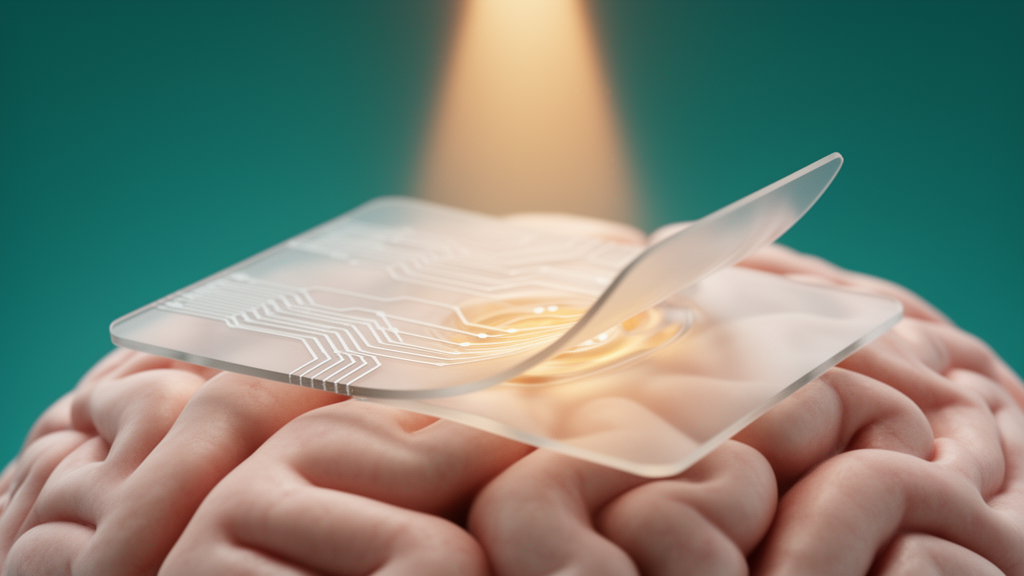
Implantable neural electronics face a persistent materials dilemma: electrodes must grip tissue tightly enough to record clean signals over weeks or months, yet any device that may eventually need to be repositioned or retrieved risks tearing delicate neural tissue if its adhesion is permanent. A team reporting in npj Flexible Electronics has now built a photo-programmable biointerface designed to resolve this tension, pairing strong, stable bonding with on-demand release triggered by ultraviolet light.
The core of the system is a self-healing matrix the researchers call bPDMS@Fe, constructed from a carboxyl-functionalized polydimethylsiloxane network dynamically crosslinked by coordination bonds between iron ions and carboxylate groups. Because these Fe3+-carboxylate coordination bonds are reversible, the material can re-form connections after damage, giving it self-healing behavior, while remaining chemically responsive to external stimuli. According to the study, the resulting electrode adheres robustly to a range of substrates and to biological tissues, and its adhesion can be weakened on demand through UV illumination, allowing controlled debonding without mechanical force.
The team demonstrated the interface first in a peripheral setting: the material supported stable epidermal electrocardiogram recordings under various conditions, showing that the adhesive layer maintains reliable electrical contact with skin even as the body moves. This surface-level application served as a testbed for the adhesion and signal-fidelity properties before the same materials strategy was scaled down and made implantable.
Translated into an implantable format, the biointerface became a nine-channel cortical electrode array. In freely moving mice, the array delivered stable local field potential recordings and enabled spatiotemporal mapping of seizure-associated neural activity, capturing how abnormal activity propagates across the cortical surface over time. Stable long-term contact between electrode and cortex is critical for such chronic recordings, since even small shifts in positioning degrade signal quality, and the adhesive dynamic interface is intended to maintain that contact throughout the monitoring period.
The authors position the work as establishing a dynamic adhesive strategy, a new materials design paradigm for neural bioelectronic interfaces aimed at next-generation chronic electrophysiological monitoring devices. The design logic is that the same reversible coordination chemistry that grants self-healing also provides a remote-control release mechanism: light exposure weakens the bonding network, so a device can be removed or reconfigured deliberately rather than surgically forcing a permanently bonded implant away from tissue.
As with any early-stage materials demonstration, the findings so far come from the specific systems tested: epidermal ECG in the reported conditions and cortical recording in mice. The study was published as open-access peer-reviewed research in npj Flexible Electronics on 26 October 2026, with the team led by Zili Li, Binbin Hu, Quansheng He and colleagues including Yousheng Shu and Miao Tang. Whether the UV-triggered debonding and chronic recording performance translate to larger animals and clinical timelines remains to be established by future work, but the demonstration marks a concrete step toward neural interfaces that are simultaneously durable in place and retrievable by design.
Subject of Research: Light-programmable adhesive biomaterial interfaces for flexible neural bioelectronics and chronic electrophysiology
Article Title: Light-regulated biomaterial interfaces enable flexible neural bioelectronics with stable adhesion and on-demand detachment for chronic electrophysiology
Article References: Li, Z., Hu, B., He, Q., Wang, Z., Sun, L., Yang, H., Zhang, X., Guo, H., Shu, Y., & Tang, M. (2026). Light-regulated biomaterial interfaces enable flexible neural bioelectronics with stable adhesion and on-demand detachment for chronic electrophysiology. npj Flexible Electronics. https://doi.org/10.1038/s41528-026-00659-w
Image Credits: AI Generated
DOI: 10.1038/s41528-026-00659-w
Keywords: neural interfaces, biomaterials, flexible electronics, photo-programmable adhesion, self-healing polymer, Fe3+-carboxylate coordination, cortical electrodes, local field potentials, seizure mapping, chronic electrophysiology, npj Flexible Electronics, Light-regulated
News Source: Cassandra Pierce. (October 26, 2026). Light-Controlled Adhesive Interface Lets Neural Implants Stick Firmly and Detach on Demand. Scienmag.