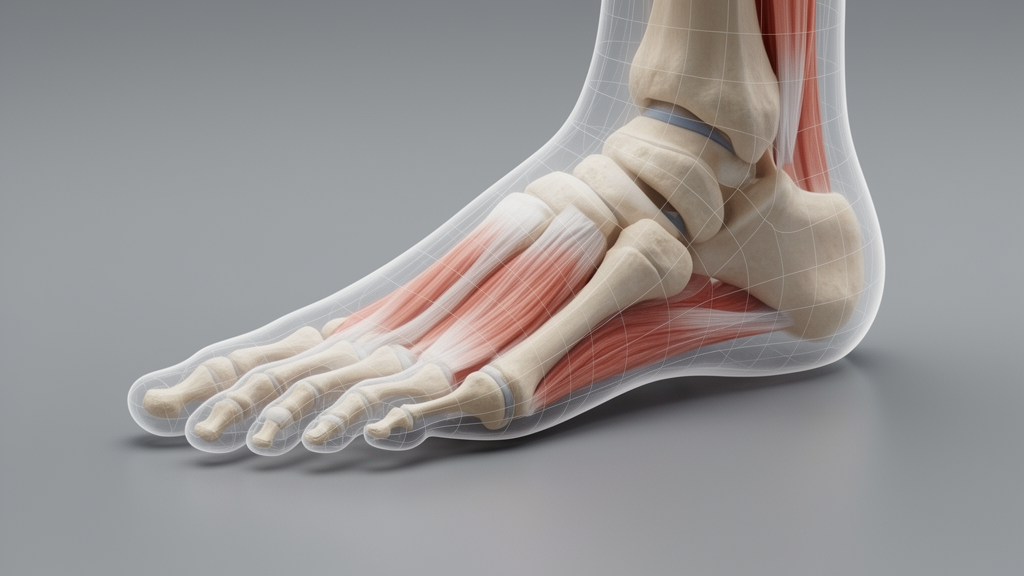
Personalized foot-ground contact models significantly enhance the accuracy of predictive walking simulations compared to generic models, according to a study published in the Annals of Biomedical Engineering. The research addresses a critical limitation in biomechanics: the difficulty of measuring ground reaction forces outside of controlled laboratory settings. By calibrating specific contact parameters to individual subjects, the team demonstrated that simulations can more reliably estimate joint loads and motions.
This capability is essential for clinical applications where only motion data is available, as it allows for the estimation of forces that cannot be directly measured without specialized hardware like force plates. The primary motivation for this research stems from the growing interest in quantifying walking function without the use of expensive force plates. While motion capture systems can track joint movements, they do not directly measure the forces exerted by the ground on the foot.
Consequently, researchers often rely on computational optimizations to estimate these ground reactions and the resulting joint loads. However, previous studies have typically employed generic foot-ground contact models, which use standardized parameter values that may not reflect the unique biomechanical properties of an individual’s foot. This study investigates whether the effort required to personalize these models yields a meaningful improvement in predictive performance.
The study utilized experimental walking data from three subjects in varying states of health: a healthy male, a stroke survivor with right-sided hemiparesis, and a male with a pelvic sarcoma. This diverse cohort allowed the researchers to test the robustness of the models across different gait patterns and physical conditions. The data included marker-based motion capture and ground reaction forces collected on an instrumented treadmill.
By using subjects with different health profiles, the researchers ensured that the findings were not limited to idealized, healthy gait cycles, but were applicable to a range of movement impairments. Two distinct computational approaches were employed to compare the generic and personalized models. The first was a calibration optimization, which evaluated how well each model could reproduce experimental ground reaction and foot motion data simultaneously.
The second was a tracking optimization, which estimated ground reactions and joint loads from kinematic data alone while solving for dynamic consistency. This latter approach is particularly relevant for real-world applications where only motion data is available. The personalized models were calibrated using the Neuromusculoskeletal Modeling Pipeline, an automated tool that adjusts stiffness, damping, and friction parameters to match individual subject data.
The results indicated that personalized foot-ground contact models consistently outperformed generic models across all subjects and both optimization types. In calibration optimizations, the personalized models reduced root mean square errors in ground reaction forces and moments by approximately 40 to 60 percent compared to the generic models. More significantly, in tracking optimizations, the personalized models reduced errors in predicted ground reactions by 60 to 80 percent.
One of the most notable findings was that the personalized models not only improved accuracy but also reduced computation time in tracking optimizations. For two of the three subjects, the simulations using personalized models converged in fewer iterations and less time than those using generic models. This efficiency gain is crucial for researchers who need to run multiple simulations for the same subject, as it lowers the computational barrier to high-fidelity modeling.
The study also highlighted that simply increasing the density of contact elements in a generic model does not replicate the benefits of personalization, indicating that the specific tuning of parameters to individual anatomy is the key factor in improved performance. The authors noted several limitations that must be considered when interpreting these results. The study used high-quality, marker-based motion capture data, which represents a best-case scenario for input accuracy.
In real-world settings, lower-quality data from inertial measurement units or markerless video systems may lead to less accurate model calibration. Additionally, the simulations were torque-driven and did not account for muscle dynamics, which could influence the results when predicting new motions. The study also relied on a single gait cycle for calibration, and while this was sufficient for the current analysis, future work should explore the impact of using multiple cycles to improve model robustness.
Despite these limitations, the study provides strong evidence that personalizing foot-ground contact models is worth the computational effort. The significant reductions in error for ground reactions and joint loads suggest that personalized models can provide more reliable insights into walking mechanics. The study demonstrates that automated tools can streamline the personalization process, making it feasible for a wider range of researchers and clinicians to adopt these methods.
In conclusion, this study highlights the importance of personalizing foot-ground contact models for predictive simulations of walking. By demonstrating significant improvements in accuracy and efficiency, the researchers have shown that generic models are insufficient for capturing the nuances of individual gait.
Subject of Research: Comparison of generic and personalized foot-ground contact models for predictive walking simulations
Article Title: Generic Versus Personalized Foot-Ground Contact Models for Predictive Simulations of Walking: Is Personalization Worth the Effort?
Article References: Williams, S. T., Li, G., & Fregly, B. J. (2026). Generic Versus Personalized Foot-Ground Contact Models for Predictive Simulations of Walking: Is Personalization Worth the Effort?. Annals of Biomedical Engineering. https://doi.org/10.1007/s10439-026-04386-1
Image Credits: AI Generated
DOI: 10.1007/s10439-026-04386-1
Keywords: biomechanics, walking simulation, foot-ground contact, personalized modeling, inverse dynamics, gait analysis, clinical applications, computational modeling, Generic, Versus, Personalized, Foot-Ground
News Source: Ophelia Keating. (October 26, 2026). Personalized Foot Models Improve Walking Simulation Accuracy. Scienmag.