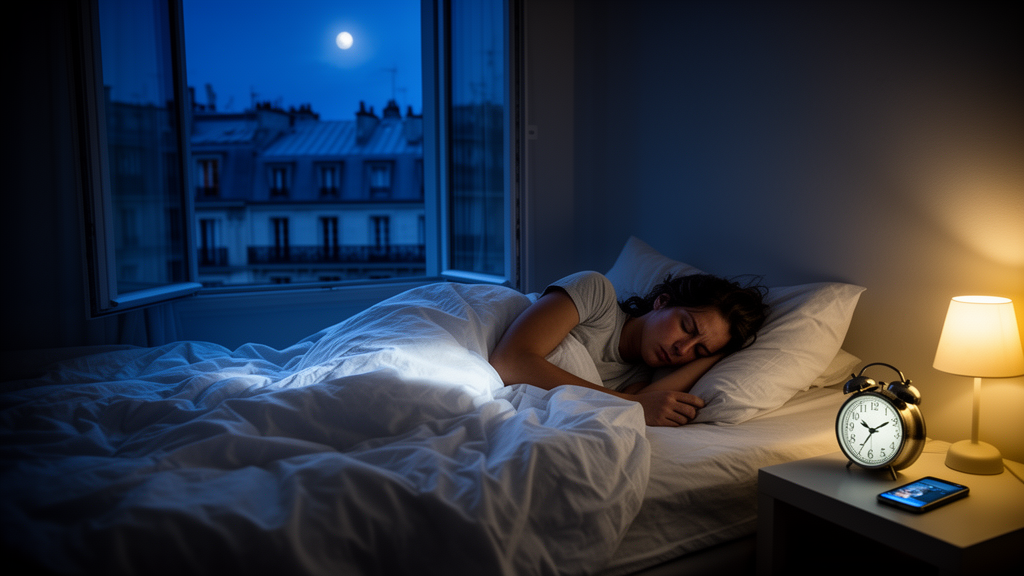
An international team of sleep researchers warns that sleep health is becoming an increasingly important public-health challenge across Europe, with climate change, urban living, digital misinformation, modern working patterns and unequal access to care creating interconnected pressures on sleep. Their peer-reviewed policy paper, “A Call to Action: Challenges and Future Directions for Sleep Health in Europe,” was prepared through the Equality, Diversity and Inclusion Committee and the Early Career Network of the European Sleep Research Society. Led by Dr Fran Pilkington-Cheney of Nottingham Trent University and Dr Adrian Michalak of the University of Modena and Reggio Emilia, the paper was published in the Journal of Sleep Research on 18 October 2026. It identifies current and emerging threats to sleep and calls for coordinated action across health, policy, employment, education, technology and urban planning.
Environmental conditions form a major focus. The researchers say noise pollution, artificial light and poor air quality can make sleep more difficult, particularly in densely populated areas and poorer-quality housing. Rising nighttime temperatures, more frequent heatwaves and exposure to extreme heat can also disrupt sleep. The paper associates heat-related sleep disruption with potential consequences for heart and mental health and with sleep apnoea, and warns that the challenge could intensify in the future. Displacement arising from climate change or conflict is another concern because it can interact with the loss of stable housing and energy poverty, creating sleep disturbances that may persist for many years.
The paper also highlights substantial inequalities in access to sleep healthcare. Access to medicines, specialist services, diagnosis and treatment pathways varies considerably across communities, while shortages of trained sleep professionals can leave some people struggling to obtain support. At the same time, researchers raise concerns about what they describe as a growing fixation on optimizing and tracking sleep. The volume of advice available online includes the rise of “sleepmaxxing” and “orthosomnia,” terms applied to obsessive efforts to achieve “perfect” sleep through wearable devices. Misleading or inaccurate information on social media and other digital platforms may shape people’s understanding of sleep and encourage unrealistic expectations. The authors say many sleep-tracking technologies require stronger evidence and should not be regarded as substitutes for individual advice from independent professionals.
Modern working and living patterns add to the concerns. Shift work, constant connectivity, after-hours communications, widespread screen use and a society organized around a 24-hour culture can disrupt natural sleep patterns and reduce opportunities for rest and recovery. Pilkington-Cheney said the situation resembles a “perfect storm” of challenges: people know that sleep matters, but few recognize how climate change, technology, shift work, urban environments and misinformation combine to influence sleep quality. The researchers argue that these pressures are likely to become more significant unless wider coordinated action is taken, although the European Sleep Research Society already has initiatives addressing some of the issues.
The proposed response extends beyond individual diagnosis and treatment. The paper calls for sleep health to receive greater recognition as a public-health issue and for coordinated engagement by policymakers, healthcare providers, educators, employers, environmental planners and technology developers. Priorities include improving sleep-health literacy through public education and professional training, countering misinformation, clarifying regulation of working hours, digital technologies and environmental exposures, addressing structural inequalities, developing the sleep-health workforce, supporting responsible use of digital tools, and improving housing, lighting and personal and workplace environments. An appendix organizes the recommendations within a PESTEL framework—political, economic, sociological, technological, legal and environmental—to support policy development. The paper’s central message is that protecting sleep health in Europe will require coordinated action that connects clinical care with the social, technological and environmental conditions in which people live and work.
Subject of Research: Environmental, occupational, digital and healthcare threats to sleep health across Europe
Article Title: Researchers warn of growing threats to sleep health across Europe
Article References: Researchers warn of growing threats to sleep health across Europe. Original publication (Bibliographic details unavailable.)
Image Credits: AI Generated
DOI: Not provided
Keywords: sleep health, Europe, climate change, urban environments, shift work, sleep tracking, health misinformation, health inequalities, public health, environmental exposure, Researchers, warn
News Source: Ophelia Keating. (October 26, 2026). Researchers warn of growing threats to sleep health across Europe. Scienmag.