• HOME
  • NEWS
  • EXPLORE
    • CAREER
      • Companies
      • Jobs
    • EVENTS
    • iGEM
      • News
      • Team
    • PHOTOS
    • VIDEO
    • WIKI
  • BLOG
  • COMMUNITY
    • FACEBOOK
    • INSTAGRAM
    • TWITTER
Monday, July 13, 2026
BIOENGINEER.ORG
No Result
View All Result
  • Login
  • HOME
  • NEWS
  • EXPLORE
    • CAREER
      • Companies
      • Jobs
        • Lecturer
        • PhD Studentship
        • Postdoc
        • Research Assistant
    • EVENTS
    • iGEM
      • News
      • Team
    • PHOTOS
    • VIDEO
    • WIKI
  • BLOG
  • COMMUNITY
    • FACEBOOK
    • INSTAGRAM
    • TWITTER
  • HOME
  • NEWS
  • EXPLORE
    • CAREER
      • Companies
      • Jobs
        • Lecturer
        • PhD Studentship
        • Postdoc
        • Research Assistant
    • EVENTS
    • iGEM
      • News
      • Team
    • PHOTOS
    • VIDEO
    • WIKI
  • BLOG
  • COMMUNITY
    • FACEBOOK
    • INSTAGRAM
    • TWITTER
No Result
View All Result
Bioengineer.org
No Result
View All Result
Home NEWS Science News Biology

Rolling dice for cell size specification in plant leaf epidermis

Bioengineer by Bioengineer
September 20, 2017
in Biology
Reading Time: 2 mins read
0
Share on FacebookShare on TwitterShare on LinkedinShare on RedditShare on Telegram
IMAGE

Credit: NIBB

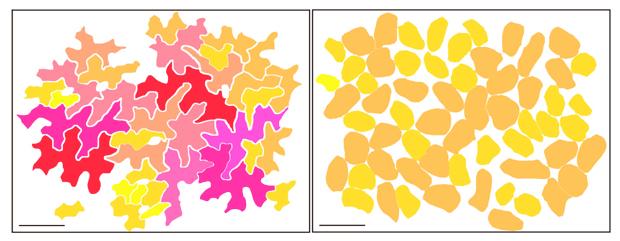
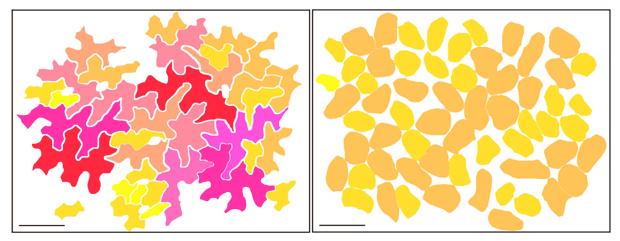
One of the central questions in biology is how a cell specifies its size. Because size distribution often shows a characteristically skewed pattern in a tissue, there may be some stochastic option for determining cell size. However, the underlying mechanism by which the target distribution is established by organizing a cellular coin-toss remains elusive. Associate Professor Kensuke Kawade at Okazaki Institute for Integrative Bioscience and National Institute for Basic Biology, in collaboration with Professor Hirokazu Tsukaya at the Graduate School of Science, the University of Tokyo, discovered that endoreduplication, which promotes cellular enlargement in the epidermal tissue of Arabidopsis thaliana, occurs randomly as a Poisson process throughout cellular maturation.

This finding enabled the team to effectively reproduce experimentally measured dynamics of endoreduplication with a simple mathematical model. They then investigated whether this model was sufficient to explain cell size variation in epidermal tissue. They generated an artificial cell size distribution using the mathematical model by considering the effects of endoreduplication on cell size specification. This analysis revealed that cell size was determined by endoreduplication-dependent exponential boosting, and size heterogeneity was induced by Poissonian endoreduplication dynamics.

These results link the probabilistic property of endoreduplication dynamics to cell size distribution, providing a theoretical background to explain how size heterogeneity is established within a leaf. This work will also contribute to a quantitative understanding of how stochastic dynamics generates steady-state biological heterogeneity. The results of this research were published in PLOS ONE on September 19th, 2017.

###

PLOS ONE
"Probing the stochastic property of endoreduplication in cell size determination of Arabidopsis thaliana leaf epidermal tissue."
Kensuke Kawade and Hirokazu Tsukaya
Published online 19th September 2017.
https://doi.org/10.1371/journal.pone.0185050

National Institute for Basic Biology

The University of Tokyo

Media Contact

NIBB Office of PR
[email protected]

http://www.nins.jp/english/

Original Source

http://www.nibb.ac.jp/en/press/2017/09/20.html http://dx.doi.org/10.1371/journal.pone.0185050

Share12Tweet8Share2ShareShareShare2

Related Posts

Early RNA Life May Have Repaired Genomes, Shedding Light on Origins

Early RNA Life May Have Repaired Genomes, Shedding Light on Origins

July 13, 2026
Chonnam University uncovers isoform-specific HIF signaling in muscles

Chonnam University uncovers isoform-specific HIF signaling in muscles

July 13, 2026

Han directs new $15M NIH center for organ-on-chip technology

July 11, 2026

Bacteriophages Enable Next-Gen Smart Pathogen Detection Sensors

July 10, 2026
Please login to join discussion

POPULAR NEWS

  • Detection of EDCs in Breast Milk and Infant Urine Up to Six Months Highlights Early Exposure Risks

    77 shares
    Share 31 Tweet 19
  • New Drug Candidate Developed at McMaster Shows Potential for Treating Brain Cancer

    58 shares
    Share 23 Tweet 15
  • KTU Researchers Explore Ultrasound’s Role in Enhancing Blood Flow Beyond Diagnostics

    53 shares
    Share 21 Tweet 13
  • Experimental Therapy Simultaneously Destroys Prostate Tumor Cells and Reactivates Antitumor Immunity

    46 shares
    Share 18 Tweet 12

About

We bring you the latest biotechnology news from best research centers and universities around the world. Check our website.

Follow us

Recent News

Hypothermic Preservation Extends Function in Aging Isolated Hepatocytes

Early Chemistry Boosts 847 mV Voltage in Wide-Bandgap CZTS Solar Cells

Perineurium Links Leptin to Sympathetic Response to Combat Obesity

Subscribe to Blog via Email

Enter your email address to subscribe to this blog and receive notifications of new posts by email.

Join 85 other subscribers
  • Contact Us

Bioengineer.org © Copyright 2023 All Rights Reserved.

Welcome Back!

Login to your account below

Forgotten Password?

Retrieve your password

Please enter your username or email address to reset your password.

Log In
No Result
View All Result
  • Homepages
    • Home Page 1
    • Home Page 2
  • News
  • National
  • Business
  • Health
  • Lifestyle
  • Science

Bioengineer.org © Copyright 2023 All Rights Reserved.