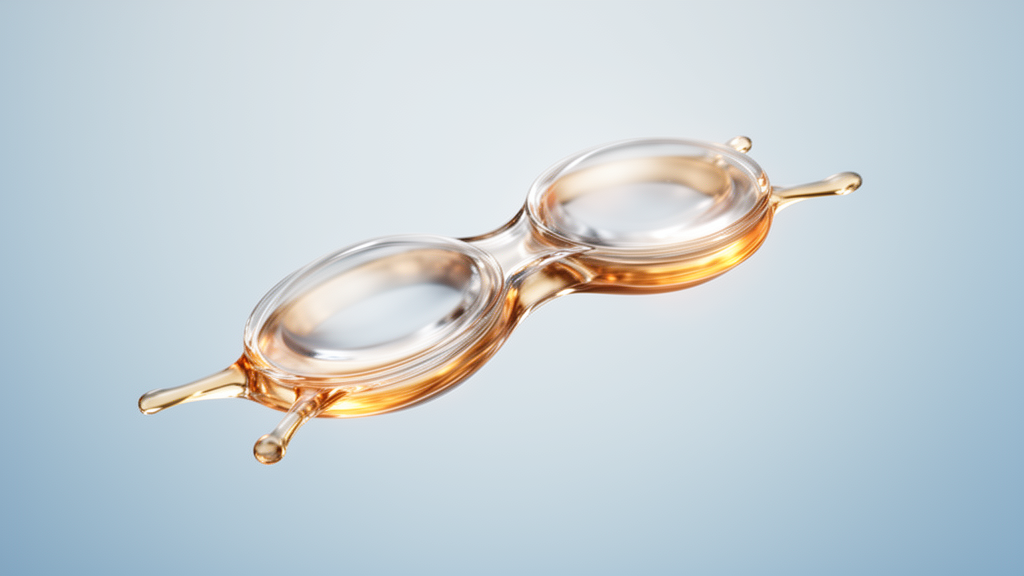
Artificial lenses that could restore the eye’s lost ability to change focus remain a goal of cataract surgery research, and a new computational study suggests that two engineering choices, the shape of the lens supports and the materials used, may strongly shape how such devices perform. In a finite element analysis published in Annals of Biomedical Engineering, researchers built twelve simulated dual-optic accommodative intraocular lenses and subjected each to the same inward radial compression, then traced how mechanical deformation translated into changes in optical power. The results show that haptic design and material selection jointly determine both the mechanical behavior and the paraxial power response of these lenses.
Dual-optic accommodative intraocular lenses, or AIOLs, consist of two optics connected by flexible haptic supports, and they are intended to mimic the natural accommodation that the crystalline lens loses with age and after cataract removal. The team, which included Yunxin Xia, Jiangzhen Guo, Chunjing Tao, Barbara K. Pierscionek and Kehao Wang, constructed models combining three haptic designs, described as non-folded, mono-folded, and multi-folded, with four different combinations of optic materials. A prescribed radial inward displacement was applied to every model, allowing the researchers to calculate deformation patterns, reaction forces, and stress distributions. The resulting deformations were then fed into optical ray tracing to evaluate how much the refractive power changed under each configuration.
The simulations revealed a clear hierarchy among the haptic designs. At a common radial displacement, both the multi-folded and mono-folded haptics produced greater changes in optical power than the non-folded design. The multi-folded design yielded a greater power change per unit force than the mono-folded design, meaning that less mechanical effort is required for the same optical effect in the simulated conditions. Material combinations also influenced the magnitude of refractive power change, indicating that neither geometry nor material properties alone can be optimized in isolation when designing these lenses.
The stress analysis added a further dimension to the comparison. In the mono-folded and multi-folded configurations, high stresses concentrated at the peripheral region of the anterior optic, while in the non-folded design they accumulated at the junction between the posterior optic and the haptic. The authors conclude that the simulated paraxial power response and biomechanical behavior of dual-optic AIOLs are jointly determined by haptic design and material selection, and that both factors should be considered together in future AIOL development.
The study is limited by its computational nature: the findings derive from finite element modeling under prescribed radial compression rather than from clinical or experimental measurements, so real-world performance in the eye remains to be verified. Even so, the work offers a practical engineering reference. By showing that a multi-folded haptic architecture converted mechanical compression into optical power change more efficiently than the alternatives in these simulations, and by pinpointing where stresses concentrate in each design, the analysis gives lens developers concrete parameters to refine. For cataract patients who currently rely on fixed-focus artificial lenses, the prospect of a truly accommodating implant depends on exactly this kind of optomechanical optimization, and the new models suggest that the path forward runs through careful co-design of haptic geometry and lens materials.
Subject of Research: Optomechanical finite element analysis of dual-optic accommodative intraocular lenses
Article Title: An Optomechanical Analysis Revealing the Importance of Haptic Design and Material Selection in Shaping the Performance of Dual-Optic Accommodative IOLs
Article References: Xia, Y., Guo, J., Tao, C., Pierscionek, B. K., & Wang, K. (2026). An Optomechanical Analysis Revealing the Importance of Haptic Design and Material Selection in Shaping the Performance of Dual-Optic Accommodative IOLs. Annals of Biomedical Engineering. https://doi.org/10.1007/s10439-026-04441-x
Image Credits: AI Generated
DOI: 10.1007/s10439-026-04441-x
Keywords: accommodative intraocular lenses, cataract surgery, finite element analysis, haptic design, biomaterials, optics, biomedical engineering, optomechanics, ray tracing, stress analysis, Optomechanical, Analysis
News Source: Ophelia Keating. (October 25, 2026). Haptic Design and Material Choice Steer Performance of Dual-Optic Accommodative Lenses. Scienmag.