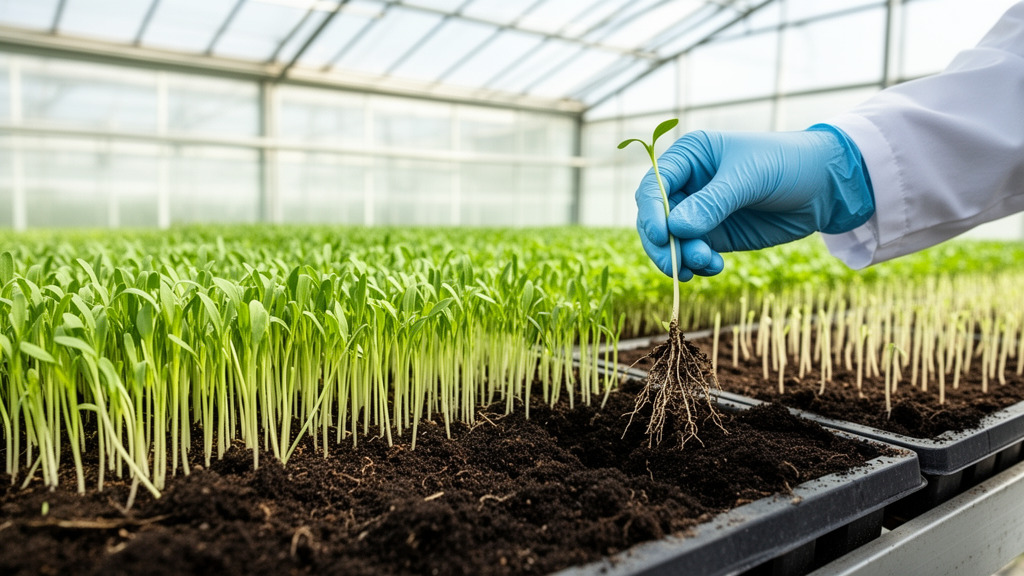
Drought striking at the moment a wheat seed germinates can devastate stands before a crop ever establishes. A study published in Theoretical and Applied Genetics now reports the identification of a stable major locus on wheat chromosome arm 4BS that influences both early shoot growth and the plant's response to drought stress during germination. The work, led by Jiajun Liu, Defu Wang and Qinghong Zhou with colleagues under the senior authorship of Jian Ma, combined quantitative trait locus (QTL) mapping with bulked segregant analysis sequencing and transcriptomics to investigate the genetic basis of this trait.
The team used a recombinant inbred line (RIL) population derived from two parent varieties. Seedlings were grown under both control conditions and drought treatment at the germination stage, and the researchers measured three seedling traits: maximum root length, root number and shoot height. Across these conditions they detected 21 QTLs, the statistical signatures of genomic regions contributing to trait variation.
Among these, three signals—QSH.scwl-CK-4B, QSH.scwl-DT-4B and QRSH.scwl-4B—co-localized to a common region on chromosome arm 4BS, indicating that a single locus exerts pleiotropic effects on both basal shoot growth and the drought-stress response. The most striking result came from QRSH.scwl-4B, which was independently recovered through bulked segregant analysis sequencing, a method that pools the genomes of plants with extreme phenotypes to locate causal regions. Mapping placed the locus within a 2.09 megabase interval on 4BS, and across analyses it explained between 24.32% and 30.89% of the phenotypic variation—a substantial share for a single locus in a complex trait.
By integrating RNA sequencing data with the bulked segregant results and sequencing of the two parental genomes, the researchers identified two putative candidate genes within the interval, TraesCS4B03G0104700 and TraesCS4B03G0102800. KEGG pathway enrichment analysis suggested that TraesCS4B03G0104700 may regulate drought tolerance during germination through jasmonic acid biosynthesis, a plant hormone pathway involved in stress responses. The authors present this as a mechanistic hypothesis supported by enrichment evidence rather than a functionally validated conclusion.
Crucially for breeding programs, the locus appears to carry a favorable trade-off profile. The positive allele of QRSH.scwl-4B increased productive tiller number—the number of grain-bearing heads per plant, a direct yield component—by 13.37%, while showing only limited adverse effects on other yield-related traits. The authors describe QRSH.scwl-4B as a promising locus for improving wheat drought tolerance with potentially minimal negative impact on yield.
The findings represent a foundation for cloning the locus and for improving drought tolerance through molecular breeding, rather than a finished product. The candidate genes remain putative, and the study was conducted in a single RIL population at the germination stage, so the results will need confirmation in other genetic backgrounds and environments. Even so, the convergence of QTL mapping, sequencing-based bulk analysis and transcriptomics on the same 4BS interval, together with the observed benefit to a yield component, marks QRSH.scwl-4B as a notable target for further research.
The authors state that these findings collectively provide a basis for cloning the locus and for improving drought tolerance in wheat through molecular breeding.
Subject of Research: Genetic mapping of a drought-tolerance locus and candidate genes for wheat germination on chromosome 4BS
Article Title: Identification of a stable major locus and candidate genes for drought tolerance during wheat germination
Article References: Liu, J., Wang, D., Zhou, Q., Qin, N., Liu, J., Liu, X., Li, Y., Peng, H., & Ma, J. (2026). Identification of a stable major locus and candidate genes for drought tolerance during wheat germination. Theoretical and Applied Genetics, 139(11), Article 317. https://doi.org/10.1007/s00122-026-05422-3
Image Credits: AI Generated
DOI: 10.1007/s00122-026-05422-3
Keywords: wheat, drought tolerance, germination, QTL mapping, chromosome 4BS, jasmonic acid, candidate genes, bulked segregant analysis, RNA sequencing, productive tiller number, molecular breeding, recombinant inbred lines
News Source: Alan Morgan. (October 25, 2026). Stable wheat locus on chromosome 4BS linked to drought tolerance at germination. Scienmag.