• HOME
  • NEWS
  • EXPLORE
    • CAREER
      • Companies
      • Jobs
    • EVENTS
    • iGEM
      • News
      • Team
    • PHOTOS
    • VIDEO
    • WIKI
  • BLOG
  • COMMUNITY
    • FACEBOOK
    • INSTAGRAM
    • TWITTER
Sunday, October 25, 2026
BIOENGINEER.ORG
No Result
View All Result
  • Login
  • HOME
  • NEWS
  • EXPLORE
    • CAREER
      • Companies
      • Jobs
        • Lecturer
        • PhD Studentship
        • Postdoc
        • Research Assistant
    • EVENTS
    • iGEM
      • News
      • Team
    • PHOTOS
    • VIDEO
    • WIKI
  • BLOG
  • COMMUNITY
    • FACEBOOK
    • INSTAGRAM
    • TWITTER
No Result
View All Result
Bioengineer.org
No Result
View All Result
Home NEWS Science News Chemistry

Amino alcohol blends boost silica foam’s indoor carbon dioxide capture

by
October 25, 2026
in Chemistry
Reading Time: 2 mins read
0
Amino alcohol blends boost silica foam's indoor carbon dioxide capture

Amino alcohol blends boost silica foam's indoor carbon dioxide capture

Share on FacebookShare on TwitterShare on LinkedinShare on RedditShare on Telegram

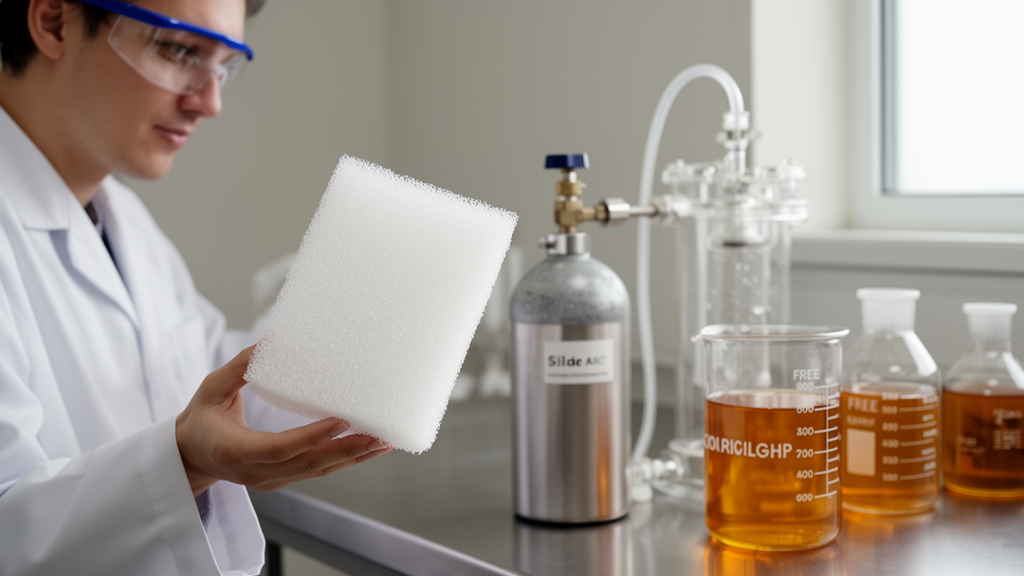
Researchers have developed hybrid amine adsorbents that capture carbon dioxide from indoor air at room temperature with markedly higher capacity and faster kinetics than single-amine materials. Writing in Environmental Chemistry Letters, a team led by Junyang Lu, Xuehua Shen and Zuotai Zhang loaded polyethylenimine and several small amines into a mesoporous silica foam support whose ultra-large pore structure allows unusually high amine loadings.

Solid amine adsorbents are promising for enclosed spaces because they combine high selectivity for CO2 with low regeneration energy. The challenge, the authors note, has been achieving fast kinetics, high capacity and long-term stability simultaneously. Polyethylenimine, a polymer densely packed with amine groups, tends to form entangled chains that block access to many of its own active sites, limiting both uptake rate and effective capacity.

The team addressed this by blending polyethylenimine with diethanolamine, aminoethylethanolamine and diethylenetriamine inside the foam’s pores. The amino alcohols weaken the polymer’s chain entanglement, making more amine sites accessible to incoming CO2 molecules. In addition, surface silanol (Si–OH) groups on the silica scaffold form hydrogen bonds with the amino alcohols, stabilizing them within the pores and improving cyclic durability.

The standout formulation combined polyethylenimine and diethanolamine in a 1:1 mass ratio. This hybrid achieved a CO2 uptake of 177 milligrams per gram of adsorbent, around 70 percent above the theoretical additive capacity of its two components, and showed no capacity decay after 60 adsorption–desorption cycles. Hybrid adsorbents across the series outperformed their single-amine counterparts in both uptake and kinetics.

To explain these gains, the researchers ran molecular dynamics simulations. The modeling attributes the improvements to increased free volume within the amine phase, percolated diffusion pathways that let CO2 move through the material, and hydrogen-bond-stabilized amine networks that hold the active chemistry in place over repeated cycles. These are model-based explanations consistent with the measured performance rather than direct observations of the material’s internal structure.

The results indicate that pore architecture and molecular blending can be engineered together rather than treated separately. The foam’s large pore volume supplies the loading headroom, while the amino alcohol additives unlock the polymer’s latent capacity by loosening its internal structure. The study reports laboratory-scale adsorption performance; long-term behavior in real indoor environments and performance at larger scales remain to be demonstrated.

Subject of Research: Hybrid amine adsorbents in mesoporous silica foam for room-temperature indoor carbon dioxide capture

Article Title: Amino alcohols and polyethyleneimine in mesoporous silica foam for indoor carbon dioxide capture

Article References: Lu, J., Shen, X., Lu, Y., Sun, X., Zhang, T., Chen, B., Wang, L., Lei, S., Yan, F., & Zhang, Z. (2026). Amino alcohols and polyethyleneimine in mesoporous silica foam for indoor carbon dioxide capture. Environmental Chemistry Letters. https://doi.org/10.1007/s10311-026-01932-0

Image Credits: AI Generated

DOI: 10.1007/s10311-026-01932-0

Keywords: carbon dioxide capture, mesoporous silica foam, polyethylenimine, diethanolamine, amino alcohols, solid amine adsorbents, indoor air quality, molecular dynamics simulations, adsorption kinetics, hydrogen bonding, Amino, alcohols

News Source: Bethany Barker. (October 25, 2026). Amino alcohol blends boost silica foam’s indoor carbon dioxide capture. Scienmag.

Tags: adsorption kineticsalcoholsAminoamino alcoholscarbon dioxide capturediethanolaminehydrogen bondingindoor air qualitymesoporous silica foammolecular dynamics simulationspolyethyleniminesolid amine adsorbents
Share12Tweet7Share2ShareShareShare1

Related Posts

Germanium photodetector hits 110 GHz bandwidth for 400-Gbps AI optical links

Germanium photodetector hits 110 GHz bandwidth for 400-Gbps AI optical links

October 25, 2026
New Chalcone Compound B15 Eases Acute Lung Injury in Mice by Blocking p38 MAPK Signaling

New Chalcone Compound B15 Eases Acute Lung Injury in Mice by Blocking p38 MAPK Signaling

October 25, 2026

Electron waves trapped in a metal for the first time

October 25, 2026

New Imidazolidin-4-One Derivatives Show Antibacterial Activity Against Staphylococcus and E. coli

October 25, 2026

POPULAR NEWS

  • Chemokine Signal Behind VEGF-Driven Retinal Neovascularization Identified

    Chemokine Signal Behind VEGF-Driven Retinal Neovascularization Identified

    29 shares
    Share 12 Tweet 7
  • Amino alcohol blends boost silica foam’s indoor carbon dioxide capture

    29 shares
    Share 12 Tweet 7
  • Two Collagen Receptors Team Up to Rebuild Skull Bone in Mice, Study Shows

    29 shares
    Share 12 Tweet 7
  • New control strategy keeps quadrotors on track under denial-of-service attacks

    29 shares
    Share 12 Tweet 7

About

We bring you the latest biotechnology news from best research centers and universities around the world. Check our website.

Follow us

Recent News

Chemokine Signal Behind VEGF-Driven Retinal Neovascularization Identified

Amino alcohol blends boost silica foam’s indoor carbon dioxide capture

Two Collagen Receptors Team Up to Rebuild Skull Bone in Mice, Study Shows

Subscribe to Blog via Email

Enter your email address to subscribe to this blog and receive notifications of new posts by email.

Join 85 other subscribers
  • Contact Us

Bioengineer.org © Copyright 2023 All Rights Reserved.

Welcome Back!

Login to your account below

Forgotten Password?

Retrieve your password

Please enter your username or email address to reset your password.

Log In
No Result
View All Result
  • Homepages
    • Home Page 1
    • Home Page 2
  • News
  • National
  • Business
  • Health
  • Lifestyle
  • Science

Bioengineer.org © Copyright 2023 All Rights Reserved.