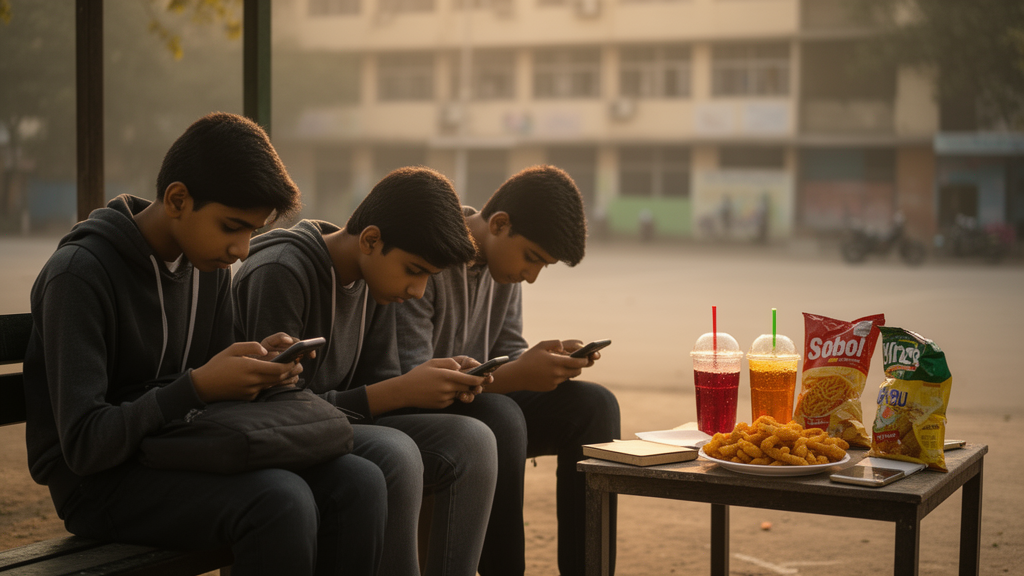
Adolescents across South Asia are gaining weight in ways that are reshaping the region’s health profile, and a new narrative review of recent evidence examines why. Synthesising eight primary studies and five systematic reviews published between 2015 and 2025, the review finds that physical inactivity, prolonged sedentary behaviour and unhealthy dietary practices are the factors most consistently associated with overweight and obesity among adolescents aged 10 to 19 in the region. Yet the picture is far from uniform: prevalence estimates vary dramatically between countries, settings and even neighbouring schools, and the authors caution that nearly all of the underlying evidence is cross-sectional, meaning these are associations rather than proven causes.
The scale of the regional burden is substantial. A recent meta-analysis of 152 studies involving 489,525 participants from seven South Asian countries estimated pooled prevalences of 12.4 percent for overweight, 6.6 percent for obesity and 19.3 percent for combined overweight and obesity among children and young people aged 19 or younger. Globally, a synthesis of 2,033 studies from 154 countries estimated that 14.8 percent of children and adolescents had overweight, 8.5 percent had obesity and 22.2 percent had combined excess weight. The review’s authors stress that these figures cannot be directly compared, because the two syntheses differed in study periods, participant ages, sampling designs and the body mass index classification systems used to define excess adiposity.
What emerges from the primary studies is a striking patchwork. In Nepal, combined overweight and obesity prevalence ranged from roughly 6.4 percent in an urban municipality school survey of 768 students to 29.2 percent in a smaller rural school sample of 267 students, a gap the authors attribute partly to differences in sample size, population selection and the Asia-Pacific BMI criteria applied in the rural study. In India, one school-based study of 1,900 adolescents in Raichur City reported overweight and obesity prevalences of 4.57 percent and 5.11 percent respectively. In Sri Lanka, a study of 310 adolescent girls in Batticaloa District found 9.4 percent overweight, 5.5 percent obesity and, notably, 21.6 percent central obesity measured by waist circumference, a reminder that waist-based measures and BMI capture different dimensions of adiposity and should not be merged.
The most methodologically robust evidence came from Bangladesh. A nationally representative survey of 9,128 adolescents aged 15 to 19, using WHO 2007 BMI-for-age criteria, found a combined overweight and obesity prevalence of 10.61 percent. The burden was higher among girls than boys, 11.63 percent versus 8.25 percent, and higher in urban than rural areas, 15.66 percent versus 9.21 percent. By contrast, a small study of 150 schoolchildren aged 9 to 14 in Dhaka reported overweight and obesity prevalences of 36.0 percent and 25.3 percent, but the review treats this as contextual mixed-age evidence from a selected urban sample rather than a figure representative of Bangladeshi adolescents nationally.
Across the behavioural domains, physical inactivity stood out. In the large multicountry Global School-based Student Health Survey analysis covering 51,597 adolescents aged 13 to 17, including Bangladesh and Nepal, physical inactivity was associated with increased odds of overweight or obesity, with an odds ratio of 1.19, while sedentary behaviour exceeding one hour per day carried an odds ratio of 1.25. A Nepalese urban school study found that adolescents reporting no physical activity had nearly five times the adjusted odds of excess weight, with an adjusted odds ratio of 4.97, and those not participating in school games or extracurricular activities had 2.49 times the odds. A rural Nepalese study and an Indian school study reported similar associations, though the review notes that exposure definitions varied considerably and several studies failed to distinguish physical inactivity from sedentary behaviour, which are related but distinct exposures.
Dietary evidence pointed in the same general direction but was measured far less rigorously. High-calorie lunches were associated with excess weight in the Nepalese urban study, fast-food preference was linked to excess weight in the Dhaka study, and dietary practices emerged as correlates in the Indian school sample. A small Indian case-control study of 60 participants identified junk-food consumption and a sedentary lifestyle as potential factors, but reported no effect estimates, confidence intervals or statistical comparisons, leading the review to classify these findings as suggestive rather than confirmed. The authors conclude that the evidence supports an association between unhealthy dietary behaviour and adolescent overweight or obesity, but cannot pin down particular foods, quantities or causal pathways, especially since most studies relied on brief self-reported questions rather than validated dietary assessments.
Beyond behaviour, the review highlights a set of context-dependent factors that resist simple generalisation. Socioeconomic position showed a positive association: in the nationally representative Bangladeshi survey, adolescents from wealthier households bore a greater burden, a pattern that contrasts with many high-income countries where obesity increasingly concentrates among disadvantaged groups. The authors interpret this as reflecting an earlier or intermediate stage of nutrition transition, in which greater household wealth buys more access to energy-dense commercial foods, motorised transport and screen-based entertainment. Urban residence was independently associated with excess weight in Bangladesh, and media exposure carried an adjusted odds ratio of 1.39, though the available studies could not separate the effects of sedentary screen time, exposure to food advertising and underlying socioeconomic advantage.
Sex-related findings were notably inconsistent. The rural Nepalese study reported markedly higher adjusted odds of obesity among girls, at 5.2 times those of boys, while other studies found smaller differences, no association, or higher prevalence among boys. The review argues that female sex should not be treated as a universal risk factor, and that few studies distinguished biological sex from gender-related influences such as mobility restrictions, household responsibilities, safety concerns and unequal access to sport. Evidence on familial factors was similarly thin: the Sri Lankan study reported that 70.6 percent of adolescent girls with obesity had a family history of noncommunicable diseases, but this was a descriptive finding without an adjusted comparison. Meanwhile, sleep duration, mental health, academic pressure, food insecurity and neighbourhood environments were barely examined at all, a gap the authors identify as one of the most important deficits in the regional literature.
The review also situates these findings within South Asia’s double burden of malnutrition, in which undernutrition, micronutrient deficiencies and obesity coexist within the same countries, communities, households and sometimes the same individuals. An adolescent with excess adiposity may still lack essential micronutrients, and early-life undernutrition followed by rapid weight gain and exposure to energy-dense diets may heighten later metabolic vulnerability, although the included studies offered little longitudinal evidence to test these pathways directly. The authors warn that prevention strategies based solely on restricting energy intake could inadvertently worsen undernutrition, and instead call for coordinated policies promoting healthy growth, dietary quality and physical activity while protecting adolescents from deficiency.
The evidence base itself carries heavy caveats. No eligible primary studies were identified from Afghanistan, Bhutan, the Maldives or Pakistan during the search period, leaving four of the region’s eight countries essentially unmapped. Most studies were school-based and geographically restricted, potentially excluding out-of-school adolescents whose circumstances and exposures may differ substantially. Age ranges, sampling frames, anthropometric measures and BMI classification systems, spanning WHO, IOTF, CDC, Asia-Pacific, national and adult thresholds, differed across studies, and one Indian case-control study used self-reported height and weight with adult BMI cutoffs. Because most primary studies were cross-sectional, the review deliberately uses the language of associated factors rather than determinants or causal risk factors. The authors call for prospective cohort studies, nationally representative surveys in underrepresented countries, population-based sampling that includes out-of-school adolescents, standardised BMI-for-age reporting, sex-disaggregated analyses and rigorous evaluation of commercial food marketing, arguing that only such research can support equitable and context-specific prevention across a region whose adolescent obesity problem is growing faster than the evidence needed to address it.
Subject of Research: Factors associated with overweight and obesity among adolescents in South Asia
Article Title: Factors Associated With Overweight and Obesity Among Adolescents in South Asia: A Narrative Review of Recent Evidence
Article References: Siddiquee, T., Bhowmik, B., Moreira, N. C. D. V., Munir, S. B., Nasrin, H., Islam, T., Mahmud, F., Nesa, L. Q., Akhtar, S., Khan, S., Khan, F. R., Amin, M. R., & Khan, A. K. A. (2026). Factors Associated With Overweight and Obesity Among Adolescents in South Asia: A Narrative Review of Recent Evidence. Endocrinology, Diabetes & Metabolism, 9(6), Article e70372. https://doi.org/10.1002/edm2.70372
Image Credits: AI Generated
DOI: 10.1002/edm2.70372
Keywords: adolescent obesity, South Asia, overweight, physical inactivity, sedentary behaviour, nutrition transition, double burden of malnutrition, BMI, cross-sectional studies, food environment, socioeconomic position, public health
News Source: Daisy Hatcher. (October 25, 2026). Physical Inactivity, Sedentary Behaviour and Unhealthy Diets Most Consistently Linked to Adolescent Obesity in South Asia, Review Finds. Scienmag.