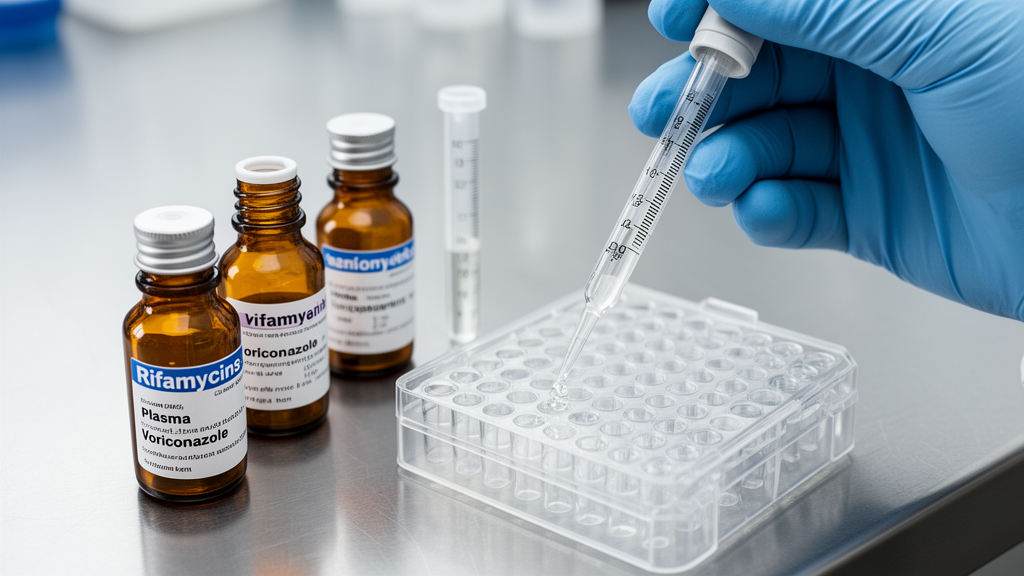
A structured narrative review found that the antituberculosis drugs rifampicin, rifapentine and rifabutin can substantially reduce exposure to voriconazole, an antifungal used to treat severe fungal infections such as invasive aspergillosis. The strongest evidence concerns rifampicin, whose induction of voriconazole metabolism produced an approximately 96% reduction in area under the concentration–time curve in one pharmacokinetic report and widespread subtherapeutic trough concentrations in clinical studies. Rifapentine also caused marked underexposure, while rifabutin presented a bidirectional interaction in which it could lower voriconazole concentrations and voriconazole could increase exposure to rifabutin and its active metabolite. Evidence for most other antituberculosis agents was considerably weaker and did not establish causal pharmacokinetic interactions.
The review searched PubMed, Embase, Web of Science and the China National Knowledge Infrastructure from database inception through May 2026. Investigators identified 2,198 records, removed 615 duplicates and screened 1,583 titles and abstracts. Of 132 full texts assessed, 17 clinical studies met the eligibility criteria and entered a narrative synthesis. Most were case reports, small retrospective therapeutic drug monitoring studies or observational cohorts, and their designs, patient populations, dosing regimens, sampling schedules and endpoints were too heterogeneous for quantitative pooling. Direct human pharmacokinetic studies were treated as the strongest source for quantifying exposure changes, while observational and monitoring studies supplied clinically relevant but less controlled evidence.
The clinical significance of the rifampicin interaction was consistent across the available studies. In a retrospective analysis of 18 patients receiving voriconazole and rifampicin, 94.44% had trough concentrations below 1.0 mg/L and 72.22% were below the assay’s quantification limit of 0.16 mg/L. A separate comparison of 15 patients receiving concurrent treatment and 17 treated sequentially reported mean trough concentrations of 1.58 and 3.67 mg/L, respectively; target attainment was 26.7% during combination therapy and 82.4% without concurrent rifampicin. In a single-patient pharmacokinetic study, rifampicin lowered voriconazole maximum concentration from 3.92 to 0.038 mg/L and its area under the concentration–time curve from 27.4 to 0.145 h·mg/L. These observations indicate that conventional loading and maintenance regimens frequently fail under rifampicin-induced metabolism.
Rifampicin’s induction effect may persist after the antibiotic is withdrawn, complicating the restart or adjustment of voriconazole. In one cohort, 91.67% of samples collected within six days after rifampicin withdrawal were below 1.0 mg/L, compared with 83.33% of samples collected seven days or more that were above that level. Another cohort reported mean trough concentrations of 0.36 mg/L at one to three days and 0.49 mg/L at four to six days, rising to 1.34 mg/L from day seven onward. Individual cases suggested residual induction could last for 10 to 13 days or longer. The review therefore described approximately seven days only as an observation-based starting reference, not a guaranteed washout period, and advised serial trough monitoring rather than immediate conventional-dose re-initiation or empirical escalation.
Rifapentine appears to induce voriconazole metabolism less strongly than rifampicin, but the clinical effect can still be substantial and recovery can be prolonged. In one cohort of 109 patients with chronic pulmonary aspergillosis, all 22 concentrations measured during rifampicin treatment were below the 1.0–5.5 mg/L reference range, with a mean of 0.14 mg/L; among 32 concentrations measured during rifapentine treatment, only six were within that range and the mean was 0.63 mg/L. In two patients, concentrations fell by approximately 71.4% to 81.9% after seven to ten days of rifapentine. Case reports also documented concentrations increasing only after rifapentine withdrawal. Maintaining an escalated voriconazole dose during this interval could therefore produce marked overexposure, with reported trough concentrations reaching 10.8 mg/L in one case.
Rifabutin cannot be considered a reliably safe substitute for rifampicin. Although it can reduce voriconazole exposure through metabolic induction, voriconazole inhibits CYP3A4 and may increase concentrations of rifabutin and 25-O-desacetyl-rifabutin. Current United States voriconazole labeling lists their coadministration as contraindicated. Evidence from six patients included four adverse reactions, including neurological symptoms, QTc prolongation, elevated aminotransferases and severe nausea, while voriconazole concentrations remained below 1.0 to 5.5 mg/L despite doses averaging 1.81 times the recommended amount. Concentrations then rose 13.7- to 36-fold during septic shock in some patients, although severe inflammation and changing organ function prevented isolation of the rifabutin effect.
Direct human pharmacokinetic evidence for isoniazid, pyrazinamide, ethambutol, linezolid, bedaquiline and most other non-rifamycin agents was sparse or absent. Isoniazid inhibits CYP2C19 and CYP3A activity in vitro, making increased voriconazole exposure biologically plausible, but no direct human study established the magnitude of that effect. A conference report described increased voriconazole clearance and subtherapeutic concentrations in five patients receiving linezolid, yet its small, uncontrolled design did not permit causal attribution. Ethambutol was associated with visual dysfunction in one case, raising concern about possible additive optic toxicity without proving a pharmacokinetic interaction. For meropenem, one renal-failure case and later laboratory work suggested possible CYP2C19 and CYP3A4 inhibition, but that evidence remains hypothesis-generating.
Other combinations are primarily concerns about shared toxicity rather than established changes in voriconazole exposure. Pyrazinamide can add to hepatotoxicity, while bedaquiline, delamanid, clofazimine and fluoroquinolones can increase the risk of QT prolongation. Pretomanid undergoes metabolism partly through CYP3A, but direct interaction data with voriconazole are lacking. Cycloserine and terizidone require attention to central nervous system effects; ethionamide, protionamide and para-aminosalicylic acid raise concerns involving gastrointestinal reactions, liver function and thyroid dysfunction. Amikacin and streptomycin are mainly eliminated through the kidneys, making nephrotoxicity, ototoxicity and electrolyte abnormalities more relevant than an unvalidated adjustment of voriconazole. These distinctions matter because a concentration can be altered by illness and organ dysfunction as well as by another drug.
The review supports risk-matched management rather than universal dose rules. Coadministration of voriconazole with rifampicin or rifabutin should be avoided in accordance with current labeling, and rifapentine should be avoided where feasible. Serial trough therapeutic drug monitoring is strongly supported when rifamycin exposure is suspected, after rifampicin or rifapentine is stopped, and following major voriconazole dose changes or an unexpected clinical response. A commonly cited trough reference range of 1.0 to 5.5 mg/L is not a universal therapeutic threshold because targets vary with infection site, organism, assay, treatment phase and toxicity risk. Monitoring should also include liver tests for hepatotoxicity, electrocardiography and electrolytes for QT risk, complete blood counts for marrow toxicity, and ophthalmic or neurologic assessment for visual and neuropsychiatric effects. Because the evidence base is dominated by small observational studies and case reports, conclusions for non-rifamycin combinations remain provisional and require prospective multicenter validation.
Subject of Research: Pharmacokinetic and toxicologic interactions between voriconazole and antituberculosis drugs
Article Title: Research advances and clinical management of drug interactions between voriconazole and antituberculosis agents
Article References: Fu, Y., & Lin, Z. (2026). Research advances and clinical management of drug interactions between voriconazole and antituberculosis agents. Frontiers in Pharmacology, 17, Article 1962108. https://doi.org/10.3389/fphar.2026.1962108
Image Credits: AI Generated
DOI: 10.3389/fphar.2026.1962108
Keywords: voriconazole, antituberculosis drugs, rifampicin, rifapentine, rifabutin, drug interactions, pharmacokinetics, therapeutic drug monitoring, antifungal therapy, tuberculosis, Research, advances
News Source: Ophelia Keating. (October 25, 2026). Rifamycins can sharply reduce voriconazole exposure, review finds. Scienmag.