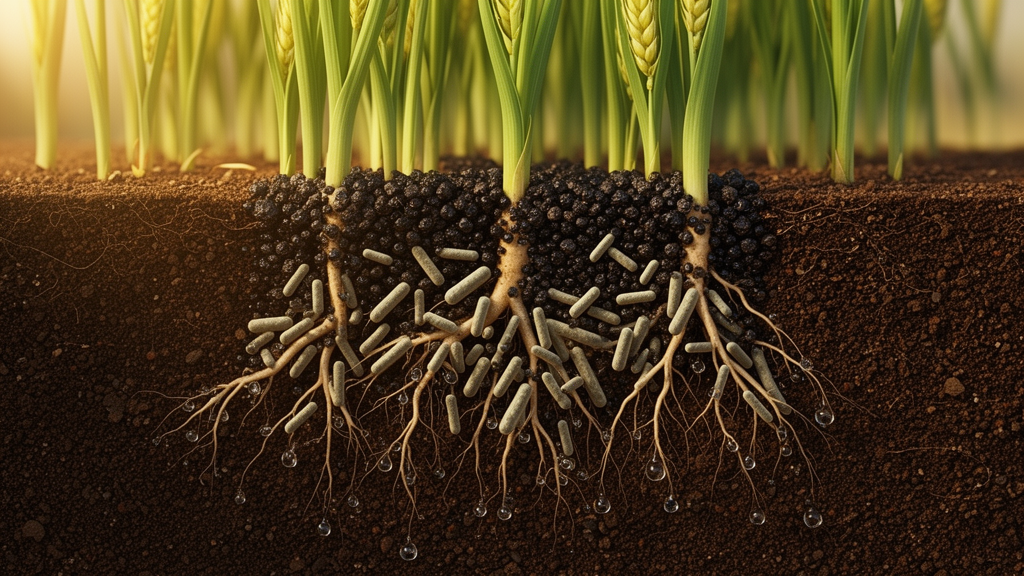
Wheat fields hit by drought at the tillering stage may have a new, low-cost line of defense: a combination of the plant growth-promoting rhizobacterium Azospirillum brasilense and humic acid, an organic soil amendment. A field experiment published in BMC Plant Biology reports that applying the two together, rather than either one alone, produced the most favorable growth, physiological and yield outcomes under both well-watered and drought-stressed conditions. The authors describe the combined field application as a practical, low-cost strategy for sustaining wheat productivity under water-limited conditions, where drought at the tillering stage is identified as one of the most damaging abiotic constraints to wheat production in arid and semi-arid cropping systems.
The research team set up a randomized complete block design with eight treatments and three replications. The treatments comprised an untreated control, sole application of A. brasilense , sole application of humic acid, and the combined treatment, each evaluated under two water regimes: well-watered and drought-stressed. Drought stress was initiated at the tillering stage, 25 days after sowing, by withholding the first irrigation, and was maintained for 21 days before normal irrigation resumed.
The results were unambiguous at the statistical level: drought stress significantly reduced all measured growth, physiological and yield attributes relative to the well-watered control, with the analysis reporting p < 0.01. Sole applications of either A. brasilense or humic acid partially alleviated these reductions, but neither matched the performance of the combined treatment, which consistently produced the best outcomes under both water regimes. According to the authors, this pattern indicates that the two inputs act in a complementary manner.
Under well-watered conditions, the combined treatment increased plant height by 13.2 percent, spike length by 25.4 percent, spikelets per spike by 9.9 percent, 1000-grain weight by 10.5 percent, grain yield by 0.9 percent and biological yield by 1.8 percent relative to the untreated control. The same treatment also recorded the highest values for stomatal conductance, crop growth rate, relative water content and leaf area index among the treatments tested. The most striking findings emerged under drought.
The combined treatment improved grain yield and biological yield relative to the drought-stressed control, and its drought susceptibility index for grain yield was 0.55, less than half the value of 1.29 recorded for the untreated pairing. The authors attribute the complementary action to the distinct properties of the two inputs. According to the study, the microbial phytohormone and nitrogen-fixation activity of Azospirillum brasilense is reinforced by the water- and nutrient-retention properties of humic acid, so the combined treatment delivers both the bacterial growth-promoting activity and an improved capacity of the rooting environment to retain water and nutrients during the stress period.
The authors frame the combined field application as a practical, low-cost strategy for sustaining wheat productivity under water-limited conditions. The published article is an early release, shared to provide faster access to peer-reviewed, accepted research; it is citable and carries a permanent DOI, and the version is subject to further edits before the final Version of Record appears. The reported numbers themselves show where the treatment's effects were largest and smallest.
Under well-watered conditions, the gain in grain yield from the combined treatment was modest at 0.9 percent, while structural traits such as spike length responded far more strongly at 25.4 percent. Under drought, the improvement in grain and biological yield relative to the drought-stressed control, together with the halving of the drought susceptibility index, marks the combined treatment as the standout option in this experiment for sustaining wheat productivity when water is withheld at the tillering stage.
Subject of Research: Plant science and agricultural field trial of combined Azospirillum brasilense and humic acid application in wheat under tillering-stage drought stress
Article Title: Combined application of Azospirillum brasilense and humic acid improves growth, physiology and yield of wheat (Triticum aestivum L.) under tillering-stage drought stress
Article References: Jamil, S., Zaheer, M. S., Hameed, A., Ikram, K., Ali, B., Niaz, Y., Ali, H. H., Sharafat, M. Y., Tariq, H., Zaheer, H., Khan, F., & Perveen, K. (2026). Combined application of Azospirillum brasilense and humic acid improves growth, physiology and yield of wheat (Triticum aestivum L.) under tillering-stage drought stress. BMC Plant Biology. https://doi.org/10.1186/s12870-026-10163-y
Image Credits: AI Generated
DOI: 10.1186/s12870-026-10163-y
Keywords: wheat, drought stress, Azospirillum brasilense, humic acid, plant growth-promoting rhizobacteria, tillering stage, grain yield, drought susceptibility index, soil amendment, abiotic stress, Combined, application
News Source: Alan Morgan. (October 24, 2026). Soil Bacteria Paired with Humic Acid Shield Wheat Yields from Drought Stress. Scienmag.