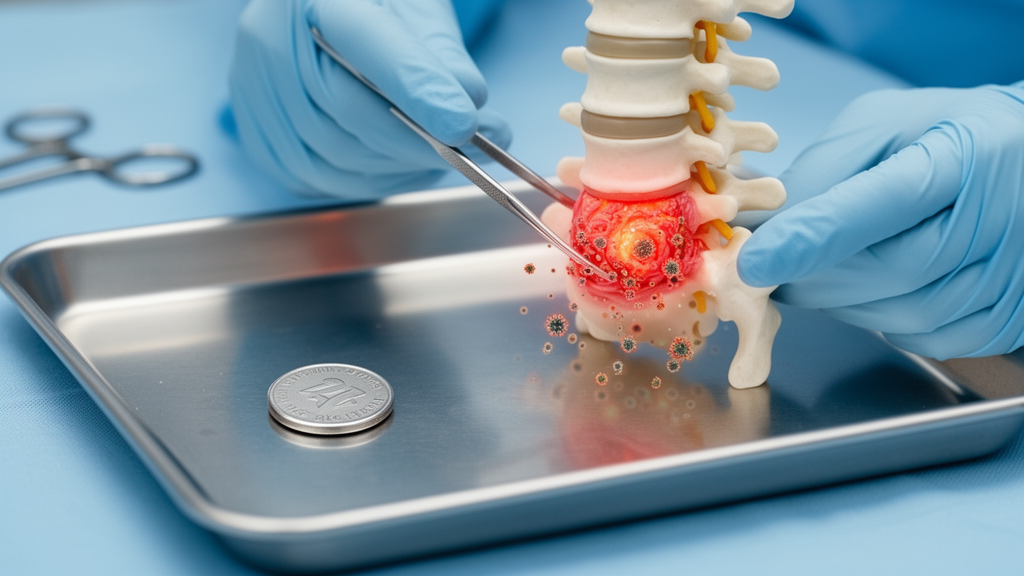
Button battery ingestion can cause a rare but serious spinal infection that emerges weeks after the battery is removed, according to two new pediatric cases and a systematic review of 11 affected children. The analysis found that the condition, called delayed spondylodiscitis, repeatedly developed in the upper spine after a battery had lodged in the esophagus. Early imaging showed no leak in every patient for whom results were reported, underscoring why a reassuring test immediately after extraction may not rule out deeper injury.
The researchers reviewed studies identified in PubMed, Embase, Web of Science and Scopus from their inception through February 2026, using a PRISMA-compliant process in which two reviewers independently screened studies and extracted patient, battery, impaction, imaging, treatment and outcome data. Together with the two new cases, the analysis included 11 patients with a median age of 14 months. It was designed to characterize the timing and clinical and radiological pattern of delayed spondylodiscitis and to inform a proposed framework for surveillance after battery removal.
Several features recurred across the small case series. Among eight patients with available battery-size information, seven had batteries measuring at least 20 millimeters, or 87.5%. The battery was lodged in the cervicothoracic esophagus in the cases assessed, and all six patients whose battery orientation was documented had the negative pole facing posteriorly. These observations identify characteristics associated with delayed spinal complications in the reported patients, but the systematic review is too limited to establish how reliably they predict infection or how often such complications occur.
The delay between extraction and diagnosis was median three weeks, with a range of one to five weeks. During that clinically quiet interval, early post-extraction contrast esophagrams showed no leakage in all five patients with reported results. Symptoms then most often involved the neck, including pain, stiffness, restricted movement or abnormal posturing, which appeared in eight of the 11 patients, or 72.7%. Fever occurred in five patients, or 45.5%. Magnetic resonance imaging consistently demonstrated inflammation in the tissue in front of the vertebrae and confirmed cervicothoracic spondylodiscitis, involving the discs and adjacent vertebral structures.
None of the 11 reported patients underwent spinal debridement or fusion. The study does not provide a comparison group or a controlled evaluation of surveillance strategies, so it cannot show that its proposed framework prevents infection, shortens diagnosis or improves outcomes. Its main finding is instead a repeated clinical sequence: esophageal impaction, battery removal, a period with little or no overt evidence of deep injury, and later neck-related or systemic symptoms accompanied by MRI-confirmed spinal inflammation. The small number of cases, incomplete reporting of some battery characteristics and the inability of early esophagrams to exclude occult tissue injury limit generalization.
The authors recommend individualizing follow-up according to battery size, anatomical location, estimated time of impaction, orientation and the apparent severity of injury to the back of the esophagus. Their evidence supports particular vigilance during the first five weeks after removal, when delayed manifestations emerged in the reviewed cases. They also propose that new neck-related, systemic or neurological symptoms after extraction should prompt MRI rather than reliance on a normal early radiograph or contrast study.
The report highlights a diagnostic hazard in pediatric button battery care: the most visible signs of perforation may be absent soon after extraction even when a later spinal infection becomes apparent. Because the evidence comes from two cases plus a review of only 11 patients, the proposed surveillance framework remains expert-based rather than validated by a prospective trial. It nevertheless identifies a focused period of observation and a specific imaging trigger for a complication that can be difficult to recognize because of its delayed onset and initially inconclusive imaging.
Subject of Research: Delayed cervicothoracic spondylodiscitis after pediatric esophageal button battery ingestion
Article Title: The hidden danger of button battery ingestion: two cases and a systematic review of delayed spondylodiscitis, with a proposed surveillance framework
Article References: Deqin, Z., Yuan, M., Li, Y., Xu, C., He, T., & Yang, G. (2026). The hidden danger of button battery ingestion: two cases and a systematic review of delayed spondylodiscitis, with a proposed surveillance framework. BMC Pediatrics. https://doi.org/10.1186/s12887-026-07835-x
Image Credits: AI Generated
DOI: 10.1186/s12887-026-07835-x
Keywords: button batteries, pediatric ingestion, spondylodiscitis, esophageal impaction, MRI, delayed complications, spinal infection, child health, radiology, surveillance, hidden, danger
News Source: Kristina Jarvis. (October 24, 2026). Delayed spinal infection can follow button battery removal in children. Scienmag.