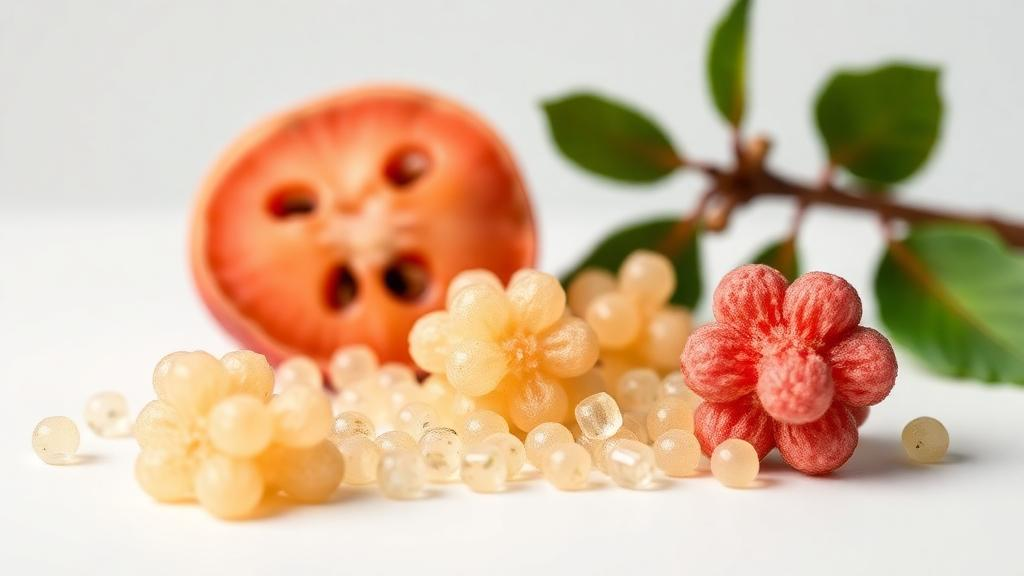
Up to 40 percent of the world’s fresh fruit and vegetable production is lost after harvest, with fungal infection and transpiration-driven water loss identified as the leading causes of quality deterioration. Cold storage and synthetic fungicides remain the dominant countermeasures, but refrigeration is energy-intensive and inaccessible in many postharvest supply chains of developing regions, while chemical treatments such as sulfur dioxide-generating pads and thiabendazole raise persistent concerns over chemical residues, pathogen resistance, and consumer acceptance amid growing demand for clean-label foods. A research team in China has now reported a non-contact alternative: porous hydrogel beads made from a fungal polysaccharide that continuously release a natural plant polyphenol into the package headspace, preserving grapes and cherry tomatoes at room temperature without ever touching the fruit.
The beads are built from Poria cocos polysaccharide, or PCP, a water-soluble beta-D-glucan extracted from the sclerotium of Wolfiporia cocos, an edible and medicinal fungus with a long history of safe consumption in East Asia. PCP offers favorable film-forming ability, hygroscopicity, and inherent bioactivity, but its potential as a structural matrix for controlled-release packaging had remained largely unexplored. The researchers combined it with tannic acid, a hydrolyzable plant polyphenol with generally recognized as safe status whose multiple galloyl groups donate hydrogen atoms to quench radicals and interact with bacterial membrane proteins and lipids, underpinning broad-spectrum antimicrobial and radical-scavenging activity at relatively low concentrations. Earlier systems incorporating tannic acid into pectin, gelatin, or alginate matrices mostly functioned as edible coatings or direct-contact films that adhere to fruit surfaces, altering appearance and complicating standardized application.
To overcome the density constraint of previously annealed PCP-tannic acid networks, the team fabricated the beads through thermal dissolution of PCP and tannic acid in dimethyl sulfoxide at 80 degrees Celsius, followed by incorporation of sodium chloride particles sieved to 75 to 150 micrometers as a porogen. The hot solution was extruded dropwise through a 21-gauge needle into uniform droplets, then subjected to gradient annealing from 80 to 25 degrees Celsius to induce physical gelation. Repeated rinsing removed the salt and residual solvent, verified below the proton NMR detection limit, leaving behind beads with three distinct pore architectures designated PTB-1, PTB-2, and PTB-3 at 3, 4, and 5 percent PCP respectively. Fourier transform infrared spectroscopy confirmed that tannic acid was molecularly incorporated rather than simply admixed, with new peaks at 1704 and 1608 per centimeter reflecting intermolecular hydrogen bonds between the phenolic hydroxyl groups of tannic acid and the PCP backbone.
Scanning electron microscopy revealed that all beads possessed interconnected porous networks, but tannic acid incorporation progressively refined the architecture. The tannic-acid-free control showed large, irregular macropores averaging 50.32 micrometers, whereas PTB-1, PTB-2, and PTB-3 displayed progressively smaller and more uniform pores of 36.35, 31.21, and 24.93 micrometers. Total porosity followed the same decreasing trend, from 78.99 percent in the control to 58.99, 53.61, and 41.70 percent in the three loaded formulations, attributed to increasing chain entanglement and denser hydrogen bonding at higher PCP concentration. Rheological and compressive testing showed that the storage modulus of PTB-2 reached 1070.24 pascals, nearly double that of the control, confirming that tannic-acid-mediated hydrogen bonding substantially reinforced the network while preserving the balanced stiffness and deformability needed for in-package handling.
Moisture sorption isotherms displayed a Type II profile with gradual uptake below 75 percent relative humidity and a pronounced increase above 93 percent, reflecting capillary condensation within the porous network. At 100 percent relative humidity, PTB-2 reached an equilibrium moisture content of 242.36 grams of water per 100 grams of dry weight, far exceeding the 38 to 49 grams per 100 grams typical of pure polysaccharide powders. Notably, moisture uptake did not scale linearly with total pore volume: PTB-1 with the largest pores absorbed the least, while PTB-2 with intermediate porosity achieved the highest uptake, an optimal balance between capillary retention and void volume in which the finer pore network generated stronger capillary forces without sacrificing storage capacity.
Release kinetics monitored over 72 hours in phosphate-buffered saline and acidic citrate buffer showed a biphasic profile with a 4-hour burst followed by a plateau after 48 hours. PTB-2 achieved 97.43 percent cumulative release by 72 hours, the most complete extraction among the formulations, and release at pH 4.0 closely matched the neutral medium, within 1.3 percentage points at the plateau. Fitting early-phase data to the Korsmeyer-Peppas model yielded excellent fits with the diffusional exponent n rising monotonically from 0.45 in PTB-1 to 0.55 in PTB-2 and 0.69 in PTB-3, capturing a pore-governed transition from Fickian diffusion to anomalous transport in which the densest network required the greatest matrix relaxation. Because tannic acid is essentially non-volatile at molecular weight 1701 daltons, the researchers attributed headspace activity to moisture-mediated transfer: sorbed water forms a tannic-acid-rich surface film whose condensed microdroplets reach the surrounding space while the beads remain physically separated on an elevated mesh.
A modified headspace DPPH assay, in which beads were supported on a perforated mesh above the radical solution without direct contact, confirmed sustained non-contact antioxidant activity over 48 hours. PTB-2 attained the highest headspace scavenging of 66.85 percent, overtaking the faster-releasing PTB-1 after 8 hours as its moderate pore network sustained release over a longer period, while the dense PTB-3 matrix limited moisture-mediated transfer and yielded the lowest activity of 48.84 percent. Linear regression between total phenolic release and radical scavenging yielded a near-unity slope with R-squared of 0.982, demonstrating that headspace activity was quantitatively attributable to released tannic acid rather than the polysaccharide matrix. In broth co-culture, PTB-2 kept optical density of both Staphylococcus aureus and Escherichia coli below 0.17 over 24 hours, while tannic-acid-free controls grew normally, attributing the inhibition specifically to the released polyphenol.
Whole fruit preservation trials over 14 days at 25 degrees Celsius, with a commercial dual-release sulfur dioxide pad as a positive control, delivered the study’s most striking results. On Red Globe grapes, PTB-2 limited weight loss to 7.05 percent versus 12.84 percent in untreated packages, delayed decay onset to day 8, and held terminal decay incidence at 19.17 percent, statistically comparable to the sulfur dioxide pad at 14.24 percent, with anthocyanin retention and firmness also matching the industry standard. On cherry tomatoes, however, the picture diverged sharply: the sulfur dioxide pad provided only marginal protection, reducing decay from 58.63 to 53.08 percent, whereas PTB-2 delayed decay onset to day 10 and reduced terminal decay to 21.33 percent, a 59.8 percent reduction relative to the pad. PTB-2 also preserved lycopene at its initial level, maintained a stable hue angle, and kept firmness 1.72-fold higher than untreated fruit. The researchers explained that sulfur dioxide acts through sulfite diffusion across fruit skin, effective on the thin permeable cuticle of grapes but impeded by the thick waxy surface and higher pH of tomatoes, whose principal spoilage fungi are far less sulfur-dioxide-sensitive and whose tissue is prone to bleaching injury. Tannic acid’s antioxidant and membrane-disrupting activities operate independently of fruit surface morphology. Direct residue analysis detected only trace tannic acid on intact fruit surfaces, at 2.07 to 6.26 micrograms per gram fresh weight, while levels in the flesh remained below the quantification limit, indicating non-penetrating, residue-minimized exposure.
Environmental and safety evaluations supported the platform’s credentials. Soil burial tests showed both formulations fully biodegradable, with PTB-2 reaching complete degradation by day 49, a moderate rate the authors considered advantageous because the beads must retain integrity through a two-to-four-week storage window yet ultimately decompose without environmental residue. In a worst-case 28-day mouse feeding study conceived to assess accidental whole-bead ingestion at an exaggerated 2 grams per kilogram daily dose, treated animals showed body weight gain, organ indices, serum biochemistry, and liver, kidney, and spleen histology indistinguishable from saline controls, with no detectable hepatic or renal toxicity. The authors note that the food-grade ingredients and drop extrusion are compatible with continuous nozzle scale-up, though an all-aqueous dissolution route is targeted to eliminate current dimethyl sulfoxide solvent-recovery costs, and comprehensive food-contact conclusions would require standardized migration testing. The findings establish pore architecture as a tunable structural lever governing polyphenol mass transfer from a bio-based matrix, positioning pore-engineered PCP-tannic acid beads as a natural, biodegradable active packaging platform that can match synthetic sulfite chemistry on grapes and extend preservation to fruit commodities that sulfur dioxide technology cannot protect.
Subject of Research: Pore architecture-controlled tannic acid release from porous Poria cocos polysaccharide beads for headspace antioxidant preservation of fruit
Article Title: Pore architecture governs tannic acid release from porous Poria cocos polysaccharide beads for headspace antioxidant preservation of fruit
Article References: Qiao, X., Zou, J., Zhang, Y., Zhou, C., Qian, R., Tan, X., Wu, S., Li, C., Wu, Y., Xiong, H., & Zhou, Z. (2026). Pore architecture governs tannic acid release from porous Poria cocos polysaccharide beads for headspace antioxidant preservation of fruit. Food Chemistry: X, 40, Article 104670. https://doi.org/10.1016/j.fochx.2026.104670
Image Credits: AI Generated
DOI: 10.1016/j.fochx.2026.104670
Keywords: Poria cocos polysaccharide, tannic acid, active packaging, controlled release, Korsmeyer-Peppas model, porous hydrogel beads, postharvest preservation, table grapes, cherry tomatoes, antioxidant activity, biodegradable packaging, salt porogen leaching
News Source: Bethany Barker. (October 24, 2026). Pore-engineered fungal polysaccharide beads preserve fruit without sulfur dioxide. Scienmag.