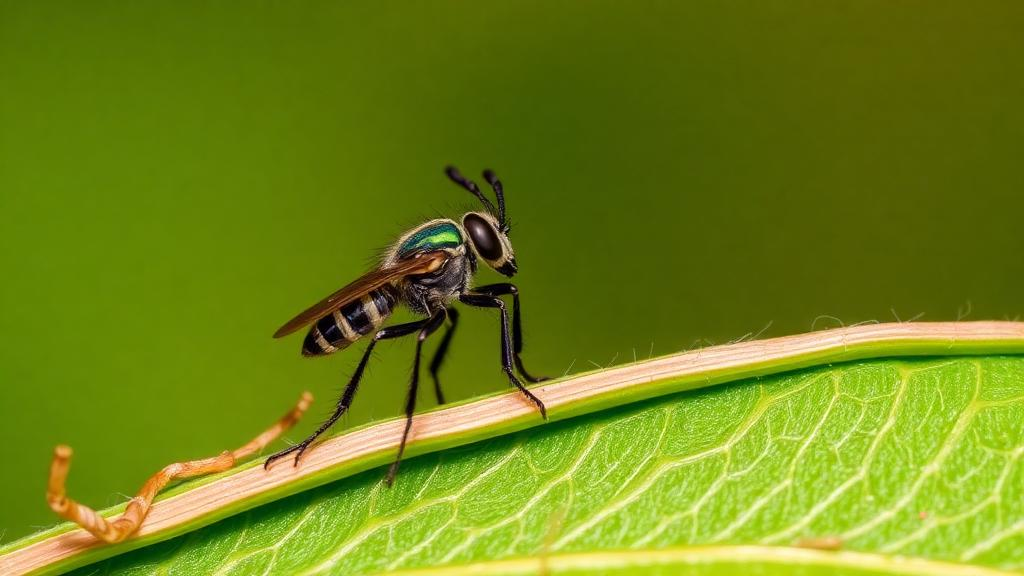
Rearing insects on residual streams that contain animal proteins is unlikely to result in bovine spongiform encephalopathy (BSE) transmission to cattle, according to a quantitative risk assessment published in Frontiers by researchers at Wageningen Bioveterinary Research. The model, developed by Clazien J. De Vos and colleagues, estimates that even under worst-case assumptions about the survival and movement of the infectious agent, the exposure of cattle to BSE infectivity through insect production remains very low. The highest median exposure calculated in the study was 5.2 × 10⁻⁶ cattle oral ID50, obtained for yellow mealworm reared on kitchen food scraps.
That level of exposure corresponds to a probability of at least one new BSE infection of 3.6 × 10⁻⁶ — in other words, fewer than one out of every 100,000 slaughtered BSE-infected cows would give rise to a new infection through the insect-rearing pathway. The assessment addresses a narrow but consequential question: what the BSE risk would be if insects were reared on residual streams containing animal proteins. The researchers parameterized their model for three such streams — former food from supermarkets, kitchen food scraps from consumer households, and category 2 meat meal from rendering — and evaluated two insect species, the yellow mealworm (Tenebrio molitor) and the black soldier fly (Hermetia illucens).
The model produces two linked estimates: the expected exposure of cattle to BSE infectivity, expressed in cattle oral ID50 units, and the corresponding probability that this exposure results in at least one new BSE infection. The calculations are anchored to a specific scenario in which a single BSE-infected cow escapes detection at slaughter and enters the residual stream used as insect substrate. From the substrate, the model traces infectivity along three routes that could return it to the cattle population.
The first is cross-contamination of ruminant feed, in which infectivity carried by the insects or their processing residues reaches feed intended for cattle. The second runs through grassland fertilized with pig or poultry manure or with insect frass, where material derived from the rearing process could be deposited on pasture grazed by cattle. The third is calf milk replacer, a feed product for young calves through which contaminating material could also be distributed.
For each combination of residual stream, insect species and exposure route, the model combines the amount of infectivity entering the substrate, the fraction carried over into the insects and their processed products, and the pathways by which those products can reach cattle. The authors identify the carry-over of prions from substrate to insects as the main uncertainty in the assessment. Direct measurements of this transfer are limited, and the magnitude of prion survival through insect rearing and processing is therefore not precisely known.
To account for this, the team adopted a worst-case approach, choosing assumptions at the pessimistic end of the plausible range so that the calculated risks should overstate rather than understate the true exposure. Even against this deliberately cautious backdrop, the estimated exposures remained very low for every combination of residual stream and insect species assessed. The results did vary with both substrate and species, with kitchen food scraps fed to yellow mealworm producing the highest median exposure among the scenarios examined.
On the basis of these results, the researchers conclude that rearing insects on residual streams containing animal proteins is unlikely to result in BSE transmission. The findings are model-based estimates rather than direct measurements, and they apply to the specific scenario of a single BSE-infected cow escaping slaughter detection under the worst-case assumptions described. Within those boundaries, the study quantifies how small the residual risk would be: a median exposure of at most 5.2 × 10⁻⁶ cattle oral ID50, and a corresponding probability of new infection below one in 100,000 per infected cow.
Subject of Research: Quantitative risk assessment of BSE transmission through insects reared on residual streams containing animal proteins
Article Title: Quantitative risk assessment of BSE transmission if insects are reared on residual streams containing animal proteins
Article References: de Vos, C. J., Antonis, A. F. G., Appel, M. J., & Hoek-van den Hil, E. F. (2026). Quantitative risk assessment of BSE transmission if insects are reared on residual streams containing animal proteins. Frontiers in Microbiology, 17, Article 1943428. https://doi.org/10.3389/fmicb.2026.1943428
Image Credits: AI Generated
DOI: 10.3389/fmicb.2026.1943428
Keywords: BSE, prions, insect rearing, yellow mealworm, black soldier fly, residual streams, risk assessment, cattle, food safety, quantitative model, animal proteins, Wageningen
News Source: Gavin Prescott. (October 24, 2026). Worst-Case Model Finds Very Low BSE Risk From Insects on Residual Streams. Scienmag.