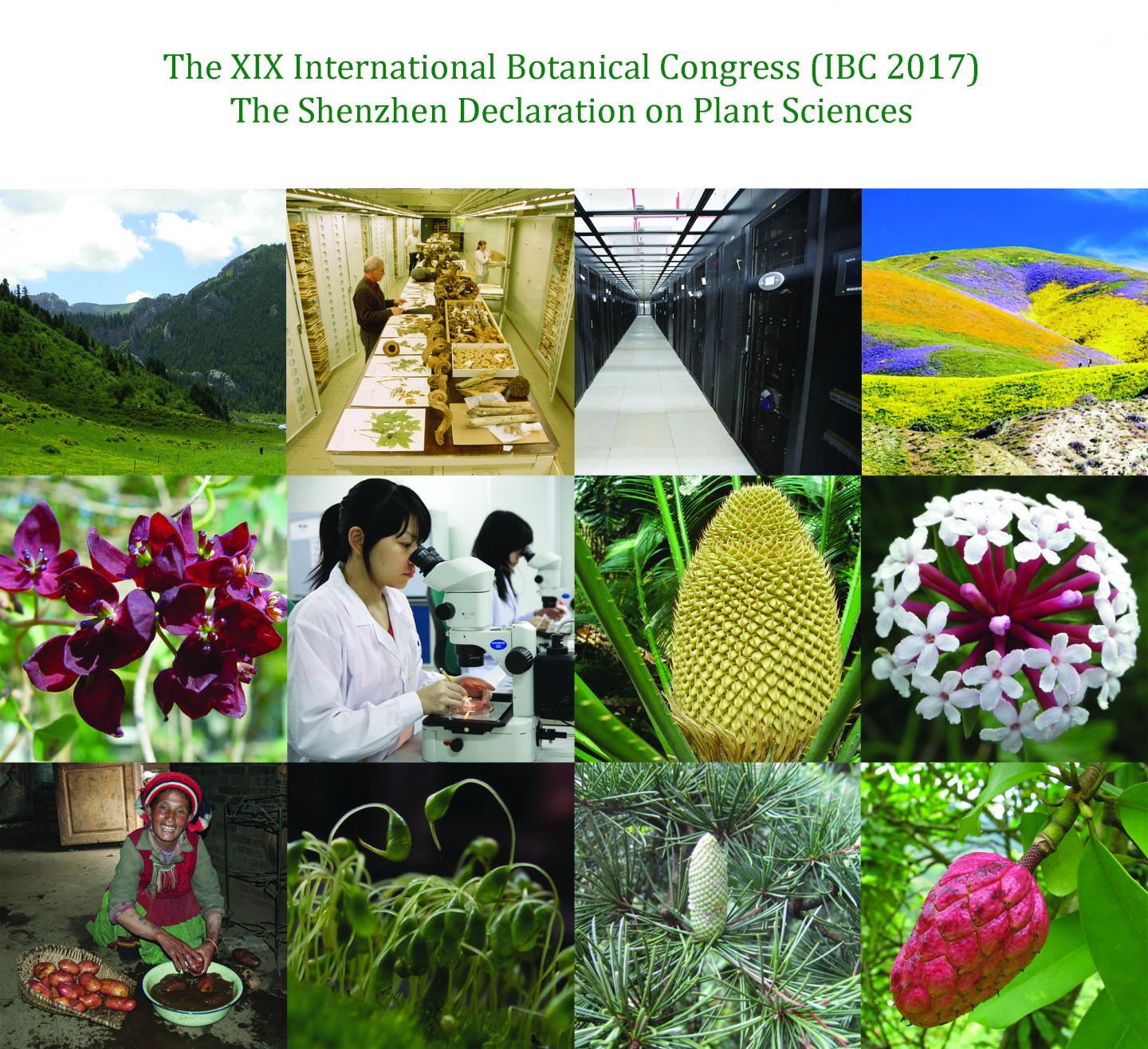
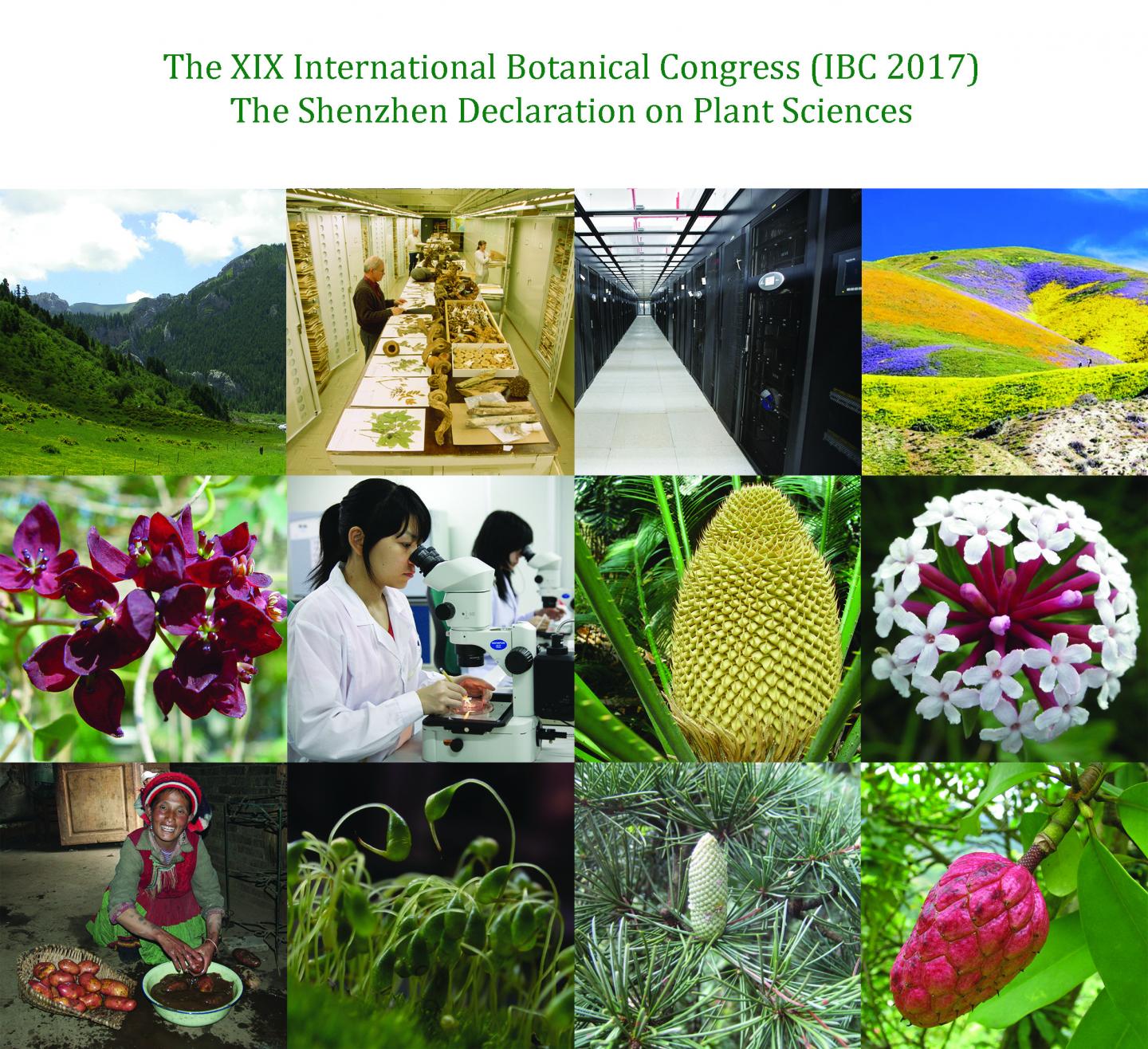
Credit: his image is designed for the Shenzhen Declaration on Plant Sciences by Genlin Jiao, Alice Tangerini and Jun Wen. Photo credits go to Chip Clark, Genlin Jiao, Hong Jin, Sandra…
Environmental degradation, unsustainable resource use, and biodiversity loss are just a few points in the long list of pertinent issues that call for collaborative solutions from science and society together.
Unanimously supported by participants at the XIX International Botanical Congress, held in July 2017, Shenzhen, China, the Shenzhen Declaration for Plant Sciences, runs under the slogan of "Uniting plant sciences and society to build a green, sustainable Earth" and comes in response to the rapid changes experienced by both our Planet and society.
On 29 July 2017 in the closing session of the Congress, nearly 7,000 plant scientists from 77 countries endorsed a statement to focus their research and educational efforts on finding solutions to the growing problems of of our changing world.
Central to the declaration comes a commitment from its signatories and supporters alike to take immediate in both their lifestyles and their research programs to find solutions before an environmental threshold is crossed that will inevitably lead to irreversible degradation of our societies, natural habitats, and biodiversity.
Although it was largely agreed that the immense changes are the result of unbridled human activities, it was also made clear that it is still in society's power to find solutions to reverse or slow down some of these processes.
Many scientists believe that humanity and the planet may have already crossed that threshold," explain PhytoKeys Editor-in-Chief, John Kress, Smithsonian Institution, USA and his Deputy Editor-in-Chief Sandy Knapp, Natural History Museum London, UK, in their dedicated Editorial for the journal. "However, the authors of the Declaration and the botanists who have endorsed it believe that time still exists for answers to be found and implemented. However, that time is short."
The Declaration calls for collaborative approaches by the rapidly evolving field of Plant Science and other disciplines and society, including implementation of new technologies, valuing local and traditional knowledge and greater engagement with the public.
Paving a solid and inspiring roadmap for development for the botanical community, the Declaration outlines seven priorities:
- To become responsible scientists and research communities who pursue plant sciences in the context of a changing world.
- To enhance support for the plant sciences to achieve global sustainability.
- To cooperate and integrate across nations and regions and to work together across disciplines and cultures to address common goals.
- To build and use new technologies and big data platforms to increase exploration and understanding of nature.
- To accelerate the inventory of life on Earth for the wise use of nature and the benefit of humankind.
- To value, document, and protect indigenous, traditional, and local knowledge about plants and nature.
- To engage the power of the public with the power of plants through greater participation and outreach, innovative education, and citizen science.
Find the full text of the Shenzhen Declaration, co-published in the open access journal PhytoKeys and the Journal of Systematics and Evolution.
"We believe that, by working together, we can achieve these goals and connect the increasingly innovative plant sciences with the needs and strengths of human societies." comment the authors of the Declaration. "We strongly believe that only through such collaboration we can work towards creating new paths to a green, sustainable future for Earth, where plants and people in harmony is at the centre."
###
Original Sources:
Shenzhen Declaration Drafting Committee (2017) The Shenzhen Declaration on Plant Sciences – Uniting plant sciences and society to build a green, sustainable Earth. PhytoKeys 86: 3-7. https://doi.org/10.3897/phytokeys.86.20859
Kress WJ, Knapp S (2017) The Shenzhen Declaration on Plant Sciences: Too late or just in time? PhytoKeys 86: 1-2. https://doi.org/10.3897/phytokeys.86.20712
Media Contact
W. John Kress
[email protected]
@Pensoft
http://www.pensoft.net