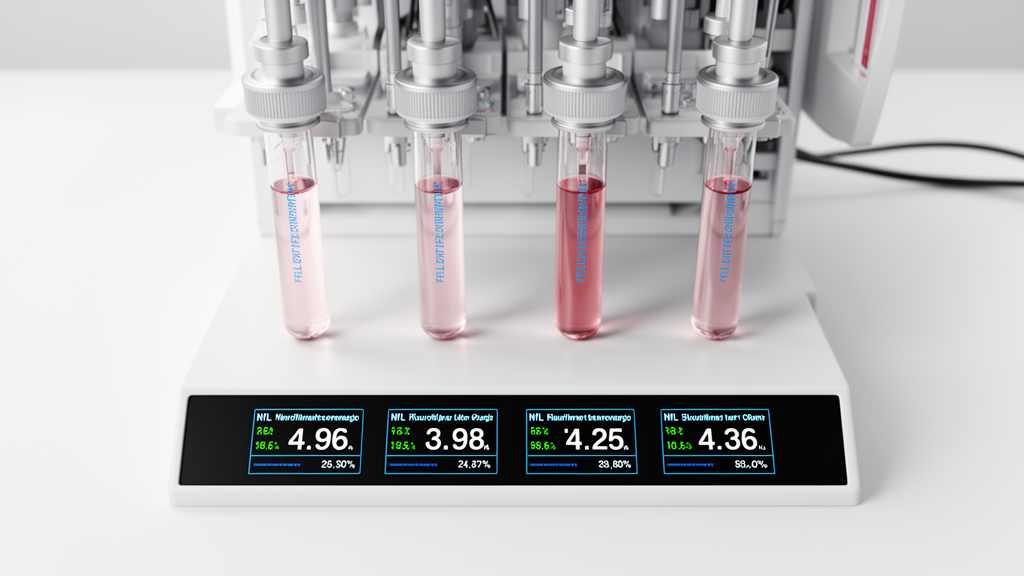
Serum neurofilament light chain, a widely used marker of neuroaxonal injury in multiple sclerosis, does not behave identically before and after freezing, and the size of the shift depends on which immunoassay platform is used to measure it. That is the central finding of a new study published in Scientific Reports, in which researchers compared paired fresh and frozen serum samples from 20 patients with multiple sclerosis across four commercial immunoassays: Simoa, Elecsys, Atellica, and ELISA.
The experimental design was deliberately simple. Matched aliquots of serum from each patient were analyzed fresh, then stored at −70 °C for 10 days, subjected to a single freeze–thaw cycle, and measured again on the same four platforms. Because every sample served as its own control, the researchers could isolate the effect of freezing itself from biological variation between patients.
The results showed that fresh-to-frozen differences varied significantly across platforms. A Friedman test produced χ² = 24.06 (p < 0.001) with Kendall’s W of 0.401, indicating meaningful disagreement among the assays in how freezing affected measured concentrations. Median sNfL levels decreased after freezing by 12.8 percent on Simoa, 5.4 percent on Elecsys, and 9.7 percent on ELISA, while Atellica showed almost no change, with a median difference of just +0.9 percent.
Agreement between platforms was moderate to strong in both sample states. Spearman correlations between assays ranged from 0.663 to 0.877 in fresh samples and from 0.677 to 0.931 in frozen samples, even though the absolute concentrations reported by the different platforms differed substantially. When the researchers converted results to assay-specific Z-scores, the Simoa and Elecsys platforms correlated strongly in both fresh (ρ = 0.886) and frozen samples (ρ = 0.923; both p < 0.001), yet systematic differences between the two assays persisted.
The authors conclude that fresh-to-frozen differences in sNfL measurement are assay-dependent, and they recommend keeping both the analytical immunoassay and the sample-processing conditions consistent when monitoring sNfL longitudinally in patients. For clinical practice and research alike, the message is that a value obtained on one platform from a fresh sample cannot be freely interchanged with a value from another platform or from frozen material without accounting for these systematic effects.
Several limitations frame the findings. The study involved only 20 patients and a single freeze–thaw cycle after a 10-day storage period, so the results speak to short-term frozen storage rather than long-term biobanking. The measurements were also confined to four immunoassays and one disease population, and the article was released as a version subject to further editorial edits before the final Version of Record. Even so, the work offers a concrete, quantified warning: for a biomarker increasingly used to track disease activity in multiple sclerosis, how a sample is handled and where it is measured can shift the number as much as the biology itself.
Subject of Research: Fresh-to-frozen comparability of serum neurofilament light chain measurements across four immunoassays in multiple sclerosis
Article Title: Fresh-to-frozen comparability of serum neurofilament light chain across four immunoassays
Article References: Kusnierova, P., Svub, K. D., Zeman, D., Sobkova, M., Maresova, S., Vilimova, K., Slepcanova, H., Stejskal, D., & Zondra Revendova, K. (2026). Fresh-to-frozen comparability of serum neurofilament light chain across four immunoassays. Scientific Reports. https://doi.org/10.1038/s41598-026-77730-z
Image Credits: AI Generated
DOI: 10.1038/s41598-026-77730-z
Keywords: neurofilament light chain, multiple sclerosis, biomarkers, immunoassays, Simoa, Elecsys, Atellica, ELISA, sample handling, freeze-thaw, laboratory comparability, neuroaxonal injury
News Source: Denise Maddox. (October 24, 2026). Freezing Shifts Serum Neurofilament Light Chain Results Differently Across Four Immunoassays. Scienmag.