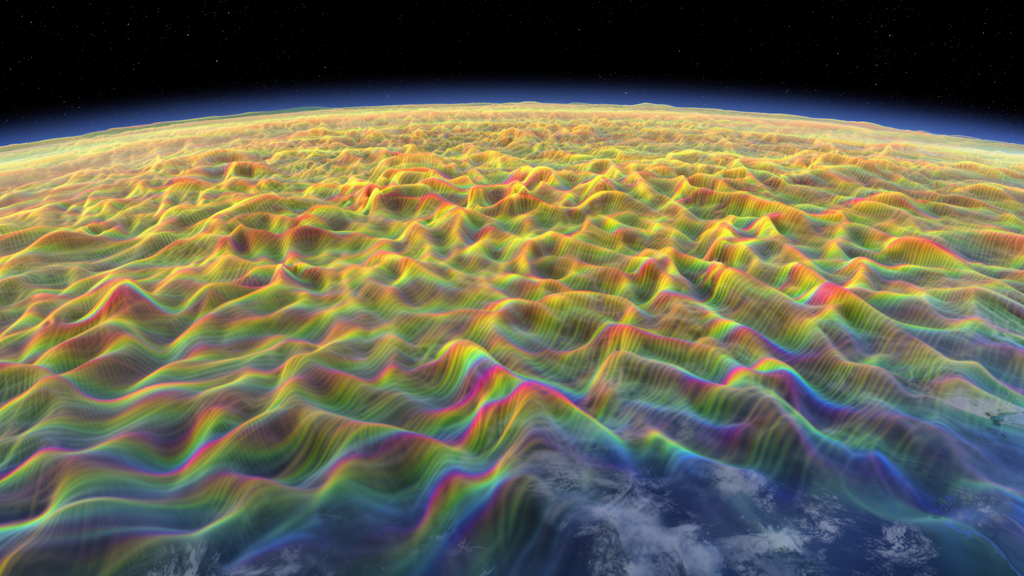
High above Germany, three independent observatories watched the same colossal ripple pass through the sky. During the boreal winter of 2016/2017, ground-based spectrometers in Greifswald, Wuppertal and Hohenpeißenberg simultaneously recorded a temperature oscillation in the mesopause region with a period of roughly 26 days and amplitudes that at times reached about 20 kelvin. Satellite measurements from SABER on the TIMED spacecraft and MLS on the Aura satellite confirmed that the fluctuation carried all the hallmarks of a Rossby (1,4) normal mode oscillation, a large-scale planetary wave pattern long known to atmospheric theorists. According to the research team, this is the first study to report such a strong Rossby (1,4) wave in the middle atmosphere of the Northern Hemisphere. The signature also appeared in atomic oxygen mixing ratios in the mesopause region and lower thermosphere, showing that events of this kind reshape not only the temperature field but also the temporal variation of trace-gas distributions.
Planetary waves are among the great movers of the middle atmosphere. Generated mainly in the lower atmosphere, they transport momentum upward and, under certain conditions, can propagate into the mesosphere and lower thermosphere, the region spanning roughly 50 to 110 kilometres in altitude. Ground-based instruments have detected such waves for decades using measurements of wind, temperature and airglow, revealing periodicities that range from a few days to several weeks. Within this broad spectrum, some fluctuations can be attributed to specific Rossby-wave modes which, although modulated by the background wind field, emerge at relatively well-defined periods when typical background winds are present. A large event with a period of about 28 days reported from an Antarctic station was previously interpreted as being associated with the Rossby-wave (1,4) mode. Long-term measurements with the GRIPS instrument in Wuppertal had also shown that a substantial proportion of detected periodicities fell within the 25 to 30 day range, motivating the researchers to analyse one such event in detail with additional stations and satellite observations.
The German observations rely on GRIPS instruments, short for GRound-based Infrared P-branch Spectrometers, which measure three emission lines of excited hydroxyl molecules, the OH*(3,1) P-branch lines P1(2), P1(3) and P1(4), in the near-infrared spectral range between 1.524 and 1.543 micrometres. The emission layer of excited hydroxyl resides at approximately 87 kilometres altitude with a thickness of about 9 kilometres, and rotational temperatures derived from the relative intensities of the lines closely approximate the kinetic temperatures in the mesopause region, particularly for the (3,1) vibrational band. Wuppertal has observed since the early 1980s with continuous measurements since summer 1987; after a detector failure in mid-2011 and subsequent technical issues with a replacement instrument, the current GRIPS-N spectrometer has run reliably since early 2014. The GRIPS-I instrument at Hohenpeißenberg operated from the end of 2003 until mid-2017, when its detector finally failed. The Greifswald spectrometer has been operated continuously since 2015, viewing the hydroxyl layer roughly 100 kilometres west of the city at an elevation angle of about 40 degrees.
Integration times differ between the sites, at 15 seconds in Greifswald, 210 seconds in Wuppertal and 270 seconds in Hohenpeißenberg, which affects how often clouds contaminate a single spectrum and therefore how complete each record is. To isolate the wave, the team subtracted a seasonal fit comprising annual, semi-annual and ter-annual cycles from the OH*(3,1) rotational temperatures, which are lower in summer and higher in winter. The residuals for winter 2016/2017 showed pronounced fluctuations at all three stations, with mean fitted periods of approximately 25 days at Hohenpeißenberg and Greifswald and about 27 days at Wuppertal. Moving Lomb–Scargle periodograms, computed with a fixed 60-day window and evaluated using the false alarm probability, confirmed that the centre of the wave event was statistically significant at every site. The amplitude increased systematically with latitude, with the northernmost station in Greifswald showing the largest signal, and a distinct temporal amplitude modulation was captured by fitting a Lorentzian-shaped envelope to the oscillation.
To place the ground-based record in a global context, the researchers turned to satellite data. SABER, an infrared limb radiometer on the non-sun-synchronous TIMED satellite operating since January 2002, provided temperature and atomic oxygen profiles with a vertical resolution of about 2 kilometres, averaged over the region 48 to 57 degrees north and 2 degrees west to 28 degrees east. MLS on the sun-synchronous Aura satellite, observing since August 2004, supplied global temperatures subjected to strict quality filtering. The team converted SABER profiles into OH equivalent temperatures by weighting with hydroxyl volume emission rate profiles, shifted downward by 0.75 kilometres to account for the fact that the emission centroid altitude increases by about 0.5 kilometres per vibrational level, since the ground-based instruments observe the OH*(3–1) band while the SABER emission rate profiles correspond to the OH*(4–2) and OH*(5–3) bands. The agreement between the three anomaly time series was very good: all showed the remarkable quasi-periodic signature with amplitudes typically exceeding 10 kelvin and partly even 20 kelvin, the strongest event in this period range that the ground-based instruments had observed in the last decade.
The satellite views revealed the wave’s anatomy. A vertical cut through the temperature anomaly field along all longitudes in the latitude band 50 to 55 degrees north on day 371 of the analysis showed a clear zonal wave number 1 structure, with antiphased behaviour across different altitude regimes; both satellite instruments concurred, although the MLS measurements exhibit reduced vertical resolution in the upper layers. Horizontal maps of the MLS anomalies at 84, 60 and 44 kilometres altitude displayed the same zonal wave number 1 pattern, and comparing day 371 with day 384, roughly half a period later, showed the anomaly structures reversing colour in many regions, indicating a periodicity of roughly 26 days. Because the meridional structure was partly masked by other fluctuations, the team fitted sinusoids to the 84-kilometre temperature anomalies across Northern Hemisphere latitude boxes in the 0 to 30 degrees east longitude range. The mean fitted period was about 26.5 days, the phases clustered around 7 days and around 20 days, roughly half a period apart, and the latitudinal amplitude distribution exhibited two pronounced maxima of opposite sign, consistent with a Rossby-wave (1,4) mode. The ground-based amplitudes, periods and phases agreed well with the satellite results, with the stations lying within a region of steep amplitude increase toward higher latitudes.
A global fit to the MLS temperature anomalies at 84 kilometres reproduced the zonal wave number 1 structure in the Northern Hemisphere, with meridional amplitudes of opposite sign near the equator and at high latitudes. In the Southern Hemisphere, a complete sign reversal was evident at large western and eastern longitudes, though it was absent around 0 degrees east. SABER anomalies yielded a comparable pattern when the sinusoid period was fixed at 26.5 days; fits allowing a free period produced noisier but qualitatively identical results, most likely due to data gaps at high northern and southern latitudes. Taken together, the authors conclude, these analyses substantiate that the 25 to 27 day temperature fluctuations observed from the ground are attributable to a Rossby-wave (1,4) mode.
The wave left its mark on atmospheric chemistry as well. Atomic oxygen anomalies measured by SABER between 80 and 100 kilometres altitude clearly show the oscillation. Because the volume mixing ratios of atomic oxygen largely increase with altitude, the absolute effect of the wave intensifies at higher altitudes within the range shown; near the centroid altitude of the hydroxyl layer the absolute effect is relatively small but still visible. At 84 kilometres, approximately the winter centroid altitude of the layer, the oxygen anomalies correlate pronouncedly with the ground-based rotational temperatures from Greifswald and Wuppertal: relatively higher rotational temperatures, which are indicative of downward motion of air masses and consequent adiabatic heating, coincide with relatively elevated oxygen values. The interpretation is that downward transport brings atomic oxygen from higher altitudes, where its volume mixing ratio is enhanced, whereas upward motions produce the opposite effect. The authors expect the wave signature to be present in other chemical species as well.
The finding also carries a caution for a different branch of atmospheric research: studies of the solar 27-day rotation signal. Signatures of the Sun’s 27-day rotation have been identified in numerous middle atmospheric parameters, including ozone, hydroxyl, temperature, including OH* rotational temperature, and noctilucent clouds, typically via cross-correlation analysis with a solar proxy variable such as the solar F10.7 centimetre radio flux or the MgII index, or through superposed epoch analyses. The solar 27-day signature in stratospheric and mesospheric temperature has an amplitude of less than 1 kelvin, far smaller than the up to 25 kelvin amplitude that a Rossby (1,4) mode can reach at a similar period. A large wave event could therefore interfere with the identification of solar signals and lead to spurious identifications; suppressing a 25 kelvin wave signature in a superposed epoch analysis, for example, would require a large number of epochs. The authors stress that they are not claiming all previously identified solar 27-day signatures in middle atmospheric parameters are artifacts, since some connections between temperature and the solar proxy are visible to the bare eye, but future studies should investigate to what extent the detection and quantification of solar 27-day signatures are affected and how the different processes can be separated from each other.
The event itself was extraordinary in its persistence: the wave signature, with a period of about 26 days and amplitudes of up to about 20 kelvin, covered almost four full cycles during the winter. The consistency between three independent ground stations separated by several degrees of latitude, and between two satellite instruments with different observing geometries, lends the identification unusual robustness. As the first reported instance of such a strong Rossby (1,4) wave in the middle atmosphere of the Northern Hemisphere, the event offers a rare, well-characterised case study of how planetary normal modes manifest near the edge of space, and a reminder that the mesopause region, far from being quiescent, can host oscillations powerful enough to rearrange both its temperature field and its trace-gas chemistry.
Subject of Research: Simultaneous ground-based and satellite observations of a quasi 26-day Rossby (1,4) planetary wave in the mesopause region over northern mid-latitudes
Article Title: Simultaneous ground-based observations of a large quasi 26 d wave from three different measurement sites in northern mid-latitudes
Article References: Kalicinsky, C., Wallis, S., Depenthal, L., Hoffmann, C. G., Lange, A., & von Savigny, C. (2026). Simultaneous ground-based observations of a large quasi 26 d wave from three different measurement sites in northern mid-latitudes. Atmospheric Chemistry and Physics, 26(20), 14905-14915. https://doi.org/10.5194/acp-26-14905-2026
Image Credits: AI Generated
DOI: 10.5194/acp-26-14905-2026
Keywords: planetary waves, Rossby (1,4) mode, mesopause, OH rotational temperature, airglow spectroscopy, GRIPS spectrometers, SABER, MLS, atomic oxygen, middle atmosphere, winter 2016/2017, solar 27-day signature
News Source: Russell Cooper. (October 24, 2026). Giant 26-Day Rossby Wave Ripples Mesosphere Above Northern Mid-Latitudes. Scienmag.