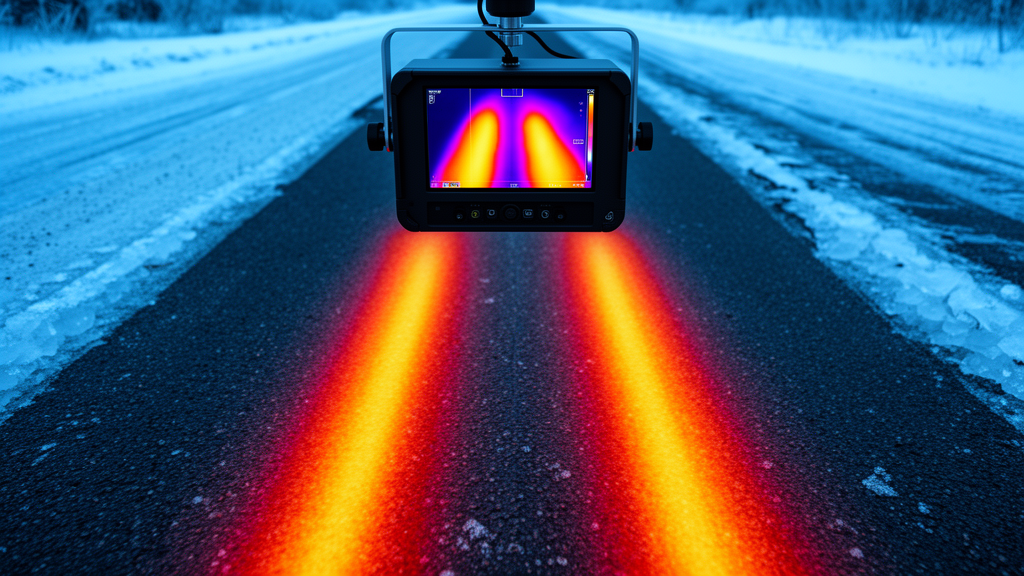
Every winter, the thin transparent layer of ice that drivers call black ice turns ordinary expressway sections into hidden traps. In the United States alone, winter storms and slippery road conditions contribute to nearly half a million crashes and more than 2,000 road deaths each year, and roughly 24 percent of weather-related crashes occur on snowy, slushy, or icy pavement. In China, about 30 percent of traffic accidents in cold seasons are closely tied to ice and snow. Black ice is considered the most dangerous and hidden form of this road disaster because it sharply reduces surface friction while offering almost no visual warning, and its strong bond with the pavement makes conventional mechanical and chemical de-icing both difficult and potentially damaging to the road structure.
Active heating technology attacks the problem at its source. By embedding heating elements or heat transfer pipelines inside the pavement structure, radiant heat melts the ice layer from within, preventing black ice from forming in the first place. The challenge, however, lies in knowing exactly when the pavement is safe to open to traffic. The traditional evaluation index, the snow-free area ratio, works reasonably well for loose snow but performs poorly for compacted snow layers or black ice. Contact instruments such as the pendulum friction tester, which measures the British Pendulum Number (BPN), deliver direct and reliable readings, yet they carry high safety risks on unclosed roads and cannot achieve rapid, continuous detection across an entire section, often forcing maintenance units to keep lanes shut longer than necessary and wasting energy.
Non-contact alternatives have their own bottlenecks. Visible-light cameras struggle to distinguish thin, transparent black ice from the underlying asphalt because visual contrast is insufficient, and accuracy drops drastically under cloudy, nighttime, or intense sunlight conditions. Millimeter-wave and spectral sensors demand expensive hardware and complex signal-decoupling algorithms, while conventional road condition sensors rely on single-point infrared temperature measurements and LiDAR whose limited range cannot evaluate the overall skid resistance of a heated pavement. A new study addresses this gap by tracking how pavement skid performance evolves during ice melting under different environmental conditions and heating powers, using real-time collection of ice surface temperature and black ice cleaning ratio from an infrared thermal imaging sensor to build a BPN prediction model grounded in tire-pavement coupling friction theory.
The experimental platform was a 5 m by 4 m step-by-step freezing chamber housing a full-scale pavement model of 120 cm by 120 cm by 56 cm, insulated with 10 cm of foam on the inner walls. Carbon fiber heating wire, the core heating element, was pre-embedded at the top of the asphalt middle surface layer in an S-type series connection, with a total laying length of 11 m and a spacing of 10 cm between adjacent wires. The chamber included two transformers for voltage regulation from 0 to 250 V, an electricity meter for power consumption monitoring, and a 4G data transmission module for real-time signal transfer. The infrared thermal imaging sensor, built from a microcomputer, an infrared thermal imaging module, and a 3D-printed shell, operates in the 8-14 micrometer wavelength range with an 80 by 62 pixel array, a 90-degree field of view, plus or minus 1.5 degrees Celsius accuracy, and a measurement range from -40 to 400 degrees Celsius.
Testing followed ASTM E303 with the pendulum friction tester, which characterizes skid resistance at low speeds of about 10 km/h. Five test locations were randomly selected, with five consecutive swings at each location; readings were valid when the difference between maximum and minimum values was less than 2 BPN units, and the average of the five readings was recorded. Because the ice surface inherently retains a thin liquid water film, additional water spraying was omitted. In total, 25 experimental working conditions were established, spanning ambient temperatures of -1 to -15 degrees Celsius, heating powers of 200 to 400 W/m2, and ambient humidity of 70 to 90 percent. Three independent replicate trials per condition yielded 75 initial data sets, and after removing outliers beyond the 3-sigma threshold, 72 valid data sets were retained. Data were partitioned into a fitting group and an orthogonal validation group to prevent leakage.
The results revealed a striking four-stage evolution of skid resistance. During precipitation and icing, the expanding black ice area drove the BPN value down rapidly. In the ice stable period, the surface state remained basically constant and BPN leveled off, typically at 20-30, indicating good test repeatability. When heating began, the BPN value decreased slightly by 5.0-5.9 units as the rising ice surface temperature produced a melted water film that lubricated the tire-ice interface. Once the ice surface temperature exceeded 0 degrees Celsius, the ice-melting period commenced and BPN rose rapidly with the cleaning ratio, defined as the proportion of pixel area corresponding to exposed pavement in the thermal image. The mechanism is clear: tire-ice interface friction is far weaker than tire-pavement interface friction, and a water film at the contact zone weakens skid resistance further before recovery begins.
Environmental factors shaped the recovery process in a clear hierarchy. For every 1 degree Celsius increase in ambient temperature, the BPN recovery rate during ice melting increased by about 0.94 BPN/h, and for every 100 W/m2 increase in heating power, the recovery rate increased by about 2.23 BPN/h. Lower ambient temperatures produced smoother ice coatings because water froze before it could fit into the micro-texture of the asphalt surface, degrading skid resistance of the frozen pavement. Ambient humidity, by contrast, showed no significant effect on BPN reduction, ice melting rate, melting time, or ice surface heating rate, so its influence could be ignored in the monitoring model. The coefficient of variation analysis confirmed the ranking: ambient temperature dominates, heating power follows, and humidity trails far behind.
The segmented prediction model switches computational modes at an ice surface temperature of 0 degrees Celsius, chosen as the boundary threshold because the melting point of the distilled-water ice, governed by the 1.0 MPa dynamic contact pressure of the pendulum slider, was calculated at approximately -0.07 degrees Celsius. Under complete ice coverage, the model superposes a theoretically calculated adhesion friction component, based on the Makkonen adhesion friction model with ice hardness varying linearly with temperature, and an experimentally fitted hysteresis friction term obtained by second-order polynomial least-squares regression, yielding BPN = -0.055T2 + 0.606T + 36.168 + BPNadh, where T is ambient temperature. Under incomplete coverage, the model weights the friction of the exposed road surface, taken as 80 BPN for the dry AC-13 asphalt layer, against the ice surface value using the thermal-imaging-derived cleaning ratio. The measured and theoretical cleaning ratios agreed with R2 = 0.96, and the expanded uncertainty median stayed below 5.0 percent across ambient temperatures.
Verification tests probed the model’s robustness. Ice thickness from 2 to 4 mm had relatively little impact on prediction accuracy, with R2 values before and after melting ranging from 0.833 to 0.946. Strong light irradiation, however, induced micro-melting of the ice surface and introduced infrared background radiation noise, dropping R2 by about 19 percent. Rotating the sensor from vertical to 45 degrees reduced R2 by about 6 percent through projection distortion, while predicted values ran 5 to 10 percent high. Compacted snow proved the worst case, cutting prediction accuracy by about 24 percent because its loose structure increases contact friction between the slider and the road surface. The method is therefore best suited for thin black ice or residual ice conditions, and direct application to compacted snow is not recommended.
Field verification came from the Qintang Expressway, where three heating sections with carbon fiber heating cable embedded 4 cm below the pavement structure layer operate on 220 V mains. Under an initial ambient temperature of -7 degrees Celsius, wind velocity of 2 m/s, and 6 mm initial ice thickness, the dry pavement BPN was 70 and the fully ice-covered value was 32. After 1.5 hours of heating, the road surface appeared dark and visually free of ice, yet thermal imaging and the model predicted a BPN of only about 36, revealing a thin black ice layer that visual judgment missed entirely, a discrepancy that could easily mislead drivers. Across the whole outdoor ice-melting process, the prediction coefficient reached R2 = 0.892, confirming dynamic and reliable monitoring of skid performance on operating roads.
The study translated these findings into engineering thresholds and control strategies. Drawing on China’s road traffic safety regulations, the Penn State model for friction conversion at speed, and Swedish VTI research linking BPN values to accident incidence, the team established a cleaning ratio of 70 percent, corresponding to BPN of at least 65, as the safety threshold for resuming traffic, with a safe driving speed of 80 km/h on a 120 km/h design highway. A cleaning ratio of 40 percent, or BPN below 45, serves as a traffic risk early warning index, since brake failure and rollover become very likely on such surfaces. A fitted ice-melting time model, t = -4.10 – 1.19T + 0.024P – 0.060T2 – 2.56e-5P2 + 0.0038TP, with mean absolute error of 1.01 hours, captures the nonlinear coupling between melting time, heating power, and ambient temperature.
Energy analysis revealed a critical threshold at -7 degrees Celsius. Below that temperature, higher heating power of 300 to 400 W/m2 yields greater energy savings because intense convective heat loss between the cold pavement and ambient air makes shortening the heating duration the dominant factor. Above -7 degrees Celsius, convective loss diminishes while the latent heat of fusion remains constant, so lower power of 200 W/m2 proves more energy-efficient, and the hierarchical strategy switches accordingly. The authors note that the hysteresis friction fitting curve derives from laboratory tests without covering pavement service life, traffic loads, or surface texture evolution, and that measured data deviate from the linear BPN-friction relationship in high-BPN regimes. Future work should quantify ice surface roughness and water film dynamics at micro-scale, and the framework is adaptable to hydronic, conductive asphalt, and heat-pipe heated pavements operating under the same active heating principles.
Subject of Research: Non-contact monitoring of skid resistance on actively heated ice-melting expressway pavement using thermal imaging and BPN prediction
Article Title: Skid-resistance performance of active heating ice-melting pavement on expressways: A new non-contact monitoring method integrating thermal imaging and BPN prediction model
Article References: Miao, C., Mao, S., Yue, Z., Jie, S., Liu, L., Hu, T., Zhang, H., & Hao, Y. (2026). Skid-resistance performance of active heating ice-melting pavement on expressways: A new non-contact monitoring method integrating thermal imaging and BPN prediction model. Case Studies in Construction Materials, 25, Article e06640. https://doi.org/10.1016/j.cscm.2026.e06640
Image Credits: AI Generated
DOI: 10.1016/j.cscm.2026.e06640
Keywords: black ice, active heating pavement, skid resistance, infrared thermal imaging, British Pendulum Number, cleaning ratio, tire-pavement friction, ice melting, expressway safety, heating control strategy, cold regions, asphalt pavement
News Source: Denise Maddox. (October 24, 2026). Infrared thermal imaging predicts skid resistance of actively heated ice-melting pavement. Scienmag.